Muscle Is Your Independence Insurance. Here’s Why That Changes Everything After 55.

Muscle Is Your Independence Insurance. Here’s Why That Changes Everything After 55.

Nobody ever told me that muscle was the thing standing between me and a stairlift. They told me it was about fitness. About looking good in a swimsuit I stopped wearing twenty years ago. About being athletic, which I never really was. So I filed it under optional, the way you file the gym membership you keep meaning to use.

That was one of the more expensive filing mistakes I have made about my own body. I want to walk you through it, because I think you may have filed it in the same place I did.

The frame we were handed

For most of my life, strength was sold to me as a vanity project. The before-and-after photos. The toned arms. The thing other people did at six in the morning while I was making coffee and being glad I was not them.

That framing works fine when you are forty and your body does what you ask without being asked twice. It falls apart completely somewhere after fifty-five, and almost nobody updates the framing for you. You are left thinking strength is still optional, still about appearance, still a thing for other people, right at the age when it quietly becomes the opposite.

The afternoon the frame broke

I did not have a dramatic moment. That is sort of the point. It was a series of very small ones I had been ignoring for years.

I noticed I was pushing off the arms of the chair with my hands to stand up. Not always. Just sometimes. Then more than sometimes.

I noticed I had started taking the short way around the block when I walked the dog, and that I had a quiet story about why that was fine.

I noticed I was making two trips from the car with the groceries when I used to make one, and that I had a story about that too.

None of these were injuries. None of them were a diagnosis. Every one of them was my body telling me something I did not want to hear, in a voice low enough that I could pretend I had not heard it. That is how this happens. Not with an event. With a hundred small accommodations you make without noticing you are making them.

What muscle actually does at this age

Here is the reframe that changed how I think about all of it.

Every single thing that lets you live independently is, underneath, an act of strength.

Standing up from a toilet is a strength act. Climbing the stairs to your own bedroom is a strength act. Catching yourself when your foot snags the edge of a rug, the half second that decides whether you stumble or you fall, is entirely a strength act. Carrying a laundry basket. Getting up off the floor after you bend to the bottom cabinet. Getting out of a bathtub. Opening a heavy door against the wind.

None of that is fitness. None of it happens in a gym. All of it is the difference between living in your own home and not.

When you lose muscle, you do not notice it as “I am weaker.” You notice it as your world getting smaller. The stairs you stop climbing. The trip you stop making. The thing on the high shelf you stop reaching for and start doing without. Muscle does not announce its departure. It quietly takes rooms of your life with it.

Why this changes everything

Once you see strength as the thing holding up your independence rather than a thing that shapes your arms, the whole calculation flips.

It stops being the optional item at the bottom of the list, the one you will get to when things slow down. It becomes the load-bearing wall. You can let a lot of things slide in your sixties and seventies and be fine. This is not one of them, because this is the one that decides whether all the other plans even matter. A beautifully organized folder of documents does not help you up off the bathroom floor.

That is what I mean by independence insurance. You are not training for anything. You are not competing with anyone. You are quietly keeping the ability to do the ordinary things that, added together, are the entire difference between staying and leaving.

What this is not

I want to be clear, because the old framing is sticky.

This is not the gym, unless you want it to be. It is not marathons. It is not punishing yourself at dawn. It is not lifting something heavy until you are shaking. It is not a number on a scale or a photo or anything you have to buy special clothes for.

It is mostly small and unglamorous and done at home in regular clothes while the coffee brews. Fifteen honest minutes most days does more at this age than two heroic hours once a week. The people who keep their strength into their eighties are almost never the ones who trained hardest. They are the ones who kept doing a little, consistently, long after no one was grading them.

Where to start

I am not going to hand you a workout in this piece, because the first step is not a workout. The first step is the reframe itself. You have to stop seeing this as optional. Everything else follows from that one change, and nothing useful happens until it does.

When you are ready for the actual movements, talk to your own doctor first, especially if something hurts or you have a condition that complicates things. Then start absurdly small. Smaller than feels worth it. Standing up from a chair without using your hands, a few times, is a real beginning. So is walking the long way around the block again.

I am putting together a simple home strength starting guide, the unglamorous version, nothing that needs equipment or a gym. When it is ready I will send it to my newsletter. If you are not on the list, you can sign up at the bottom of any page on this site.

And if you want to see where strength sits next to the other parts of staying independent, the Independence Assessment scores you across all five pillars in three minutes and tells you which one needs you first.

Take the 3-Minute Assessment

You do not have to get strong this week. You just have to stop believing it is optional. That part you can do right now, before you even stand up.

I’m glad you’re here.

Anne
Home Safety Audit: What I Found in My Own Home

Home Safety Audit: What I Found in My Own Home

I had lived in my house for more than twenty years. I knew where every creak in the floor was. I could walk it in the dark. If you had asked me whether it was safe, I would have looked at you like the question didn’t make sense. Of course it was safe. It was home.

Then I walked through it with different eyes, and I counted eleven things in one afternoon that were going to be a problem. Not that day. But someday. And someday has a way of arriving without an appointment.

Why I finally looked

I didn’t do this because I read an article about it. I did it because my husband came home from the hospital using a walker, for what we thought would be a few weeks, and the house I knew in the dark suddenly didn’t fit us anymore.

The walker didn’t fit through the bathroom doorway. I had walked through that doorway maybe forty thousand times and never once noticed it was narrow. It wasn’t narrow for me. It was narrow for a walker, and I had never needed to know that until the afternoon I did.

That’s when I started actually looking. Not at the house I remembered. At the house that was actually there.

What I found

I’m going to list some of these, because I think you’ll recognize your own house in them.

The throw rug at the top of the stairs. The one I’d had for fifteen years. Pretty. Also a thing my foot caught on twice while I was carrying laundry, and I’d never thought a thing about it because I’d never fallen. Never falling is not the same as being safe. It’s just luck that hasn’t run out yet.

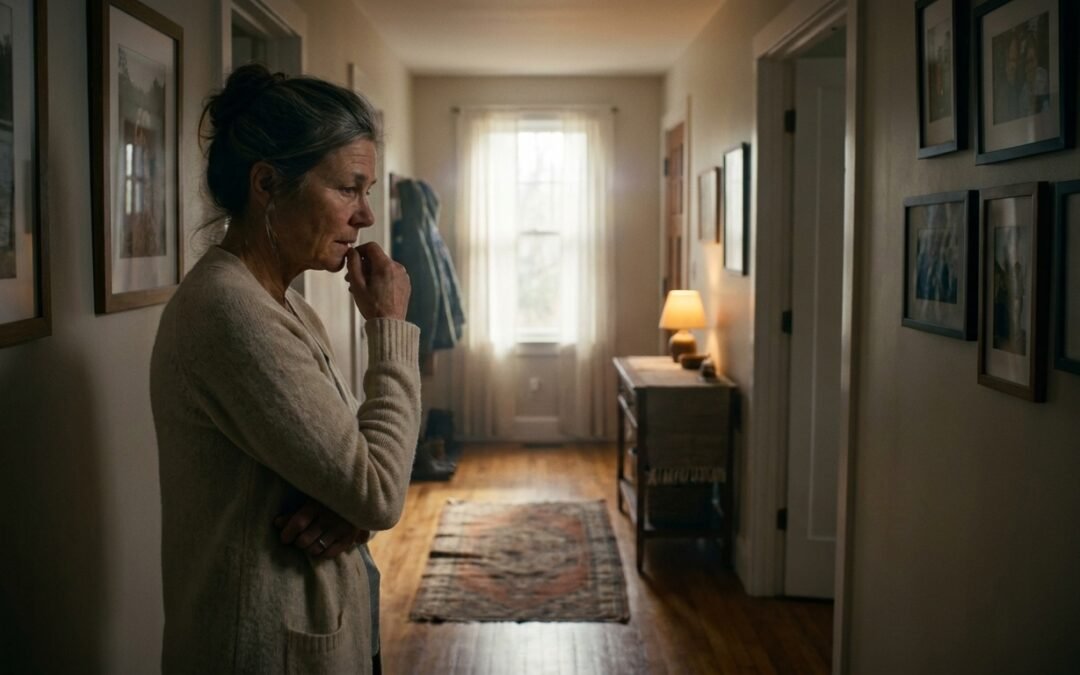
The lighting in the hallway. I’d been compensating for it for years by squinting and knowing where things were from memory. A guest would have found that hallway dim. I had simply stopped seeing it.

The bottom kitchen cabinet where I kept the heavy pots. I had to get down on one knee to reach them. I’d been doing it for years. It had become a small negotiation I had with my own kitchen every single day, and I’d stopped noticing I was negotiating.

The step down into the garage with nothing to hold onto. The bathtub I climbed over with nothing to grab. The extension cord I ran along the baseboard every winter for the space heater. The smoke detector I couldn’t remember the last time I had tested.

None of these were dangerous that afternoon. Every one of them was going to be eventually.

The thing nobody tells you about home safety

Here is what I understood, standing in my own hallway, that I want to pass along.

A home doesn’t become unsafe in a day. It becomes unsafe the way you lose touch with an old friend. Slowly, then all at once, and you don’t see it happening because you’re inside it every day.

The danger isn’t the throw rug. The danger is that you’ve stopped seeing the throw rug. Familiarity is the actual hazard. It edits things out of your vision precisely because they’ve always been there.

And here is the part that changed how I think about all of it. Almost everything on my list was cheap and easy to fix while it was still a someday problem. The same fixes done after a fall, or in a hurry while someone is coming home from a hospital, are not cheap and not easy. They are a renovation. They are a crisis with a contractor attached.

Done early, this work is almost invisible. Done late, it’s a project. The only part you control is when.

How to look at your own home

You don’t need a professional for the first pass. You need an afternoon and a willingness to be a stranger in your own house.

Walk through every room and ask one question. If I were a little less steady than I am today, what in this room would I have to be careful of? Not what is dangerous now. What would I have to think about if my balance, or my eyes, or my strength were even slightly less than they are.

The rooms that matter most are the ones where the floor changes height and the ones where water meets a hard surface. Stairs. Entryways. The bathroom. And the path from your bed to the toilet in the dark, which is a trip almost everyone makes and almost no one has ever really looked at.

Write down what you find. Do not fix anything yet. Just see it. Seeing it is the part most people never do, and it’s the part that matters most.

Where to start

If you do nothing else after reading this, do the one I would do first. The path you walk at night, half asleep, from your bed to the bathroom. Clear it. Light it. Make it so a person who is not fully awake and not fully steady could make that trip without thinking. That single path is a common place for falls, and it is almost free to fix.

I’m putting together a room-by-room checklist, the actual one I used, so you can walk your own house with it instead of trying to remember what I listed here. When it’s ready I’ll send it to my newsletter. If you’re not on the list, you can sign up at the bottom of any page on this site.

And if you want to see where home safety sits among the other parts of staying independent, the Independence Assessment will show you. Three minutes. It scores you across all five pillars and tells you which one to start with.

Take the 3-Minute Assessment

Go look at your hallway. Really look at it. I think you already know what’s there.

I’m glad you’re here.

Anne

7 Things in Your Home Right Now That Are Fall Hazards (And How to Fix Them Today)

7 Things in Your Home Right Now That Are Fall Hazards (And How to Fix Them Today)

Falls are the leading cause of injury for adults over 65, and most of them happen at home, on ordinary floors, in ordinary rooms, doing ordinary things. That is not me trying to scare you. It is what the public health data has shown for years.

I am not telling you this to make you afraid of your own house. I am telling you because almost every one of the common hazards is something you can fix this week. Most of them for very little money. A few of them for nothing at all.

I walked my own home looking for these after my husband came back from the hospital, and I found more than I expected. Here are the seven that show up in nearly every house I have ever looked at, and exactly what to do about each one.

A quick note before the list. Some of the product mentions below will eventually be affiliate links, which means if you buy through them I may earn a small commission at no extra cost to you. I only point to the kinds of things I would put in my own house, and I will tell you, every time, when a link is an affiliate link. Several of the fixes here cost nothing at all.

1. Loose rugs and runners

The throw rug. The hallway runner. The little mat by the kitchen sink. They slide. They bunch. They catch a toe. A rug you have walked over a thousand times without thinking is exactly the kind of thing that stops being harmless the first time your balance is a little off.

Fix it today: For a rug you want to keep, put a non-slip rug pad underneath so it can’t travel. For any rug in a high-traffic path, and especially at the top or bottom of stairs, the honest answer is to take it up entirely. A rug is not worth a hip.

2. The path you walk in the dark

Almost everyone makes the same trip in the middle of the night, half asleep, from the bed to the bathroom. Almost no one has ever really looked at that path. It is often the darkest route in the house and the one you walk in the worst condition to walk it.

Fix it today: Put a plug-in motion-sensor night light along that path. They cost a few dollars, they turn on by themselves when you move, and they turn off on their own so you never think about them again. This is the single highest-value fix on this list for the lowest effort.

3. The bathtub or shower with nothing to hold

Water plus a hard slick surface plus stepping over a tub wall is one of the most dangerous combinations in any home. Most bathrooms ask you to do all three at once with nothing to hold but a towel bar, and a towel bar is not a grab bar. It will come out of the wall the moment you actually need it.

Fix it today: Have properly installed grab bars put in, anchored into the studs, not just screwed into drywall. Add a non-slip bath mat inside the tub or shower. If you do nothing else in the whole house, do the bathroom.

4. Cords across walkways

The lamp cord. The phone charger. The extension cord you run to the space heater every winter along the baseboard and across the doorway. You step over it without thinking, until the once you don’t.

Fix it today: Reroute cords so they run along walls, never across a path. That part is free. For cords that have to cross a walkway, use cord covers that lie flat and tape down. This is a ten-minute job that removes a hazard permanently.

5. Clutter on the stairs and the floor

The stack of things on the stairs waiting to be carried up next time. The basket by the door. The shoes in the entryway. None of it feels like a hazard because all of it has a reason to be there. Reasons do not prevent falls.

Fix it today: This one is free. Clear the stairs completely. Nothing lives on a staircase, ever. Then walk your main paths and move anything you have to step around. If you step around it daily, it is a hazard you have stopped seeing.

6. Loose or missing handrails

A handrail you never use feels optional, right up until the day it is the only thing between you and the bottom of the stairs. Many handrails are loose, mounted on only one side, or missing entirely on a step or two outside.

Fix it today: Tighten every handrail you have. Grab each one and shake it. If it moves, fix the mount. Where there is no rail, especially on outdoor steps and basement stairs, have one added. A rail on both sides of a staircase is better than one, and not as expensive as most people assume.

7. Slippery footing

Socks on hardwood. Smooth-soled slippers. The kitchen floor near the sink that gets a little wet and a little slick. Your footing is the one variable you carry with you into every room.

Fix it today: Wear something with grip indoors. Not socks alone, not loose backless slippers. A shoe or slipper with a real sole and a back. Put a non-slip mat where the floor gets wet, especially at the kitchen sink. None of this is expensive and all of it is immediate.

Where to start

Do not try to do all seven today. Pick the free ones first, because there is no reason to wait on those. Clear the stairs. Reroute the cords. Tighten the handrails. That is an afternoon and it costs nothing.

Then do the night path I just talked about, because it is cheap and it protects the trip you are least equipped to make safely. Then the bathroom, because the bathroom is where the worst ones happen.

And if you want to see where home safety sits next to the other parts of staying independent, the Independence Assessment will show you. Three minutes. It scores you across all five pillars and tells you which one to start with.

Take the 3-Minute Assessment

If this was useful, send it to someone. Most people will not walk their own house until someone they trust tells them to.

I’m glad you’re here.

Anne

The 5 Documents Every Adult Over 55 Needs (And Most Don’t Have)

The 5 Documents Every Adult Over 55 Needs (And Most Don’t Have)

I used to tell myself I’d get around to this. The problem with “getting around to it” is that you never know when “around to it” is actually too late.

I learned that the hard way. I’m not going to tell that story here. I’ve told it before, and I’ve told it long enough. What I want to do in this article is something more practical.

I want to walk you through the five documents I now keep in one paper folder anyone in my family can open. None of them are exotic. None of them are expensive. Most of them are free. And together they’re the difference between a family that can act in a crisis and a family that has to guess.

A quick note before we start. Some of the links below are affiliate links. That means if you click and use a service I recommend, I may earn a small commission at no extra cost to you. I only point to services I’d use myself, and I’ll tell you when something is an affiliate link, every time.

Here’s the list.

Why this list matters

Most of us tell ourselves we have things in order. Then we look closely and realize we have pieces of a plan, not a plan.

A will is not a plan. Insurance is not a plan. Knowing the bank statements are in the kitchen drawer is not a plan.

A plan is a folder that another person can open and use without asking you a question. That’s the standard. If your family had to act tonight, on your behalf, could they?

If you’re not sure, this list is for you.

Document 1: Durable Power of Attorney (Financial)

A Durable Power of Attorney for finances names the person you trust to make money decisions on your behalf if you can’t. Pay your bills. Manage your accounts. Sign tax returns. Talk to your bank.

Without one, if you become unable to manage your own finances, your family typically has to go to court to get permission to help. That process is called conservatorship, and it’s expensive, slow, and public.

The word “durable” matters. A regular Power of Attorney ends if you become incapacitated. A durable one continues. You want durable.

How to get one: Many states have a free fill-in-the-blank form available through the state attorney general’s website. Services like Trust & Will and LegalZoom can also help you draft a customized version for around $89 to $199 (the LegalZoom link is an affiliate link). A local estate attorney will charge more but will tailor it to your situation. Any of those three paths works.

One mistake to avoid: Naming someone you trust now but won’t necessarily trust in fifteen years. The person who handles your finances when you’re 85 should be someone who can be that person when you’re 85. Think long-term.

Document 2: Healthcare Proxy

A Healthcare Proxy (sometimes called a Healthcare Power of Attorney) names the person who can make medical decisions on your behalf if you can’t speak for yourself.

This is the document I couldn’t find that night I told you about. It’s the document hospital social workers ask for first. It’s the document that determines whether your spouse, your child, or your sibling has the legal right to be in the room when decisions are being made about you.

It is not the same as your Living Will, which we’ll get to next. The Healthcare Proxy is the person. The Living Will is the wishes.

How to get one: Most states have a free form available through the state health department or hospital website. Trust & Will and LegalZoom include healthcare proxies in their estate planning packages (the LegalZoom link is an affiliate link). Or your doctor can give you the form on your next visit. The form doesn’t usually require a lawyer.

One mistake to avoid: Picking your spouse without a backup. If you and your spouse are in the same accident, you need a second person named. Most forms have space for a primary and an alternate. Use both.

Document 3: Advance Directive (Living Will)

An Advance Directive, also called a Living Will, is your written instructions about the medical treatment you would or would not want if you can’t speak for yourself.

This is where you say what life-extending measures you do and don’t want. It’s also where you say what kind of pain management you prefer, what your preferences are about hospice care, and what would be important to you at the end.

I want to say something honest about this one. It’s the document people put off the longest because it requires you to think about the hardest things. I get it. I put it off too. What I’ll tell you is that doing it once, even imperfectly, is better than not doing it. You can update it. You can change your mind. You can change it as many times as you want for the rest of your life. Just start.

How to get one: State-specific forms are available free through aging.gov or your state’s department of health. Trust & Will and LegalZoom include Advance Directives in their estate packages (the LegalZoom link is an affiliate link). The Conversation Project also has a free starter kit that walks you through the questions before you fill out the form.

One mistake to avoid: Filling it out alone. Talk to your doctor about it. Talk to your spouse. Talk to whoever you named as your healthcare proxy. The document is the last step, not the first.

Document 4: Current Medication List

This one isn’t legal. It’s logistical. And it’s the document every emergency room nurse I’ve ever talked to says they wish more patients had.

Your medication list should include every prescription, every supplement, every over-the-counter pill you take regularly, and the dosage of each. It should also include your major allergies and your most recent surgeries, if any.

In an emergency, this list saves time, prevents bad drug interactions, and gives the people treating you faster context. It also makes appointments with new doctors much easier.

How to get one: Make it. Today. On a piece of paper. Or in a notes app. Or with a free medication management app like Medisafe. Whatever format you’ll actually update is the right format.

One mistake to avoid: Making it once and never updating it. Doctors change. Doses change. Allergies emerge. Set a reminder to review it every six months. It takes five minutes.

Document 5: Emergency Contact Sheet

The last one is the simplest, and it’s the one I forgot about for the longest.

Your Emergency Contact Sheet is one page with the names and phone numbers of the people who would need to be called if something happened to you. That’s it. No legal language. No forms.

Who’s on it:

  • Your healthcare proxy
  • Your durable POA
  • Your closest family members (spouse, kids)
  • Your doctor
  • Your attorney, if you have one
  • A trusted neighbor
  • The friend who would step in if no one else could

How to make one: Type it. Print two copies. One goes in your folder. One goes on your refrigerator. Tell two family members where both copies are.

One mistake to avoid: Forgetting the friend or neighbor. In real emergencies, the person who reaches you first is often someone in physical proximity. Don’t leave them off the list because you’re embarrassed to ask. Most people are honored to be on it.

The folder itself

These five documents go in one folder. Paper. Labeled. In a place anyone in your family can find without asking.

That’s the whole system.

I keep mine in a fireproof box in my front hall closet. My daughter knows where it is. My sister knows where it is. The label on the outside of the box says “Open in an emergency.”

That’s it. That’s the work.

What to do this week

If you have none of these, start with the Emergency Contact Sheet. Twenty minutes. No lawyer. No fees.

If you have some of these but not all, take an hour this weekend and figure out which ones are missing. Use any of the three paths above to fill the gaps.

If you have all of these but they’re scattered, gather them. Put them in one folder. Tell two people where it is.

If you want to know which pillar of aging in place needs your attention most right now, the Independence Assessment will tell you. Three minutes. Twenty questions. A specific starting point.

Take the 3-Minute Assessment

I’m working on a one-page printable summary of this list that you can print and tuck into your folder as a cover sheet. When it’s ready, I’ll send it to my newsletter list. If you’re not on the list yet, you can sign up at the bottom of any page on this site.

I’m glad you’re here.

Anne

Planning Ahead Isn’t Giving Up. It’s the Most Loving Thing You Can Do for Your Family.

Planning Ahead Isn’t Giving Up. It’s the Most Loving Thing You Can Do for Your Family.

Someone asked me once why I spend so much time on this. Isn’t it depressing? Doesn’t it just make you think about getting old?

I said no. Not planning is depressing. Planning is what gives you your life back.

I want to talk about that. Because I think the reason most of us don’t do any of this is that we’ve been sold a story about what planning is, and the story is wrong.

This is the article that tells you the other story.

What “not planning” actually costs

When you don’t plan, you don’t avoid the future. You just hand it to someone else with no map.

I’ve been in the room when that happened to a family. I was the family. The hospital social worker was asking my daughter and me questions we couldn’t answer, about a man my daughter had known her whole life and I had been married to for thirty-seven years. We were guessing. About him. About what he’d want. About whether he’d ever done the paperwork that would have told us.

It’s hard to describe what that feels like in the moment, except that it feels like betraying the person you love most by not knowing the thing they would have told you, if anyone had asked.

The thing nobody tells you about not planning is that it doesn’t protect you from the future. It just makes the future fall on the people you love.

How planning is actually a gift to your family

I’ve thought about this a lot since.

When my husband came home, I started doing the work I should have done years before. Wills. Directives. The folder. The list of who to call. The conversation with my daughter about what we’d want if it ever happened again.

Some of those conversations were hard. Most of them were not. The hardest part was starting them, not having them.

Here’s what I noticed on the other side. My daughter wasn’t sad after we talked. She was relieved. She said, more than once, some version of “I’m glad I know now.”

What I’d been protecting her from, all those years of not having the conversation, wasn’t sadness. It was the eventual scramble. And the scramble would have been so much worse than the conversation.

That’s the gift. Not the documents. The not-having-to-scramble.

How planning is also a gift to yourself

This is the part nobody talks about, and it’s the part that surprised me most.

I thought planning would feel heavy. Like I was making my world smaller by acknowledging that it would end. What it actually felt like, once I started, was a weight coming off.

I didn’t realize how much mental space I had been giving to the thing I was avoiding. “I should really get to that.” “We need to update the will.” “I should talk to my brother about Mom’s finances.” Those thoughts were running in the background of my life for years, like a tab open in a browser that I never closed. Every time I sat down to enjoy something, there it was. Reminding me.

The peace that came from actually doing some of it was not what I expected. It was bigger than the work. I had been afraid of feeling sad, and what I felt instead was light.

You don’t have to take my word for it. Most people I know who’ve started this work say some version of the same thing. The hardest part is the part before you start.

What planning is not

I want to clear up a few things, because the word “planning” makes people imagine the wrong picture.

Planning is not a one-time event. You don’t sit in a lawyer’s office for four hours and “have a plan.” You start. You add to it. You revise. It’s a living thing.

Planning is not a contract with your future. The documents you put in your folder this year can be updated next year, and the year after that. You’re not locked in. You’re laying down a record of what you’d want if today were the last day you could say so.

Planning is not the same as deciding everything. It’s deciding the most important things and leaving room for the rest. The people who have to act on your behalf will be making their own decisions too. You’re just giving them better tools.

And planning is not depressing. I’ll say it one more time. Not planning is depressing. Planning is the opposite. It’s what lets you stop carrying the not-doing.

The simplest first step, this week

If you’ve read this far, I want to ask you to do one thing. Not all of it. Just one thing.

Pick a conversation you’ve been avoiding and have it.

Maybe it’s with your spouse about what each of you would want. Maybe it’s with a sibling about your parents. Maybe it’s with yourself, sitting at a table with a piece of paper, writing down five things you’d want someone to know if you couldn’t say them yourself.

It doesn’t have to be perfect. It doesn’t have to be complete. You don’t need a lawyer for any of it.

You just need to start.

If you’d like a way to know where to start, the Independence Assessment will point you to a specific pillar to focus on first. Three minutes. Twenty questions. A personalized starting place for the part of life that needs your attention right now.

Take the 3-Minute Assessment

One more thing

If this article made you think of someone, send it to them. The hardest part of starting is feeling like you’re the only one thinking about it. You’re not.

I’m glad you’re here.

Anne