by lynncarnes@gmail.com | May 29, 2026 | Strength
Most of the conversation about aging in place centers on people who are healthy and fully mobile.
That’s useful. But it leaves out a large part of the reality.
The majority of adults over 65 are managing at least one chronic condition. Many are managing two or more. Arthritis. Heart disease. Diabetes. COPD. Osteoporosis. These are common. They don’t automatically mean you can’t live in your own home. But they do mean your planning needs to account for them.
Managing a chronic condition well is partly a medical question. That part belongs to your doctor. But there’s a practical side of it, the coordination, the organization, the home setup, the support systems, that you can actually do something about right now.
Organize your care team
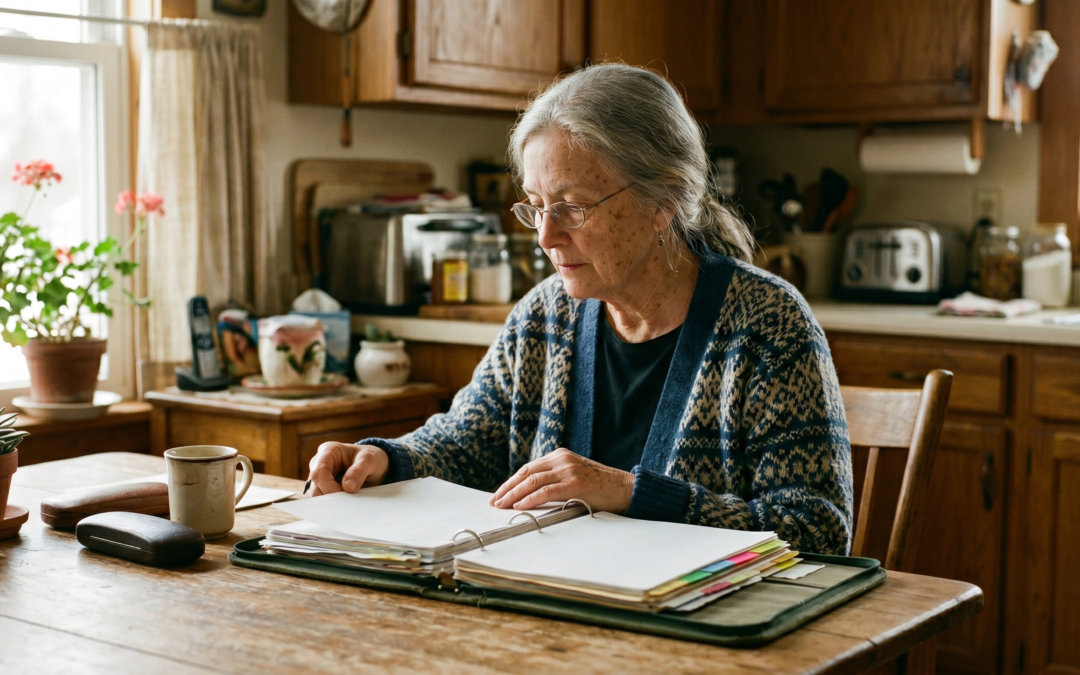
If you’re managing a chronic condition, you probably have more than one provider involved in your care. A primary care doctor. One or more specialists. A pharmacist. Possibly a physical therapist or other practitioners.
The people who care for you don’t always communicate well with each other. That coordination is often up to you.
I keep a simple document with the name and contact information for each provider, what condition or aspect of my care they manage, what they’ve prescribed and why, and when I’m next scheduled to see them. It takes about an hour to put together the first time. After that, it’s just updates.
The value isn’t just organization. In a stressful moment, at an urgent care or an emergency room, when someone is asking you questions about your health history and your medications, having the answers already written down matters more than you’d expect.
Get the medication picture right
Chronic conditions almost always involve medications. Sometimes several.
I’ve written about building a medication list in detail elsewhere, but for managing chronic conditions specifically, a few things stand out.
Medication interactions are real. The more medications you take, the more important it is to make sure they work well together. Your pharmacist is a resource for this, not just your doctor. Many pharmacies offer free medication reviews. This is genuinely underused, and it’s worth asking about.
Consistency matters. Many medications for chronic conditions work by maintaining a steady level in your system. Missed doses, irregular timing, or stopping without guidance can affect how well they work. Your doctor should tell you what to do if you miss a dose, because the right answer is different for different medications.
Keep your medication list current. When anything changes, a new prescription, a dose adjustment, a medication you’ve stopped, update the list. Outdated information is almost as bad as no information.
Monitor at home, strategically
Depending on your conditions, there may be measurements worth tracking at home: blood pressure, blood sugar, weight, oxygen levels. Your doctor should guide which ones matter for your situation and what numbers to watch for.
Technology has made this much more accessible. Reliable blood pressure cuffs, pulse oximeters, and blood glucose monitors are widely available and not expensive. Some connect to apps that keep a running record over time.
What you do with the data is what matters. Know the target ranges your doctor has given you. Know the numbers that mean you should call. Write those down and keep them near the device, not just in your memory.
Set up your home for your actual situation
Some chronic conditions change how you move through your home. Arthritis makes certain grips and surfaces harder. Balance issues change what furniture placement makes sense. Fatigue changes how far you can move without resting.
If your condition affects your mobility or physical capacity, a home assessment by a CAPS-certified contractor can look at your specific situation, not just generic safety improvements.
The standard modifications, grab bars, non-slip surfaces, better lighting, easier entry and exit, are often exactly what chronic condition management requires at the physical level. The difference is getting the placement and the specifics right for you.
Do this review while things are relatively stable. A calm, planned assessment gives you more options than a rushed evaluation after a difficult moment.
Strength and movement, carefully
Physical activity is one of the most consistently supported approaches to managing chronic conditions, but the appropriate kind and intensity vary considerably depending on what you’re managing.
This is not an area to figure out on your own. Before starting or changing your activity level, talk to your doctor or a physical therapist who knows your health history. What’s appropriate for osteoporosis is different from what’s appropriate for heart disease, and both are different from what’s right for diabetes.
That said, the broad principle holds across most conditions: consistent, appropriate movement supports independence and tends to make daily life easier. The specifics need to come from someone who knows your situation.
Build your support network before you need more of it
Chronic conditions are often manageable now but may need more support over time. Building that support structure before you need it gives you far more options than trying to construct it quickly during a health event.
Who knows your situation? Who would notice if you weren’t doing well? Who could you call if you had a difficult day and needed help? Who has a key to your house?
These questions don’t have complicated answers. They just need actual answers: names, phone numbers, people who know what’s going on. Before you need them.
The Independence Assessment covers all five areas of aging-in-place planning as one picture: preparedness, home, strength, community, and technology. Knowing where you stand across all of them, not just the medical side, is worth doing.
Take the 3-Minute Assessment
Managing a chronic condition and staying independent aren’t opposites. They just take more deliberate planning.
Anne
by lynncarnes@gmail.com | May 29, 2026 | Strength
When most people hear “strength training,” they picture something that has nothing to do with them.
A gym. Weights. People in their twenties doing something that looks effortful and loud. An entire cultural image attached to a phrase that makes it very easy for anyone over sixty to say “that’s not for me” and move on.
I want to spend a few minutes on what strength training actually looks like when it’s designed for where you are right now. Because the picture in your head is probably wrong in a specific direction, and that wrongness is keeping a lot of people from doing something that would genuinely help them.
The image that’s doing the damage
The cultural image of strength training was built on a research base and a media ecosystem that centered young men. Heavy barbells. High-intensity programs. Max lifts. Before-and-after photos that measure success by appearance.
None of that has much to do with what your body needs after sixty, or what getting stronger actually looks like for most people at this stage of life.
Getting stronger after sixty looks like:
Being able to get up from the floor without assistance. Carrying groceries in from the car without stopping. Walking up a flight of stairs without your legs feeling it the next day. Picking something up from a low shelf without thinking twice.
These are the actual goals. Not aesthetics. Functional capacity. The ability to move through your life independently.
What the research says about the basics
You don’t need a gym. The research on resistance training for older adults is fairly consistent on a few practical points.
Two to three sessions per week of resistance exercise is enough to maintain and improve muscle mass and strength. The sessions don’t need to be long. Thirty minutes is sufficient.
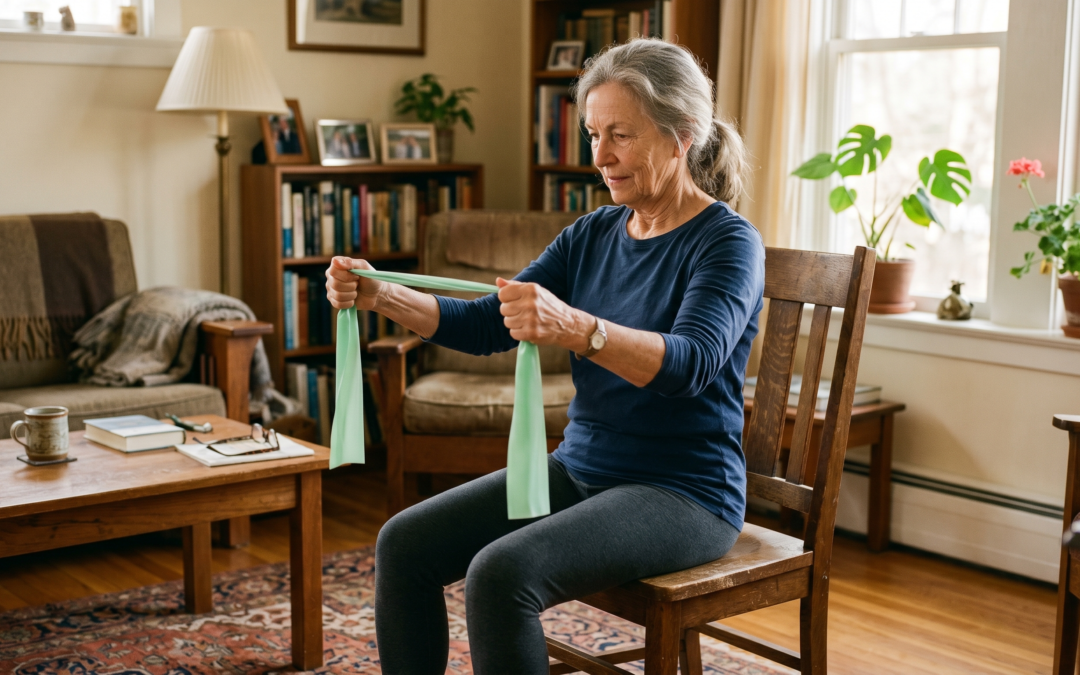
The resistance can be body weight, resistance bands, light to moderate weights, or any combination. What matters is progressive challenge over time, doing something that’s slightly harder than what was easy last time. Your muscles respond to challenge, not to a specific setting or equipment type.
The exercises that produce the most functional benefit are the ones that mimic real movements. Squats (sitting and standing from a chair). Step-ups (climbing stairs). Push variations (pressing things overhead or away from you). Pull variations (pulling toward you). Carrying things while walking.
Nothing exotic. All of it accessible.
The balance piece
Strength and balance are not the same thing, but they’re closely connected, and the training benefits overlap.
Balance exercises specifically work the neuromuscular system, the connection between your brain, your nervous system, and your muscles, that determines how quickly and accurately your body responds when your footing is uncertain.
The good news is that balance can be trained. Unlike some things that change with age, balance responds well to specific practice. Standing on one foot. Heel-to-toe walking. Weight shifts. None of these require equipment or a gym.
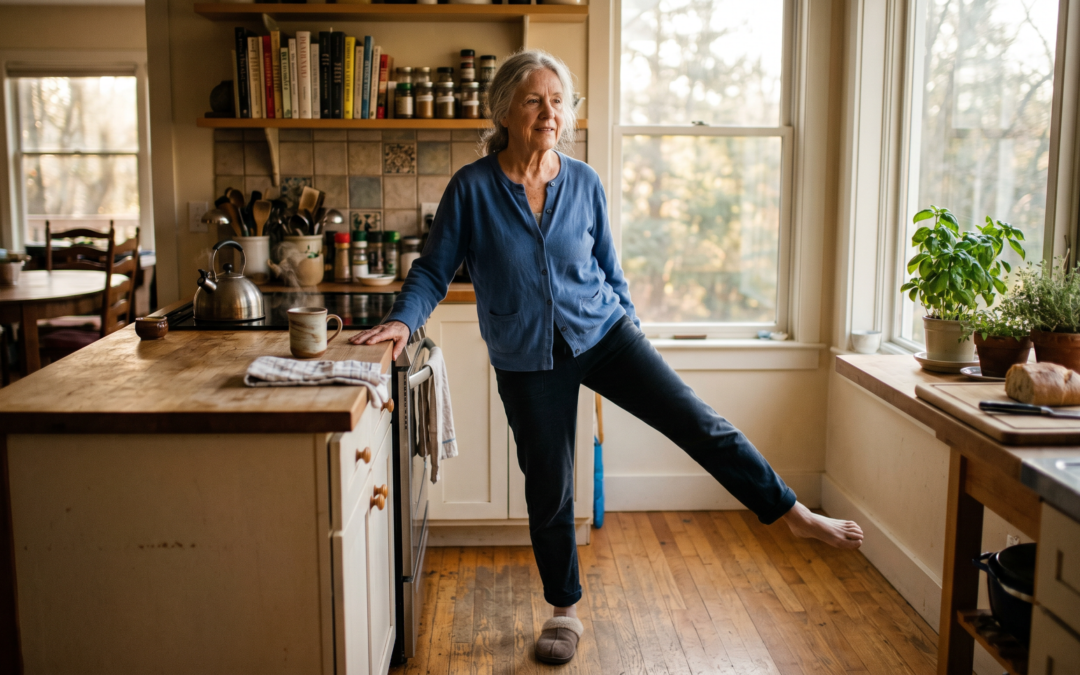
I talked about this more in the article on gentle balance moves, which covers specific exercises designed for exactly this. They’re done at the kitchen counter. Five minutes.
The part that surprises most people
Getting stronger after sixty often feels different than people expect.
It doesn’t usually involve soreness that leaves you unable to move. Done correctly, at an appropriate starting level, it feels more like effort than pain. The day after a good workout, your muscles might feel “worked” rather than damaged. That’s the adaptation process.
And the results come faster than many people expect, because starting from a relatively lower base means the early gains are noticeable. People who start resistance training in their sixties often report meaningful changes in how they feel and move within weeks.
This is not a promise of any specific result. Your experience depends on your starting point, your consistency, and what else is going on with your health. Talk to your doctor before starting a new exercise program, especially if you have any conditions affecting your joints, cardiovascular system, or bones.
But for most people who have been sedentary and start even a modest resistance program: something changes fairly quickly. And what changes is usually something they can feel in everyday life.
What to do with this
If you’ve been thinking about this and not starting, the barrier is probably not lack of desire. It’s not knowing where to begin.
The simplest starting point is body weight resistance: sit to stand from a chair, ten times. Do that three days this week. Add one set of wall push-ups. That’s a start. A real one.
If you want to understand where strength fits in your overall picture, the 3-minute assessment gives you a view across all five pillars of independent living.
Take the 3-Minute Assessment
Getting stronger after sixty is not the thing in your head. It’s simpler, more accessible, and more worth your time than the picture suggests.
Anne
by lynncarnes@gmail.com | May 29, 2026 | Strength
There’s a particular kind of helplessness that comes with watching a parent slow down.
You see things they might not. The fridge that’s less full than it used to be. The way they push themselves up from a chair now. The walk that’s gotten shorter, or stopped.
You want to do something. But every time you try, you either get “I’m fine” or a conversation that ends in hurt feelings. The gap between caring and helping can feel very wide.
This article is about that gap, and how to work in it.
What your parent is protecting
Before thinking about tactics, it’s worth understanding what physical independence means to most older adults.
It’s not just the ability to do things. It’s the sense of self that comes with it. Many people have spent their whole lives being competent, capable, and in charge of their own bodies. Slowing down is a loss. Accepting help with it is a more complicated loss.
When you express concern about a parent’s physical health, what they often hear, even when it isn’t what you mean, is: you’re not doing well. You’re declining. You need me to manage this for you.
The support that works tends to be the support that reinforces their agency rather than substituting for it.
What actually helps
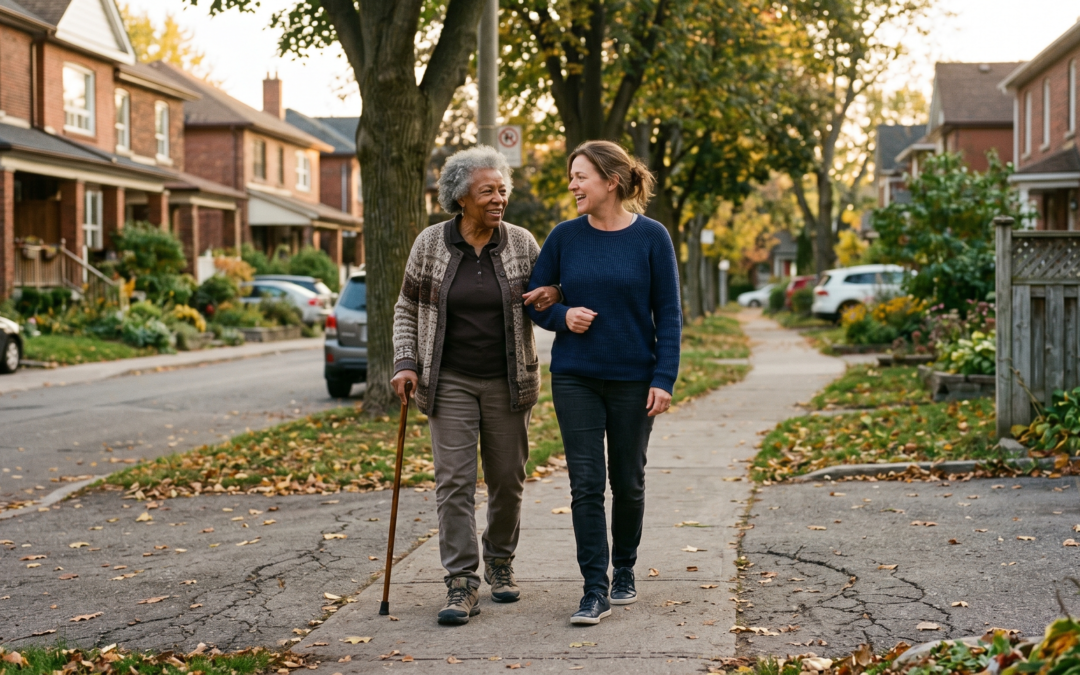
Doing alongside, not doing for. There’s a meaningful difference between “I’ll take you to the gym” and “I’ve been wanting to find a place to walk regularly. Would you want to join me?” The first positions you as the solution to their problem. The second positions you as someone doing the same thing they might want to do.
This is not a manipulation tactic. It’s an honest framing that creates a collaborative dynamic rather than a prescriptive one.
Finding something they actually enjoy. Not all movement is the same. A parent who spent their career on their feet may find structured exercise boring. A former dancer might respond to something rhythmic. A nature person wants to be outside. Exercise that fits a person’s history and preferences has a much better chance of continuing than exercise that feels like medicine.
Ask what they used to enjoy. “Were you ever active in a particular way? Is there anything like that you’d want to try again?” is a better starting place than “you should really be doing something for your strength.”
Connecting it to something they care about. Strength and mobility are means to ends. If your parent loves their garden, the argument for physical activity is “this helps you keep doing the garden.” If they want to be at a grandchild’s events, “staying strong keeps you mobile enough to be there” is the conversation.
Abstract health arguments rarely move people. Concrete life arguments often do.
Removing friction, not adding pressure. If getting to a class is a logistics problem, solving the logistics without attaching it to a conversation about their health is a genuine gift. “I’m going past the Y anyway, want me to bring you?” is different from “you really should be going to the Y.”
The harder cases
Some parents are resistant in ways that go beyond the normal reluctance. They minimize clear problems. They refuse to see doctors. They dismiss concerns with a firmness that shuts the conversation down entirely.
A few things that still apply:
You cannot make another adult take care of themselves. This is a real limit, and accepting it is part of being in this role.
You can keep the door open without forcing it. “I know you don’t want to talk about this, but I want you to know I’m here when you do” is worth saying and worth meaning.
A doctor’s recommendation carries different weight than a family member’s. If you can get a conversation happening with their physician, that changes the dynamic in ways that a conversation from you often can’t.
And in some cases, waiting for a moment of natural motivation, after a friend has a fall, after a TV segment catches their attention, is more effective than sustained pressure. The moment of receptivity matters.
The balance
The goal here is not to become your parent’s health manager. It’s to stay in genuine relationship with them while making it easy for them to stay healthy if they want to.
The distinction matters. One of those is a role that erodes the relationship over time. The other is just being a thoughtful family member.
If you’ve been finding the physical health conversations difficult, the same principles that work for broader aging conversations apply here. Lead with curiosity. Ask before you advise. Be alongside, not in front.
If this resonated and you think someone you know could use it, share it their way.
Take the 3-Minute Assessment
The people who stay most active tend to have people around them who make it easy and enjoyable. You can be that person.
Anne
by lynncarnes@gmail.com | May 29, 2026 | Strength
Here is something I wish someone had told me earlier: most of the fitness research you’ve been handed your whole life was done on young men.
Not all of it. But enough of it that the advice shaped by that research, the recommended calorie counts, the ideal workout formats, the guidance on recovery time and protein needs, was calibrated for a body that is not yours and has never been yours.
This is not a complaint. It’s a useful piece of information. Because once you know it, you can stop trying to make advice designed for someone else work for you, and start looking for what actually applies.
What changes after 60, specifically for women
Menopause changes the hormonal environment in ways that affect muscle, fat distribution, bone density, and recovery. Estrogen plays a role in maintaining muscle and bone. When it drops, the body changes how it responds to exercise and how it uses protein.
This is not a reason to exercise less. It’s a reason to exercise differently.
Researcher Dr. Stacy Sims has spent years studying how women’s physiology differs from men’s and how those differences should change exercise recommendations. Her conclusion is consistent: women, particularly postmenopausal women, do better with different protocols than the standard guidelines suggest.
The broad takeaways that come up repeatedly in this area of research:
Higher-intensity resistance training matters more, not less. The standard advice for older adults often emphasizes gentle movement and low weights. For bone density and muscle maintenance, heavier resistance (relative to your capacity) is more effective than high reps with light weight. This runs counter to a lot of popular guidance.
Recovery takes longer. This isn’t a weakness. It’s physiology. Building more recovery time into a training schedule improves results rather than slowing them down.
Protein timing matters. Muscle protein synthesis is more sensitive to timing after 60. Getting a meaningful protein source within a couple of hours of resistance exercise helps the body actually use the workout.
As always, talk to your doctor before making significant changes to your exercise routine, especially if you have any conditions affecting your joints, heart, or bones.
The “gentle” problem
I want to address the word “gentle” directly, because it comes up a lot in fitness content for older women, and I think it sometimes does harm.
Gentle has its place. A gentle walk is better than no walk. Gentle stretching maintains flexibility. The balance exercises I do every morning count as gentle, and they matter.
But gentle should not be the ceiling. If “gentle” is the only register you exercise in, you are probably not doing what your bones and muscles need. Bone density responds to load. Muscle responds to challenge. There is a version of exercise appropriate for your current condition and your history that is also demanding enough to create the adaptation your body needs.
Finding that version, with a good trainer or a physical therapist who specializes in older adults, is worth the investment.
What this means practically
I’m not suggesting you join a powerlifting gym. I am suggesting that if you’ve been doing gentle chair exercises for three years and wondering why you don’t feel stronger, the gentleness might be part of the reason.
A few things that move the needle:
Standing exercises over seated ones, where possible. Your body has to manage balance when you’re standing. That’s part of the work.
Resistance that feels challenging by the last few repetitions. If you can do twenty repetitions of something without noticing, the weight is too light for strength building.
Consistency over intensity. Three days a week of meaningful movement beats one grueling session followed by five days off.
Exercises that mimic what you actually need: getting up from a chair, going up stairs, carrying things, reaching overhead. Functional movement for a functional life.
The bigger point
Your body after 60 is not a lesser version of your body at 35. It is a different body with different needs, different strengths, and a different relationship with exercise.
The research is catching up to this. The advice is getting better. But you have to seek out the version of it that was designed for someone like you, not the version that was designed for a study population that didn’t include you.
If you want to understand where your overall independence stands, including strength and balance, the 3-minute assessment gives you a picture across all five pillars.
Take the 3-Minute Assessment
You’ve got more capacity than most of the advice assumes.
Anne
by lynncarnes@gmail.com | May 29, 2026 | Strength
I grew up with the food pyramid. I was told to eat plenty of grains, some protein, and not too much fat. I didn’t question it for about forty years.
Then my husband came home from the hospital after two months, weak in a way I hadn’t seen before. He’d lost muscle. His body had used it, because when you’re that ill and not eating well, muscle is what the body reaches for first. The doctors talked about rebuilding. About what he needed to eat. About protein, specifically.
I started paying attention to protein in a way I never had before. And what I found surprised me.
The standard recommendation was not written for you
The standard recommendation for protein in the United States is 0.8 grams per kilogram of body weight per day. For a 150-pound person, that’s about 54 grams. That sounds like a lot until you look at what’s actually in a day of food.
Here’s the problem. That number was based largely on research done on younger adults. And published research suggests that older adults, specifically those over 60, need meaningfully more protein to maintain muscle mass, not just preserve it, but actually keep what they have from slowly disappearing.
The range that shows up most consistently in the research on aging and muscle health is 1.0 to 1.2 grams of protein per kilogram of body weight per day, and some researchers say even higher for adults dealing with illness, injury, or recovery. For that same 150-pound person, that’s 68 to 82 grams a day. A significant difference from 54.
Talk to your doctor or a registered dietitian about what’s right for your specific situation. These are general ranges, not a prescription for you personally.
Why this matters more than you might think
Muscle loss after 60 is not just about strength. It’s about independence.
I wrote about this in more depth in the article on why muscle is your independence insurance. The short version: muscle is what keeps you upright, what powers you up stairs, what catches you when your balance shifts. Losing it gradually and silently is one of the ways independence slips away before anyone notices.
And here’s what I find genuinely helpful to know: you can slow that process. You cannot reverse time, but you can make real choices about how your body ages. Protein is one of the simplest levers.
What actually has protein in it
One reason people don’t hit their protein targets is that they’re not really sure what counts. Here’s a quick practical reference:
- 3 oz grilled chicken or fish: roughly 25 grams
- 2 eggs: roughly 12 grams
- 6 oz Greek yogurt: roughly 15 to 17 grams
- Half cup of cottage cheese: roughly 14 grams
- 3 oz canned tuna or salmon: roughly 22 grams
- Half cup cooked lentils: roughly 9 grams
- 2 tablespoons peanut butter: roughly 8 grams
Getting to 75 grams in a day is genuinely doable if you’re including a meaningful protein source at each meal, not just as an afterthought.
The breakfast problem
Most Americans get most of their protein at dinner. The research on muscle protein synthesis (how your body actually uses protein to build and maintain muscle) suggests that spreading protein more evenly across the day is more effective than loading it all into one meal.
For a lot of people, the weak link is breakfast.
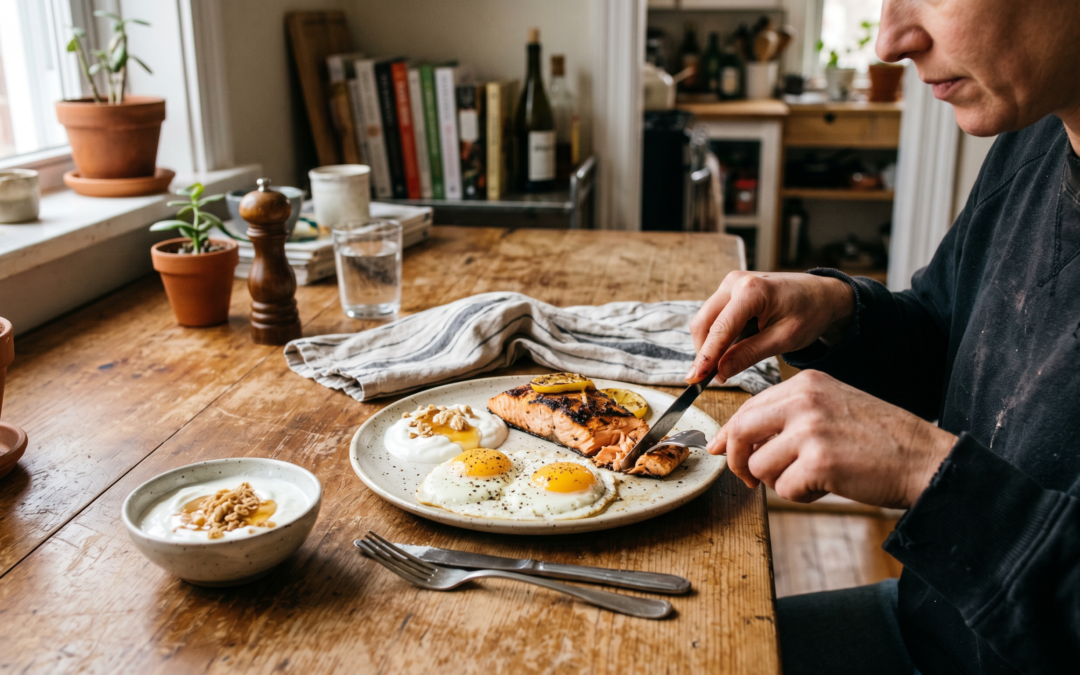
A bowl of cereal with milk might have 6 to 8 grams of protein. Two eggs with Greek yogurt on the side gets you closer to 25 to 30. The difference in how you feel mid-morning is noticeable.
I’m not a nutritionist, and I’m not telling you to overhaul everything at once. But breakfast is the easiest place to start if you want to move your daily number in the right direction.
What about protein supplements?
This comes up a lot. My honest take is that whole food sources are better when you can get them, for a lot of reasons beyond just the protein content. But supplements are not harmful and can be useful when getting enough from food is genuinely difficult.
If you’re considering a protein supplement, look for one with a short ingredient list and a low sugar content. Whey protein is well-studied and effective. Plant-based options (pea, soy) work well for people who prefer them or can’t tolerate dairy. The key is that you’re actually using it, not buying it and feeling good about it sitting in the cupboard.
Again, a conversation with your doctor or a registered dietitian is the right move before significantly changing your diet, especially if you have kidney issues or other conditions that affect how your body processes protein.
The bigger picture
Protein is one part of the strength pillar. Balance and strength exercises are the other major piece, and the two work together. Your muscles need the building blocks to maintain themselves, and the resistance from exercise signals your body to actually do the work.
If you want to understand where you stand across all five areas of independent living, including strength, the 3-minute assessment will show you your current picture and tell you what to focus on first.
Take the 3-Minute Assessment
What you eat matters. More than most of us were taught.
Anne
by lynncarnes@gmail.com | May 18, 2026 | Stories, Strength
This is the unglamorous one. The piece on why strength is your independence insurance was the reason. The ten-second sit-to-stand check was the gauge. This is the part nobody photographs: the small, boring balance practice I actually do, holding onto my own kitchen counter, while the coffee brews.
I am going to walk you through the five moves I keep coming back to. But first I need you to read the next part, because it matters more than the moves do.
Read this before you do anything
I am not a doctor. I am not a physical therapist. Nothing here is medical advice, and none of it is built around your particular body, your joints, your conditions, or your medications. It is simply what one woman in her sixties does in her own kitchen.
Before you try any of this, talk to your doctor, and ask whether a visit to a physical therapist is worth it. A physical therapist can watch you move for one session and tell you more, specifically about you, than any article ever could. If you have had a fall, or you have dizziness, joint problems, a heart condition, or anything that makes balance a real question, do not start on your own. Ask first.
When you do try these, every single one is done within arm’s reach of something solid and immovable. A kitchen counter. A heavy table. A wall. Not a chair that can slide. Not a towel rack. Not furniture that tips. Keep a hand on the support, or hovering just above it, the entire time. The moment you feel dizzy, unsteady in a way that worries you, or anything sharp, you stop and you sit down.
There is no version of this that is worth a fall in order to practice not falling.
If all of that sounds overly careful, good. That is the right amount of careful.
The five moves I come back to
These are gentle on purpose. None of them should feel like effort or strain. If one does, that is a sign to stop and ask a professional, not to push through.
1. Standing steady, feet together. Stand tall at the counter, feet together, a hand resting on it. That is the whole move. Just be still, without the small sway you stop noticing. Being able to stand quietly and steady is the foundation everything else sits on. Some days this one is enough.
2. Heel to toe. With a hand on the counter, place one foot directly in front of the other, heel almost touching toe, like standing on a line. Hold it for a moment, only as long as feels steady, then come out of it. This is the balance you use on a narrow path or a curb.
3. Standing on one foot. Hand on the counter, lift one foot off the floor just slightly, only a little, for a few seconds, then set it down. Switch sides. This is the balance behind every single step you take, because walking is really just controlled one-foot standing, over and over.
4. Slow heel raises. Hold the counter with both hands. Rise slowly onto the balls of your feet, then come down just as slowly, with control, not a drop. This is the strength that pushes you up a stair and up off the floor.
5. Sit to stand, with control. This is the same movement from the sit-to-stand check, now done as practice instead of a test. A sturdy chair against a wall, support within reach. Stand up and sit down slowly, with control. It is the most repeated strength movement in an independent life, so it is worth practicing on purpose.
That is the whole set. None of it requires equipment, special clothes, a floor mat, or anyone watching.
How I actually do this
I do not do all five every day, and I do not count anything. This is not a workout with a number to hit. It is closer to brushing your teeth than to going to the gym.
A few of these, a few times, most days, while the coffee brews. That is the entire program. The thing that protects your balance over years is not intensity. It is showing up small and often, long after no one is grading you. That is the heart of this whole pillar, and it is the part most people get backwards. They wait until they can do it seriously, so they never do it at all.
You are not trying to achieve anything here. You are trying to keep something you already have. That is a gentler goal, and a more honest one, and it is the one that actually works.
Some days the only one you will do is the first one, standing steady at the counter for a moment. That still counts. That is not nothing. That is the habit staying alive on a hard day, which is the only reason it is there for you on the day you really need it.
The printable, and where to start
I am building a simple one-page guide with these five moves, the unglamorous version, so you can keep it on the counter instead of remembering it from here. It is free. When it is ready I will send it to my newsletter, and you can get it by signing up at the bottom of any page on this site.
And if you want to see where strength sits next to the other parts of staying independent, the Independence Assessment scores you across all five pillars in three minutes and tells you which one needs you first.
Take the 3-Minute Assessment
Talk to your doctor. Keep a hand on the counter. Start with the one that feels easy. That is genuinely all this asks of you.
I’m glad you’re here.
Anne
