
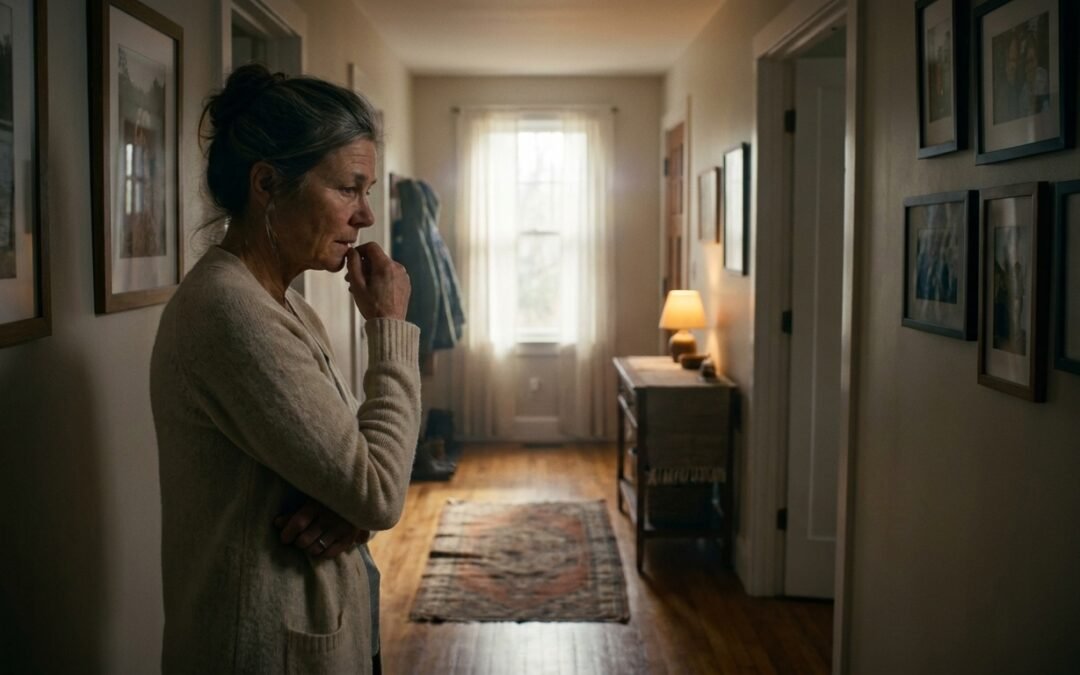
I had lived in my house for more than twenty years. I knew where every creak in the floor was. I could walk it in the dark. If you had asked me whether it was safe, I would have looked at you like the question didn’t make sense. Of course it was safe. It was home.
Then I walked through it with different eyes, and I counted eleven things in one afternoon that were going to be a problem. Not that day. But someday. And someday has a way of arriving without an appointment.
Why I finally looked
I didn’t do this because I read an article about it. I did it because my husband came home from the hospital using a walker, for what we thought would be a few weeks, and the house I knew in the dark suddenly didn’t fit us anymore.
The walker didn’t fit through the bathroom doorway. I had walked through that doorway maybe forty thousand times and never once noticed it was narrow. It wasn’t narrow for me. It was narrow for a walker, and I had never needed to know that until the afternoon I did.
That’s when I started actually looking. Not at the house I remembered. At the house that was actually there.
What I found
I’m going to list some of these, because I think you’ll recognize your own house in them.
The throw rug at the top of the stairs. The one I’d had for fifteen years. Pretty. Also a thing my foot caught on twice while I was carrying laundry, and I’d never thought a thing about it because I’d never fallen. Never falling is not the same as being safe. It’s just luck that hasn’t run out yet.
The lighting in the hallway. I’d been compensating for it for years by squinting and knowing where things were from memory. A guest would have found that hallway dim. I had simply stopped seeing it.
The bottom kitchen cabinet where I kept the heavy pots. I had to get down on one knee to reach them. I’d been doing it for years. It had become a small negotiation I had with my own kitchen every single day, and I’d stopped noticing I was negotiating.
The step down into the garage with nothing to hold onto. The bathtub I climbed over with nothing to grab. The extension cord I ran along the baseboard every winter for the space heater. The smoke detector I couldn’t remember the last time I had tested.
None of these were dangerous that afternoon. Every one of them was going to be eventually.
The thing nobody tells you about home safety
Here is what I understood, standing in my own hallway, that I want to pass along.
A home doesn’t become unsafe in a day. It becomes unsafe the way you lose touch with an old friend. Slowly, then all at once, and you don’t see it happening because you’re inside it every day.
The danger isn’t the throw rug. The danger is that you’ve stopped seeing the throw rug. Familiarity is the actual hazard. It edits things out of your vision precisely because they’ve always been there.
And here is the part that changed how I think about all of it. Almost everything on my list was cheap and easy to fix while it was still a someday problem. The same fixes done after a fall, or in a hurry while someone is coming home from a hospital, are not cheap and not easy. They are a renovation. They are a crisis with a contractor attached.
Done early, this work is almost invisible. Done late, it’s a project. The only part you control is when.
How to look at your own home
You don’t need a professional for the first pass. You need an afternoon and a willingness to be a stranger in your own house.
Walk through every room and ask one question. If I were a little less steady than I am today, what in this room would I have to be careful of? Not what is dangerous now. What would I have to think about if my balance, or my eyes, or my strength were even slightly less than they are.
The rooms that matter most are the ones where the floor changes height and the ones where water meets a hard surface. Stairs. Entryways. The bathroom. And the path from your bed to the toilet in the dark, which is a trip almost everyone makes and almost no one has ever really looked at.
Write down what you find. Do not fix anything yet. Just see it. Seeing it is the part most people never do, and it’s the part that matters most.
Where to start
If you do nothing else after reading this, do the one I would do first. The path you walk at night, half asleep, from your bed to the bathroom. Clear it. Light it. Make it so a person who is not fully awake and not fully steady could make that trip without thinking. That single path is a common place for falls, and it is almost free to fix.
I’m putting together a room-by-room checklist, the actual one I used, so you can walk your own house with it instead of trying to remember what I listed here. When it’s ready I’ll send it to my newsletter. If you’re not on the list, you can sign up at the bottom of any page on this site.
And if you want to see where home safety sits among the other parts of staying independent, the Independence Assessment will show you. Three minutes. It scores you across all five pillars and tells you which one to start with.
Go look at your hallway. Really look at it. I think you already know what’s there.
I’m glad you’re here.
Anne