
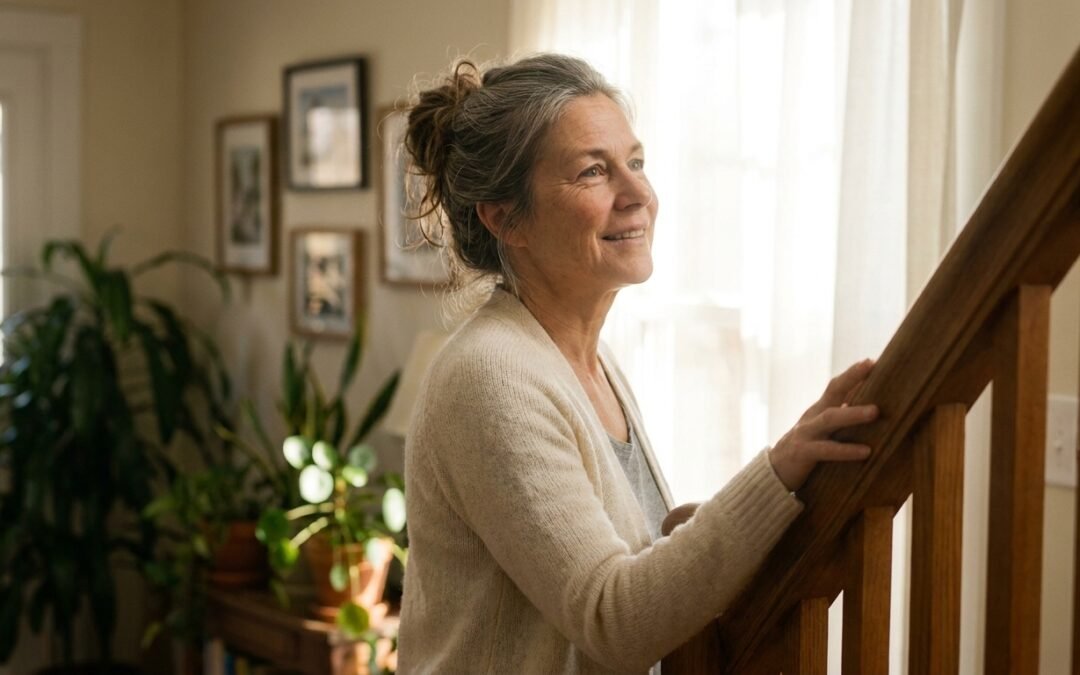
Nobody ever told me that muscle was the thing standing between me and a stairlift. They told me it was about fitness. About looking good in a swimsuit I stopped wearing twenty years ago. About being athletic, which I never really was. So I filed it under optional, the way you file the gym membership you keep meaning to use.
That was one of the more expensive filing mistakes I have made about my own body. I want to walk you through it, because I think you may have filed it in the same place I did.
The frame we were handed
For most of my life, strength was sold to me as a vanity project. The before-and-after photos. The toned arms. The thing other people did at six in the morning while I was making coffee and being glad I was not them.
That framing works fine when you are forty and your body does what you ask without being asked twice. It falls apart completely somewhere after fifty-five, and almost nobody updates the framing for you. You are left thinking strength is still optional, still about appearance, still a thing for other people, right at the age when it quietly becomes the opposite.
The afternoon the frame broke
I did not have a dramatic moment. That is sort of the point. It was a series of very small ones I had been ignoring for years.
I noticed I was pushing off the arms of the chair with my hands to stand up. Not always. Just sometimes. Then more than sometimes.
I noticed I had started taking the short way around the block when I walked the dog, and that I had a quiet story about why that was fine.
I noticed I was making two trips from the car with the groceries when I used to make one, and that I had a story about that too.
None of these were injuries. None of them were a diagnosis. Every one of them was my body telling me something I did not want to hear, in a voice low enough that I could pretend I had not heard it. That is how this happens. Not with an event. With a hundred small accommodations you make without noticing you are making them.
What muscle actually does at this age
Here is the reframe that changed how I think about all of it.
Every single thing that lets you live independently is, underneath, an act of strength.
Standing up from a toilet is a strength act. Climbing the stairs to your own bedroom is a strength act. Catching yourself when your foot snags the edge of a rug, the half second that decides whether you stumble or you fall, is entirely a strength act. Carrying a laundry basket. Getting up off the floor after you bend to the bottom cabinet. Getting out of a bathtub. Opening a heavy door against the wind.
None of that is fitness. None of it happens in a gym. All of it is the difference between living in your own home and not.
When you lose muscle, you do not notice it as “I am weaker.” You notice it as your world getting smaller. The stairs you stop climbing. The trip you stop making. The thing on the high shelf you stop reaching for and start doing without. Muscle does not announce its departure. It quietly takes rooms of your life with it.
Why this changes everything
Once you see strength as the thing holding up your independence rather than a thing that shapes your arms, the whole calculation flips.
It stops being the optional item at the bottom of the list, the one you will get to when things slow down. It becomes the load-bearing wall. You can let a lot of things slide in your sixties and seventies and be fine. This is not one of them, because this is the one that decides whether all the other plans even matter. A beautifully organized folder of documents does not help you up off the bathroom floor.
That is what I mean by independence insurance. You are not training for anything. You are not competing with anyone. You are quietly keeping the ability to do the ordinary things that, added together, are the entire difference between staying and leaving.
What this is not
I want to be clear, because the old framing is sticky.
This is not the gym, unless you want it to be. It is not marathons. It is not punishing yourself at dawn. It is not lifting something heavy until you are shaking. It is not a number on a scale or a photo or anything you have to buy special clothes for.
It is mostly small and unglamorous and done at home in regular clothes while the coffee brews. Fifteen honest minutes most days does more at this age than two heroic hours once a week. The people who keep their strength into their eighties are almost never the ones who trained hardest. They are the ones who kept doing a little, consistently, long after no one was grading them.
Where to start
I am not going to hand you a workout in this piece, because the first step is not a workout. The first step is the reframe itself. You have to stop seeing this as optional. Everything else follows from that one change, and nothing useful happens until it does.
When you are ready for the actual movements, talk to your own doctor first, especially if something hurts or you have a condition that complicates things. Then start absurdly small. Smaller than feels worth it. Standing up from a chair without using your hands, a few times, is a real beginning. So is walking the long way around the block again.
I am putting together a simple home strength starting guide, the unglamorous version, nothing that needs equipment or a gym. When it is ready I will send it to my newsletter. If you are not on the list, you can sign up at the bottom of any page on this site.
And if you want to see where strength sits next to the other parts of staying independent, the Independence Assessment scores you across all five pillars in three minutes and tells you which one needs you first.
You do not have to get strong this week. You just have to stop believing it is optional. That part you can do right now, before you even stand up.
I’m glad you’re here.
Anne