
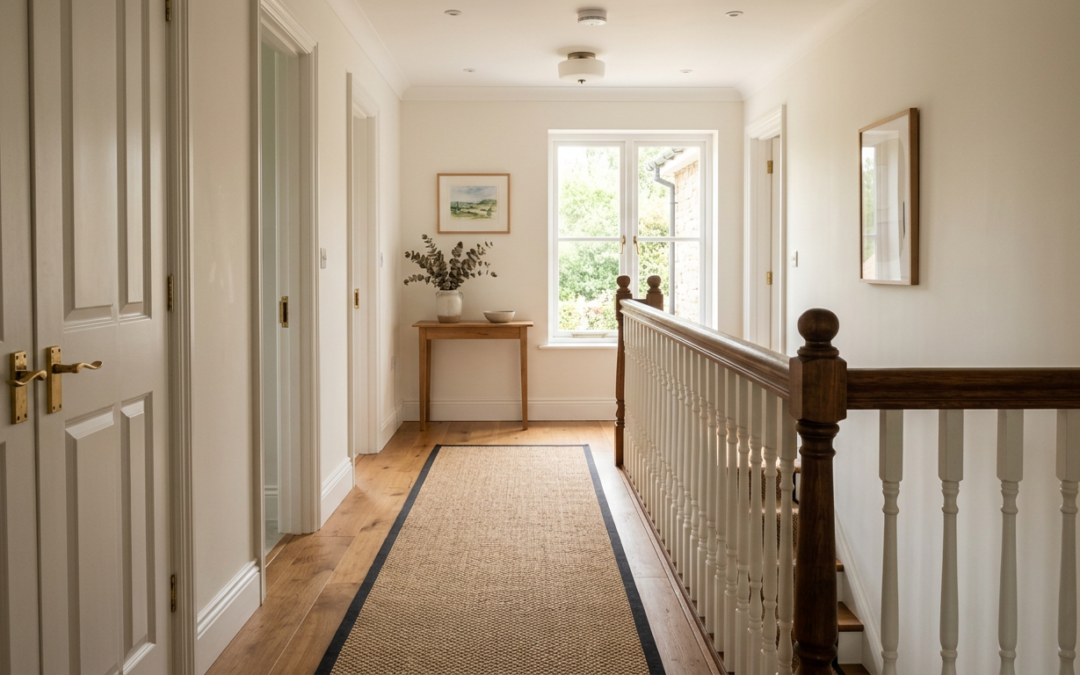
Falls are the leading cause of injury for adults over 65, and most of them happen at home, on ordinary floors, in ordinary rooms, doing ordinary things. That is not me trying to scare you. It is what the public health data has shown for years.
I am not telling you this to make you afraid of your own house. I am telling you because almost every one of the common hazards is something you can fix this week. Most of them for very little money. A few of them for nothing at all.
I walked my own home looking for these after my husband came back from the hospital, and I found more than I expected. Here are the seven that show up in nearly every house I have ever looked at, and exactly what to do about each one.
A quick note before the list. Some of the product mentions below will eventually be affiliate links, which means if you buy through them I may earn a small commission at no extra cost to you. I only point to the kinds of things I would put in my own house, and I will tell you, every time, when a link is an affiliate link. Several of the fixes here cost nothing at all.
1. Loose rugs and runners
The throw rug. The hallway runner. The little mat by the kitchen sink. They slide. They bunch. They catch a toe. A rug you have walked over a thousand times without thinking is exactly the kind of thing that stops being harmless the first time your balance is a little off.
Fix it today: For a rug you want to keep, put a non-slip rug pad underneath so it can’t travel. For any rug in a high-traffic path, and especially at the top or bottom of stairs, the honest answer is to take it up entirely. A rug is not worth a hip.
2. The path you walk in the dark
Almost everyone makes the same trip in the middle of the night, half asleep, from the bed to the bathroom. Almost no one has ever really looked at that path. It is often the darkest route in the house and the one you walk in the worst condition to walk it.
Fix it today: Put a plug-in motion-sensor night light along that path. They cost a few dollars, they turn on by themselves when you move, and they turn off on their own so you never think about them again. This is the single highest-value fix on this list for the lowest effort.
3. The bathtub or shower with nothing to hold
Water plus a hard slick surface plus stepping over a tub wall is one of the most dangerous combinations in any home. Most bathrooms ask you to do all three at once with nothing to hold but a towel bar, and a towel bar is not a grab bar. It will come out of the wall the moment you actually need it.
Fix it today: Have properly installed grab bars put in, anchored into the studs, not just screwed into drywall. Add a non-slip bath mat inside the tub or shower. If you do nothing else in the whole house, do the bathroom.
4. Cords across walkways
The lamp cord. The phone charger. The extension cord you run to the space heater every winter along the baseboard and across the doorway. You step over it without thinking, until the once you don’t.
Fix it today: Reroute cords so they run along walls, never across a path. That part is free. For cords that have to cross a walkway, use cord covers that lie flat and tape down. This is a ten-minute job that removes a hazard permanently.
5. Clutter on the stairs and the floor
The stack of things on the stairs waiting to be carried up next time. The basket by the door. The shoes in the entryway. None of it feels like a hazard because all of it has a reason to be there. Reasons do not prevent falls.
Fix it today: This one is free. Clear the stairs completely. Nothing lives on a staircase, ever. Then walk your main paths and move anything you have to step around. If you step around it daily, it is a hazard you have stopped seeing.
6. Loose or missing handrails
A handrail you never use feels optional, right up until the day it is the only thing between you and the bottom of the stairs. Many handrails are loose, mounted on only one side, or missing entirely on a step or two outside.
Fix it today: Tighten every handrail you have. Grab each one and shake it. If it moves, fix the mount. Where there is no rail, especially on outdoor steps and basement stairs, have one added. A rail on both sides of a staircase is better than one, and not as expensive as most people assume.
7. Slippery footing
Socks on hardwood. Smooth-soled slippers. The kitchen floor near the sink that gets a little wet and a little slick. Your footing is the one variable you carry with you into every room.
Fix it today: Wear something with grip indoors. Not socks alone, not loose backless slippers. A shoe or slipper with a real sole and a back. Put a non-slip mat where the floor gets wet, especially at the kitchen sink. None of this is expensive and all of it is immediate.
Where to start
Do not try to do all seven today. Pick the free ones first, because there is no reason to wait on those. Clear the stairs. Reroute the cords. Tighten the handrails. That is an afternoon and it costs nothing.
Then do the night path I just talked about, because it is cheap and it protects the trip you are least equipped to make safely. Then the bathroom, because the bathroom is where the worst ones happen.
And if you want to see where home safety sits next to the other parts of staying independent, the Independence Assessment will show you. Three minutes. It scores you across all five pillars and tells you which one to start with.
If this was useful, send it to someone. Most people will not walk their own house until someone they trust tells them to.
I’m glad you’re here.
Anne