by lynncarnes@gmail.com | May 29, 2026 | At-Home
When I first started thinking seriously about modifying my home, I did what most people do.
I called a general contractor.
Good reviews. Years of experience. Highly recommended by a neighbor. When I explained what I wanted, a bathroom that would be safer and easier to use for the long term, he nodded and wrote up a quote. He installed the grab bar where I pointed. Solid installation. Wrong placement.
It took talking to a CAPS specialist six months later to understand what I’d missed.
What CAPS stands for
CAPS stands for Certified Aging-in-Place Specialist. It’s a professional certification from the National Association of Home Builders, developed in collaboration with AARP.
Contractors who earn this certification have received specific training in home modifications for older adults and people with physical limitations. They study universal design principles, which is the approach to building and modifying spaces so they work for people across a range of abilities and life stages. They learn which modifications make a real difference, which ones people tend to regret, and how to assess a home systematically rather than just responding to what the homeowner asks for.
A license and experience in home renovation don’t substitute for this training. The knowledge is genuinely different.
What a CAPS specialist does that others don’t
A general contractor responds to what you ask for. A CAPS specialist starts by assessing what you actually need, which isn’t always the same thing.
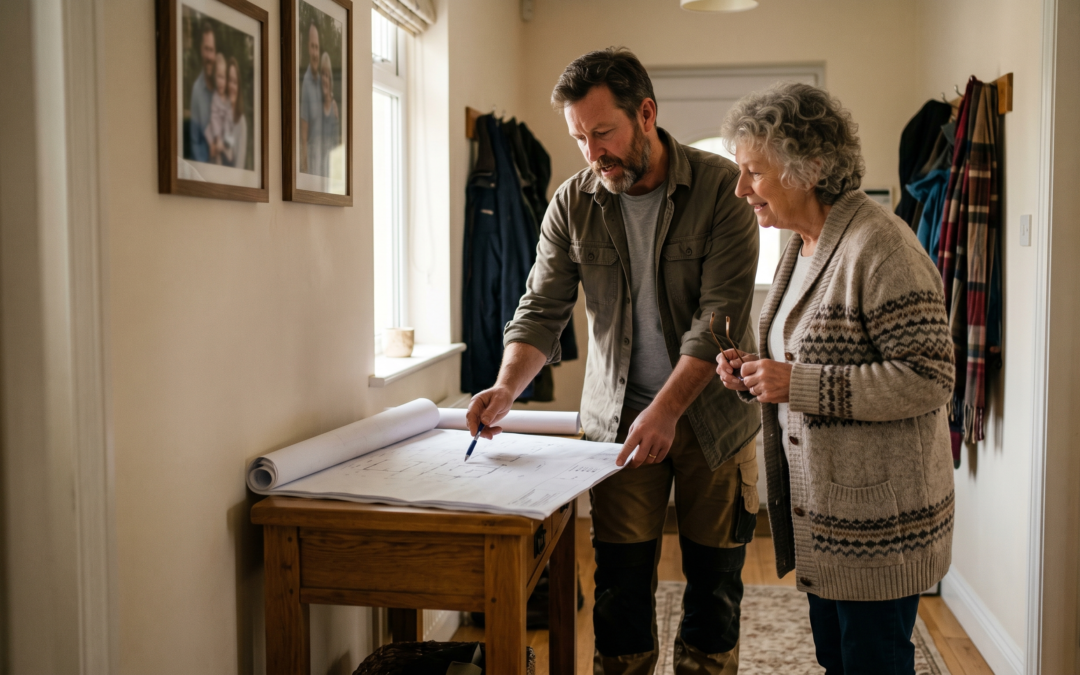
Before any work begins, they walk through your home with a trained eye. They look at traffic patterns, flooring transitions, lighting levels, door widths, furniture placement, and how the space actually functions. They bring a systematic framework for identifying what poses the highest risk, what modifications would address it, and what should happen first.
Some specific things CAPS training covers:
Grab bar placement. This is more complex than it looks. The right position depends on the person’s height, strength, and which side they favor. Bars in the wrong location don’t get used when they’re needed most.
Flooring transitions. Small height differences between floor surfaces that seem trivial can create significant trip hazards. A trained eye catches them.
Lighting levels. Aging eyes need more light than younger eyes do, and the need increases over time. CAPS specialists assess lighting at the points in the home that matter most: stairs, hallways, and the path between bed and bathroom.
Entry and exit. Getting in and out of the house safely, with consideration for how mobility may change over time, is often overlooked in standard renovation planning.
What the process looks like
A CAPS assessment typically starts with a home visit and a written report. The report describes what they found, what they recommend, and in what priority order.
From there, you decide what to tackle first. Not everything has to happen at once. A good CAPS specialist will be clear about which items address immediate risk and which are longer-term improvements to phase in over time.
They’ll also know what requires a permit and what doesn’t. Grab bars generally don’t. A widened doorway might. Understanding this upfront prevents surprises mid-project.
Cost and coverage
CAPS contractors charge market rates for their work. The assessment itself may be a separate fee or may be folded into the project estimate. Ask before the first visit.
Some modifications may qualify for tax deductions when made for documented medical reasons. Some insurance plans, particularly long-term care policies, may help with modification costs. Neither is guaranteed, and the rules are specific to each situation. Your CAPS specialist may have general guidance, but confirm the details with your insurer or tax advisor.
State and local programs that help fund home modifications for eligible older adults do exist. Availability and eligibility criteria vary considerably by location. Your local Area Agency on Aging is the best starting point for finding out what’s available in your area.
How to find a CAPS specialist near you
The National Association of Home Builders maintains a searchable directory of CAPS-certified contractors at nahb.org. Look under “Find a Builder” and filter by CAPS designation.
Age Safe America maintains their own directory of aging-in-place professionals, including CAPS specialists, at agesafeamerica.com.
If you already work with a contractor you trust, it’s worth asking whether they hold CAPS certification or know someone in their network who does.
Questions worth asking before you commit
CAPS certification requires training, but practical experience with aging-in-place projects matters too.
Before committing to any contractor, I’d ask: How many aging-in-place projects have they completed in the last year? Can they provide references from clients with similar projects? Does their process start with a written home assessment?
That last point is the most important. If a contractor is ready to schedule work before walking through your home and doing a proper assessment, that’s worth noticing.
One piece of the bigger picture
A CAPS specialist handles the physical home. That’s one of five areas I think about for aging in place well. The others, legal documents, health management, community connections, and technology, each deserve the same level of intentional attention.
If you want to see where you stand across all five, the 3-minute assessment gives you a clear picture.
Take the 3-Minute Assessment
The right home modification starts with the right assessment. That’s what a CAPS specialist brings.
Anne
by lynncarnes@gmail.com | May 29, 2026 | At-Home
When you visit, you see things your parent doesn’t see anymore.
Not because they’re unaware. Because familiarity does something to perception. The rug that’s been in that corner for thirty years doesn’t look like a hazard. It looks like part of the living room. The dim hallway at the back of the house doesn’t look dangerous. It looks like home.
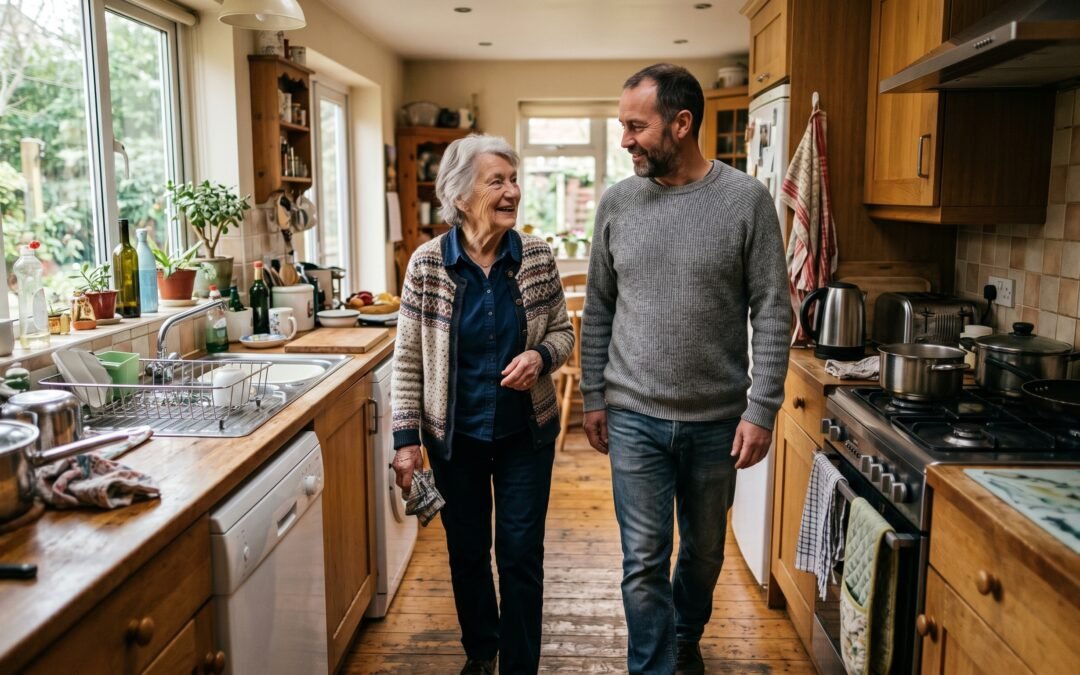
You come in with fresh eyes. And if you know what to look for, a visit becomes an opportunity to notice things that matter.
The challenge is doing this in a way that helps rather than creates conflict. This guide is for that specific task.
The frame: observation, not inspection
The difference between a visit that opens conversation and one that puts your parent on the defensive is almost entirely about framing.
You’re not there to evaluate. You’re not there to declare problems. You’re there to be present, to help where you can, and to gently notice things that you might bring up later, with care, as a question rather than a concern.
Walk through the house with your eyes open. Keep your observations to yourself during the visit unless something is genuinely urgent. Then, in a separate conversation, not in the house, not in the moment, share what you noticed as a question.
“I noticed the hallway doesn’t have much light. Is that something that bothers you?”
“The throw rug in the bathroom caught my attention. Would you ever consider something with a non-slip backing?”
What you’re doing is giving them information and a choice, not a verdict.
What to look for, room by room
Kitchen: Are the things used daily accessible without climbing or reaching to the back of high shelves? Is the stove clean and in use? Is the refrigerator stocked with food that looks fresh? Is there a fire extinguisher visible and accessible? Are items stored in a way that doesn’t require bending to floor-level cabinets repeatedly?
Living room and main areas: Are there clear walking paths, or are there tables, cords, or objects in the flow of traffic? Does the main seating have sturdy arm support for getting up? Are there rugs that slide or curl at the edges? Is the lighting adequate for reading or moving around at night?
Bathroom: This is the highest priority room. Is there anything to hold onto getting in and out of the shower or tub? Is the floor mat non-slip and does it lie flat? Is there a bathmat outside the tub or shower? Is the toilet at a comfortable height? Are medications stored where they’re easily accessible?
Bedroom: Is the path from the bed to the bathroom clear, even at night? Is there a lamp or light switch within reach of the bed? Are there cords or items on the floor? Does the bed height allow for getting up and sitting down easily?
Stairs (if present): Are both handrails solid? Is the lighting adequate at both the top and the bottom? Are there any objects stored on the stairs?
Outside the front and back: Are the steps in good repair, with no cracks or movement? Is there something to hold while going up and down? Is there adequate lighting for arriving home after dark?
What to notice beyond the physical
A home tells a story beyond the physical space.
Is the home being maintained at roughly the same level it always was? A significant change in cleanliness, organization, or upkeep can be a signal worth noting.
Is the refrigerator being used normally? Significant changes in eating habits sometimes show up in what’s in the kitchen.
Is the mail stacked up in a way that suggests it’s not being managed? Bills and correspondence that seem to be accumulating can indicate difficulty with paperwork.
You’re not investigating. You’re noticing. Most of these things turn out to have ordinary explanations. But noticing them gives you the ability to ask a gentle question.
How to bring it up
The conversation about anything you noticed is a separate moment from the visit. Not immediately after leaving. Not while still in the house.
A day or two later, in a calm moment, you might say: “I’ve been thinking about my visit. There’s something I noticed that I wanted to ask you about.”
Then ask one thing. Not a list. Not a briefing. One question, with genuine curiosity, and then listen.
The goal is a conversation, not a to-do list handed to your parent.
If there’s something that genuinely needs to change, and your parent is receptive, you can work on it together. If they’re not ready yet, planting the question is still a contribution. It may come back when the time is right.
Sharing this
If you have siblings who visit, or other family members who care for your parent’s wellbeing, share this guide. Consistent eyes across multiple visitors give a better picture than one person’s observations. And having the same language for what you’re looking for makes it easier to compare notes.
Take the 3-Minute Assessment
The next visit is an opportunity. You already care. Now you have a framework.
Anne
by lynncarnes@gmail.com | May 29, 2026 | At-Home
When my husband came home from the hospital, we started talking about what changes to make to our house. Not because we planned to sell it. Because we planned to stay in it.
What I didn’t expect was learning, in the middle of that process, that several of the things we were doing for safety were also things that would make the house more appealing on the market if we ever did decide to sell.
That surprised me. I’d assumed safety features were a compromise, something you do because you need to, that a potential buyer would see as a sign of the previous occupant’s limitations rather than as something to want.
The reality is more interesting than that.
What universal design actually means
The term is “universal design,” and it refers to home features designed to work well for people across a wide range of ages, abilities, and body types. Curbless showers. Wide doorways. Lever-style door handles. Single-floor living options. Rocker switches instead of toggle switches.
These features are not exclusively for older adults. They’re useful for anyone carrying groceries, anyone with temporary injuries, anyone moving furniture, any family with young children. The demographic shift has made them increasingly sought after, but the appeal was always broader than just the aging-in-place market.
What the real estate community says
The research here is directional rather than definitive. Home values are hyperlocal and depend on too many factors for broad numbers to mean much. But the consistent observation from real estate professionals who work with aging-in-place modifications is this: homes with good universal design features in key areas, particularly bathrooms and kitchens, sell more easily and at stronger prices than comparable homes without them.
The buyer pool has expanded. Multigenerational households are more common. Aging baby boomers are one of the largest buyer segments in many markets. Features that serve those buyers well are not liabilities.
For your specific market, talking to a local real estate professional who has experience with universal design or senior housing is the right move before making major decisions. This is general observation, not financial advice.
The modifications that do double duty
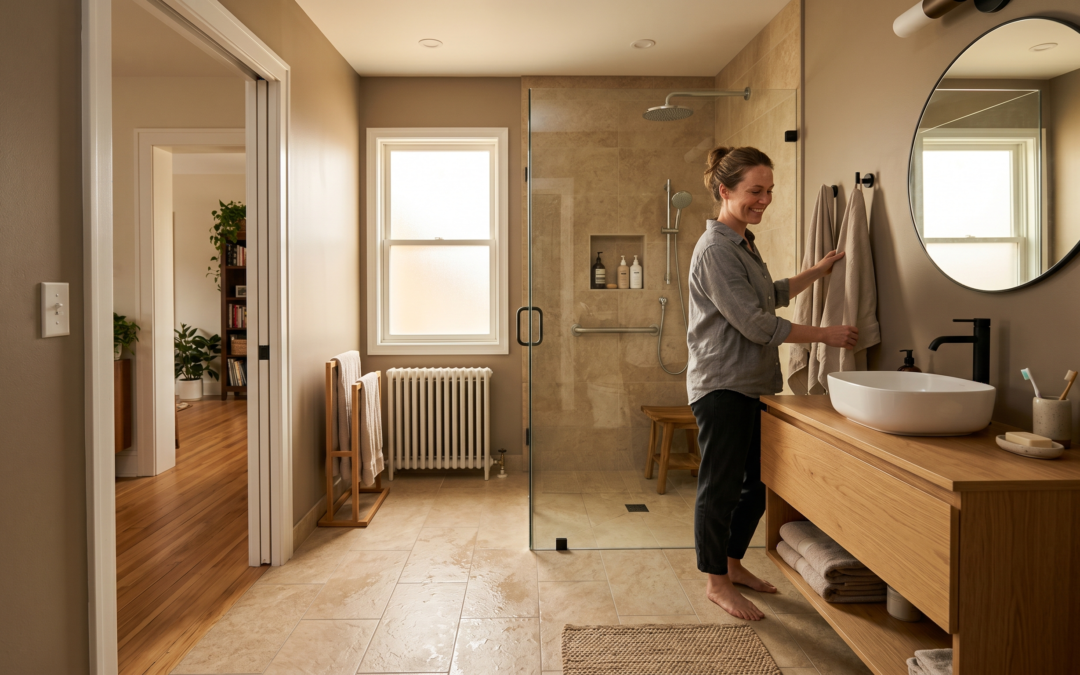
Curbless (zero-threshold) showers. A shower without a step to climb over is safer, easier to clean, and widely considered a design upgrade. Contractors and designers increasingly recommend them regardless of client age. They’re common in high-end homes.
Wider doorways. The standard in many older homes is 28 to 30 inches. Widening to 36 inches accommodates wheelchairs but also furniture moving, large dogs, anyone with a walker or crutches, and just generally creates a more open feeling. In new construction, this is increasingly standard.
Grab bars in the bathroom. I wrote separately about how modern grab bars look nothing like the institutional chrome bars of thirty years ago. High-quality grab bars in matching finishes look like intentional design. They are increasingly listed as features, not red flags.
First-floor bedroom or bedroom flex space. This one is high-value for aging in place and for sale. A dedicated first-floor bedroom, or a room that could serve as one, is highly sought after by buyers who are thinking ahead.
Lever handles. Replacing doorknobs with lever handles is inexpensive, takes an afternoon, and is better for nearly everyone, arthritic or not. The ease of use is a small quality-of-life improvement that costs almost nothing.
Rocker light switches. Standard toggle switches require more precise movement. Rocker switches are easier to use in the dark, with full hands, or with reduced grip strength. Again, inexpensive and broadly useful.
The ones that don’t add value
Not every modification works this way. Stair lifts, for example, are very useful for the people who need them and are almost always viewed as a liability by buyers who don’t. They can typically be removed if you sell, but they tend to signal a specific use case rather than a broadly desirable feature.
The same is true for some bathroom safety equipment when installed without attention to design. A cheaply installed grab bar that doesn’t match the fixtures signals “safety modification” in a way that a well-chosen bar in the right finish does not.
The principle is consistency. Modifications done well, with attention to design and finish quality, tend to read as upgrades. Modifications done hastily or purely for function tend to read as accommodations.
The main point
If you’re making modifications to age in place, make them well. That’s the whole argument.
Done well, many of these changes serve your daily life right now, protect your safety, and position your home as a more desirable property if your plans ever change.
If you want to think through what changes make sense for your home and your situation, the room-by-room home safety audit is a good place to start.
Take the 3-Minute Assessment
Your home can work harder for you. In more ways than you might expect.
Anne
by lynncarnes@gmail.com | May 29, 2026 | At-Home
Of all the things I’ve changed in my home over the past few years, nothing was cheaper or made a bigger immediate difference than lighting.
That surprised me. I’d been focused on bigger projects — the grab bars, the conversation about the stairs, the first aid kit. Lighting felt too simple to matter much.
Then I started paying attention to when I felt uncertain in my own home. The answer was almost always the same: dim corners, dark hallways at night, the bathroom at three in the morning.
I’ve since come to think of lighting as the single most underrated safety investment you can make. Here’s why.
What changes about vision after 60
The eyes change with age. This isn’t a dramatic decline. It’s a gradual shift that most people adapt to without fully realizing it.
The pupil gets smaller and responds more slowly to changes in light. The lens yellows slightly, filtering out shorter wavelengths. Contrast sensitivity decreases. Recovery time from bright light, like headlights on a dark road, gets longer.
What this means practically: you need more light than you used to, you adjust between light and dark more slowly, and low-contrast environments (a gray step edge against a gray floor) become genuinely harder to read.
Most homes are not built with any of this in mind.
Where lighting matters most
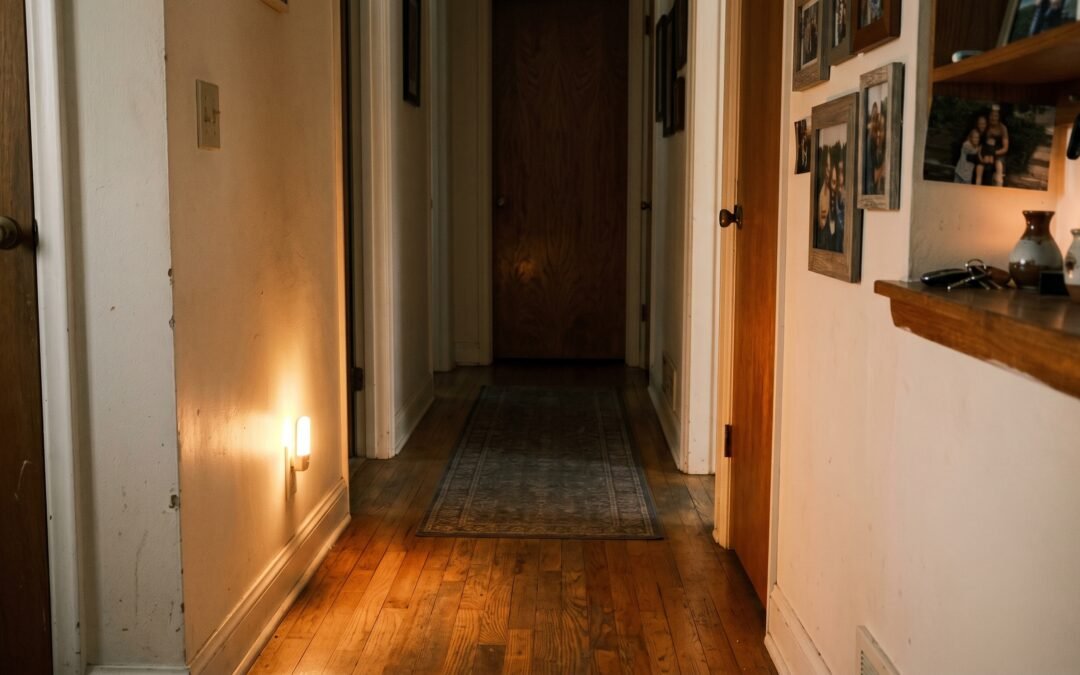
The path between the bed and the bathroom. This is the highest-risk journey in your home. Middle of the night, groggy, dark hallway. Night lights along this path, low enough that they illuminate the floor rather than shining in your eyes, are one of the highest-impact changes you can make. Motion-activated versions mean you never have to remember to turn them on.
Stairways. Both the top and the bottom of every staircase should have a light switch. If you can only reach a staircase light from one end, that’s a problem worth fixing. Light the whole staircase, not just the landing.
The bathroom. A bright bathroom matters. If your bathroom overhead light is a single dim bulb, add a brighter one or supplement with vanity lighting. You make decisions in the bathroom, about medications, about balance, about what you’re doing, and you make them better with good light.
Entry points. The front door, the garage door, the back door. Coming in from the dark to the inside of your home, or the reverse, is a transition that benefits from good lighting on both sides.
The kitchen. Under-cabinet lighting is cheap and effective. The counter is where you prepare food, handle medications, read labels. Shadow from overhead lighting is a common problem in kitchens, and task lighting solves it directly.
The easy wins
Motion-sensor night lights are inexpensive, require no wiring, and plug directly into an outlet. A few of these along the bedroom-to-bathroom path cost less than twenty dollars and last for years.
Smart bulbs let you set schedules so certain lights come on automatically at dusk or at a set time at night. Once configured, you don’t have to remember anything.
For stairways, a simple dimmer switch upgrade can make a meaningful difference. Full bright on the way up; softer when coming down at night.
For the bathroom, a bright daylight-spectrum LED is often a direct swap for what’s there. The color temperature matters: bulbs labeled “daylight” (around 5000K) give better contrast than “warm white” (2700K) for detail tasks.
What this costs
Most of these changes are in the range of ten to fifty dollars per area. The full path from bedroom to bathroom could be covered with three or four night lights. The kitchen under-cabinet lighting is a weekend project.
This is the part I want to emphasize, because people sometimes delay safety projects while they figure out which big renovation to do first. Lighting is not a big renovation. It’s a Tuesday afternoon.
The bigger picture
Lighting is one piece of the home safety picture. If you want to walk through your entire home with a checklist, the room-by-room home safety audit covers every area and tells you exactly what to look for and what to fix first.
And if you want to understand where home safety fits within your overall plan, the Independence Assessment gives you a picture of all five pillars in three minutes.
Take the 3-Minute Assessment
Good light isn’t a luxury. It’s what lets you move through your own home with confidence.
Anne
by lynncarnes@gmail.com | May 29, 2026 | At-Home
I resisted grab bars for a long time.
They felt like a statement I wasn’t ready to make. Like putting one in my bathroom was admitting something about where I was in life, some slow surrender I’d rather not acknowledge.
I’m telling you this because I suspect you’ve thought the same thing. And I want you to know that what changed my mind wasn’t stubbornness giving way. It was education.
Because the grab bar I was picturing in my head is not the grab bar I’m talking about.
What you’re probably picturing
You’re picturing the institutional chrome bar bolted to the tile in a hospital bathroom or a nursing home. White walls, fluorescent lights, and a bar that announces to everyone who walks in exactly why it’s there.
That image has done a lot of damage. It’s kept a lot of bathrooms without the one thing that would make them genuinely safer.
What grab bars actually look like now
Modern grab bars are a different product entirely.
Moen, Kohler, and Delta (among others) make grab bars in brushed nickel, oil-rubbed bronze, matte black, and polished chrome that match the hardware you already have. They’re designed by the same people who design your faucets and towel bars. Some of them are indistinguishable from a towel bar unless you look closely.
When my husband came home from the hospital, we started looking at what would make our house easier and safer to navigate. I went into the project expecting to feel like we were installing “equipment.” What I found was that the right grab bars actually make the bathroom look more finished, not less.
A well-placed grab bar in the right finish looks like a design choice. It is a design choice.
Where grab bars actually matter
The bathroom is where most falls happen at home, and the shower and bathtub are the highest-risk spots within it. Here’s where to think first:
In the shower: A bar on the wall you face when you step in, and one on the side wall if you have the space. The entering-and-exiting moment is the highest risk. A secure place to hold while stepping over the threshold makes a real difference.
Next to the toilet: A bar on the wall beside the toilet helps with sitting and standing. This is often the install people resist most, and the one that ends up being used most often. Rising from a seated position is harder than most people realize until it isn’t.
Outside the tub: If you have a bathtub, getting in and out, especially after a shower when everything is wet, is a genuine hazard. A vertical grab bar mounted at the entry point of the tub is useful here.
A note about installation
This is important: grab bars have to be mounted into studs or with toggle anchors rated for the weight. A bar mounted only into drywall will pull out of the wall exactly when you need it most.
If you’re not sure about your walls, or if you’re not comfortable with the installation, hire a handyman or a CAPS-certified contractor (CAPS stands for Certified Aging in Place Specialist). The cost of professional installation is modest. The cost of a bar that fails is much higher.
The CAPS directory is available through the National Association of Home Builders. You can search by zip code for someone certified specifically for aging-in-place modifications.
The real reason to stop waiting
Here is the thing I came to understand, eventually.
A grab bar isn’t a flag that something is wrong. It’s a flag that you’re paying attention.
Falls are the leading cause of injury for adults over 65, and most of them happen at home, in ordinary rooms, in ordinary moments. A wet tile floor. A half-step over the tub edge. A moment of imbalance on an otherwise normal morning.
The grab bar doesn’t mean you’re fragile. It means you’ve thought about the physics of your bathroom and decided that a $50 piece of hardware is a reasonable thing to put between yourself and a bad day.
That’s not admitting anything. That’s being smart about where you live.
Getting started
If this is the week you decide to actually do something about it, start with the shower entry. One bar. The right finish. Properly installed. That’s the whole project.
From there, you can add more as you see fit. But one bar, in the right place, is a meaningful change.
If you want to look at the bathroom as part of a larger picture of your home’s safety, the room-by-room home safety audit is a good place to walk through it methodically. Or if you want to understand where your whole independence plan stands, the 3-minute assessment gives you a view across all five areas.
Take the 3-Minute Assessment
Your bathroom is one room. Your independence plan is the whole house, and everything beyond it.
Anne
by lynncarnes@gmail.com | May 18, 2026 | At-Home, Stories
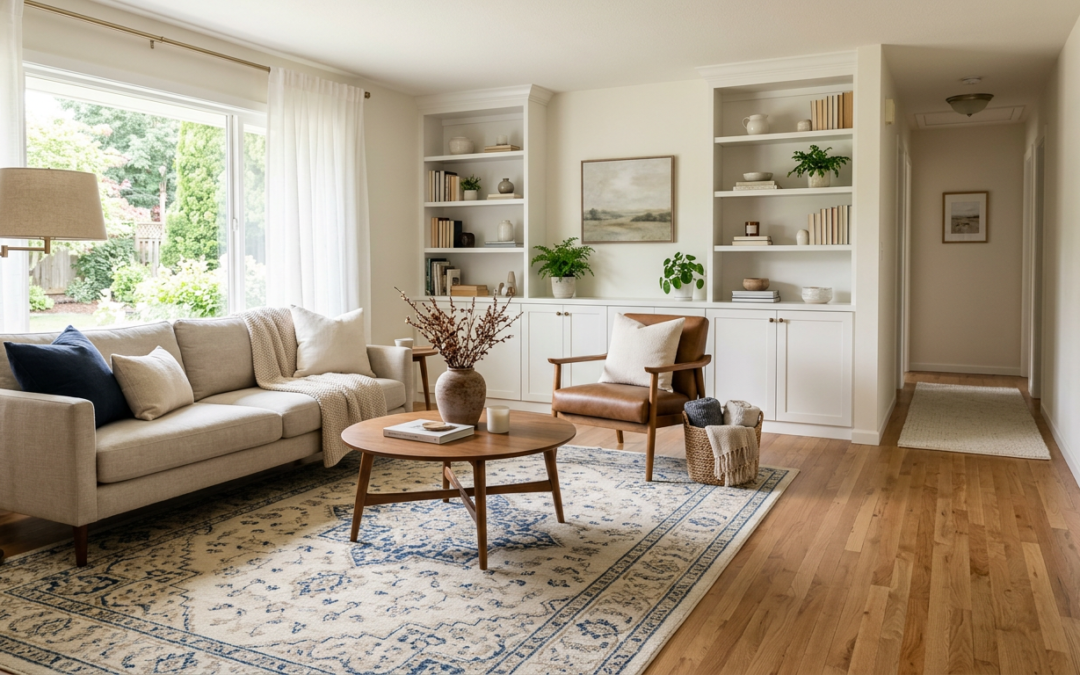
I’ve written before about the afternoon I finally walked through my own house and saw it the way a stranger would. That piece was the story. This one is the tool. It is the checklist I wish someone had handed me that day, organized the way you actually move through a house, so you are not trying to hold it all in your head.
You do not need a contractor for this. You do not need to spend a dollar to do the walk-through itself. You need an hour, a notepad, and a willingness to look at rooms you stopped seeing years ago.
Here is how to use it. Go room by room, in order. In each room, do not fix anything yet. Just look, and write down what you find. Fixing comes later, and most of it is smaller than you expect. Seeing is the part almost everyone skips, and it is the part that matters most.
A quick note before we start. A few of the fixes mention products, and some of those will become affiliate links over time, which means I may earn a small commission at no extra cost to you. I only point to the kinds of things I would put in my own house, and most of what is on this list costs nothing at all.
Start outside: the approach to your door
Most audits start inside. Start outside, because the first fall many people have is on the way in, with their hands full.
Walk up to your own front door the way you do when you are carrying groceries. Then check:
- Are the steps even, solid, and free of moss or cracks
- Is there a handrail, and does it hold firm when you pull on it hard
- Can you see the steps clearly after dark, or do you do them from memory
- Is the path level, or are there roots, pavers, or a hose you step around
- Can you set bags down somewhere while you find your keys
The fixes here are usually a handrail, a brighter or motion-sensor light by the door, and a small shelf or bench near the entrance so you are never balancing bags and keys at the same time.
Stairs and hallways
Stairs are where the worst falls happen, and hallways are where you move fastest without looking.
- Is there a handrail on both sides of every staircase, inside and out
- Does every handrail hold firm when you shake it
- Is anything stored on the stairs, ever, even temporarily
- Is each step a consistent height, with no worn or slick spots
- Are the stair edges easy to see, or do they blend together in low light
- Are hallways clear, and lit well enough that a guest would not squint
Free fixes: clear the stairs completely and keep them clear, and tighten loose rails. The fix that costs a little: a second handrail where there is only one, and better lighting where steps blend together.
The bathroom
If you only audit one room, audit this one. Water, hard surfaces, and the motions of getting in and out of a tub make the bathroom the highest-risk room in most homes.
- Is there something solid to hold getting into and out of the tub or shower, and is it an actual grab bar, not a towel bar
- Is there a non-slip surface inside the tub or shower
- Could you sit to shower if you ever needed to
- Is the floor slick when wet, especially right where you step out
- Can you get on and off the toilet without pulling on the sink or the towel bar
- Is there a night light so the path here works at three in the morning
The fixes that matter most here are properly installed grab bars anchored into studs, a non-slip mat inside the tub, and a non-slip bath mat outside it. A shower seat and a raised toilet seat are not signs of giving up. They are the difference between staying in your home and having to leave it.
The bedroom and the night path
Almost everyone makes the same trip in the dark, half asleep, from the bed to the bathroom. Almost no one has ever audited it.
- Walk that exact path. Is it clear, or do you step around furniture or a rug
- Is there light you can trigger without crossing the dark to reach a switch
- Is a phone reachable from the bed if you could not get up
- Is the bed a height you can get into and out of without effort
- Are cords, chargers, and shoes off the floor along that route
This is the highest-value, lowest-cost fix in the whole house. A plug-in motion-sensor light or two along the night path, a clear floor, and a reachable phone. Almost free, and it protects the trip you are least equipped to make safely.
The kitchen
You spend a lot of time here, often with hot or heavy things in your hands.
- Are the things you use most within reach without a stool or a deep bend
- If you must reach high, do you have a stable step stool with a handle, not a chair
- Is there a slick spot on the floor near the sink or the stove
- Are walkways clear of the bins, mats, and bags that collect underfoot
- Is the lighting good over the counter where you use a knife
Free fix: move daily-use items to the shelves between knee and shoulder height, so the heavy pots are not on the floor and the everyday plates are not over your head. The small purchase: a real step stool with a handrail. Standing on a kitchen chair is one of the most common ways people my age end up in an emergency room.
Living areas
The room you relax in is also the room you have stopped seeing most completely.
- Are walkways clear from the doorway to your chair to the rest of the house
- Are rugs secured or removed, with no curled edges
- Are cords run along walls, never across a path
- Is the chair you use easy to rise from, or do you push off the arms and rock
- Can you reach a lamp without crossing a dark room to a switch
Most of this is free. Reroute cords, secure or remove rugs, clear the paths. The one thing worth money is a chair you can actually get out of, if your main chair has quietly become a daily struggle.
Whole-house essentials
A few things do not belong to a single room. Check them once.
- Do the smoke and carbon monoxide detectors work, and were they tested in the last six months
- Could emergency responders get in if you could not reach the door
- Is there a way to call for help reachable from the floor, not only from standing
- Is there a flashlight you could find in the dark during a power outage
- Does anyone outside the house know it well enough to help in an emergency
These are mostly free and mostly forgotten. The detectors especially. Set a recurring reminder to test them, because the day you need them is not the day to find out the battery died two years ago.
What to do with what you found
You now have a list. Do not try to do all of it this weekend. Sort it into three piles.
The free fixes you can do today: clearing stairs, rerouting cords, securing rugs, moving kitchen items, testing detectors. Do these now. There is no reason to wait on any of them.
The small purchases: night lights, a step stool, non-slip mats, a second handrail. Order them this week.
The bigger jobs: grab bars installed into studs, lighting added, a chair that works for you. These take a little planning, but they are still far smaller and far cheaper done now, on a calm Tuesday, than done in a panic after a fall.
If you want the short version of where falls actually happen, I wrote a piece on the seven most common hazards that show up in nearly every house. Start there if this felt like a lot.
I made a one-page printable version of this entire audit, the actual checklist, so you can carry it room to room with a pen instead of working from memory. It is free. I send it to my newsletter, and you can get it by signing up at the bottom of any page on this site.
And if you want to see where home safety sits next to the other parts of staying independent, the Independence Assessment scores you across all five pillars in three minutes and tells you which one to start with.
Take the 3-Minute Assessment
Print the list. Walk your house. You already know some of what you will find. The whole point is to write it down somewhere you can actually act on it.
I’m glad you’re here.
Anne
