What Is a Healthcare Proxy, And Why You Need One Before You Think You Do

What Is a Healthcare Proxy, And Why You Need One Before You Think You Do

When I first heard the term “healthcare proxy,” I nodded like I understood what it meant. I didn’t.

I had a vague sense it was related to legal paperwork, the kind of thing you handle when you’re much older or very sick. I filed it under “things I’ll deal with later.”

Then my husband ended up in the hospital for two months after surgery we hadn’t planned for. And I found myself wishing I understood a lot of things better than I did.

This is the article I would have wanted then. Plain language. No legal jargon. Just what it is, why it matters, and how to get it done.

What a healthcare proxy actually is

A healthcare proxy is a person you officially designate to make medical decisions for you if you cannot make them yourself.

That’s it. One sentence.

The situations when this matters: you are unconscious, under anesthesia and something unexpected happens, experiencing a medical crisis that leaves you unable to communicate, or in a condition where cognitive ability is compromised. In those moments, someone needs to be able to talk to the doctors, understand the options, and make decisions on your behalf.

Without a designated healthcare proxy, the hospital turns to whoever is present and legally recognized, often a spouse, but sometimes the situation is more complicated. And complicated situations, in a crisis, become very hard very fast.

How it’s different from a power of attorney

This is the question I hear most, so I want to address it directly.

A power of attorney (POA) gives someone the authority to make decisions about your finances and legal matters. Signing checks, managing accounts, handling paperwork.

A healthcare proxy (sometimes called a healthcare power of attorney or medical power of attorney, depending on your state) gives someone the authority to make decisions specifically about your medical care.

Two different roles. Two different documents. One person can serve both roles, or you can choose different people for each.

If you already have a general power of attorney, check what it covers. Some include healthcare decisions. Many do not.

What happens when you don’t have one

I want to be honest here, not scary. This is not a “without this document, something terrible will happen” story. It’s a “without this document, someone else handles your most important decisions, possibly in ways you wouldn’t choose” story.

Hospitals have legal protocols for who can consent on your behalf when no proxy is named. The order typically goes to a spouse, then adult children, then other relatives. In most cases, this works out.

But “works out” and “happens the way you would want” are not the same thing.

What if your adult children disagree on your care? What if the person who shows up first doesn’t know what you’d want? What if your situation is complicated, and the doctor needs to act quickly, and nobody has the authority to say yes?

A healthcare proxy doesn’t eliminate hard situations. It does give someone you trust the legal standing to speak for you, clearly and without question.

How to choose your healthcare proxy

This is the part people worry about most. A few things to consider:

Choose someone who can handle pressure. Medical decisions are often made in difficult moments. Your proxy needs to be able to think clearly under stress, not just care about you deeply.

Choose someone who knows your values. This is more important than proximity. Your proxy doesn’t need to be nearby. They need to understand what matters to you: how you feel about aggressive intervention, what quality of life means to you, what you would and wouldn’t want.

Have the conversation before you sign the document. The document gives your proxy legal standing. The conversation gives them what they actually need to do the job. Don’t hand someone a piece of paper and assume they know what to do with it. Talk first. Then sign.

It does not have to be a family member. Many people choose a close friend. What matters is trust and judgment, not relation.

You can change your proxy. If your circumstances change, if your relationship changes, if the person you chose is no longer the right fit, you can update the designation. It’s not permanent.

What your proxy needs to know

Once you’ve chosen someone and they’ve agreed, here are the basics to walk them through:

  • Where the document is kept (and have a backup copy somewhere)
  • Your doctor’s name and contact information
  • Your general wishes about end-of-life care (the harder conversation, but the most important one)
  • Where your advance directive is, if you have one

An advance directive (sometimes called a living will) is a separate document that records your specific medical wishes. It works alongside the healthcare proxy. Your proxy is the person; the advance directive is the instruction set. Together they give the medical team everything they need.

How to actually get it done

You do not need a lawyer to complete a healthcare proxy. Most states have free standard forms.

The easiest place to start is CaringInfo.org, run by the National Hospice and Palliative Care Organization. It has free, state-specific advance directive forms that include the healthcare proxy designation. You download the form for your state, fill it in, and have it witnessed or notarized according to your state’s requirements.

It takes about twenty minutes once you sit down to do it.

If you have a more complex situation, or property and assets involved, talking to an estate attorney is worth the time. But for the healthcare proxy itself, the free state form is legitimate and legally valid.

The conversation

The hardest part is not the paperwork. The hardest part is the conversation.

Telling someone you’re naming them as your proxy, and then actually talking through what that means, feels like a lot. It feels like you’re preparing for something bad. I understand that feeling.

Here’s what I’ve found, on the other side of it. The conversation is almost always a relief. For both people. The person you’re naming usually feels honored, not burdened. And you feel lighter once it’s done, because the thing you’ve been avoiding has become a thing you’ve handled.

If you’ve been putting off this particular piece of preparation, you’re in good company. Most people have been.

The good news is that it’s one of the simpler ones to complete. The document itself is short. The conversation matters more than the form.

And having it done means that if the moment ever comes, the person you trust most is the one who gets to speak.

If you’d like to know where this fits in your overall independence plan, the 3-minute assessment will show you your current state across all five pillars, including preparedness, and tell you what to focus on first.

Take the 3-Minute Assessment

I’m glad you’re here.

Anne

Best Medical Alert Systems of 2026: An Honest Comparison (No Hype, No Sales Pressure)

Best Medical Alert Systems of 2026: An Honest Comparison (No Hype, No Sales Pressure)

If you search “best medical alert systems,” you will get a hundred articles that look like comparisons and are actually advertisements. Ranked lists where the number one pick is whoever paid the most. Editor’s scores nobody can explain. Countdown timers. A photograph of someone’s grandmother looking frightened.

This is not going to be that. I am not going to give you a fake ranking or a number I made up. I am going to tell you how these systems actually differ, what genuinely matters when you choose one, what is marketing noise, the exact questions to ask before you sign anything, the company I would start with, and the famous name I would steer you away from, plainly and with reasons.

One thing first, plainly. I have not yet entered any affiliate relationships in this category, which means as I write this I make nothing on any link in this article, period. When that changes, I will tell you in writing, at the top of the page and next to the specific link, every single time. The promise is that I will say honest things about the companies here whether or not I earn from any of them, and I will tell you plainly when something in this industry is not worth your money. That promise has to hold either way. If it ever stops, the article is not worth reading anyway.

First, an honest question: do you actually need one yet?

Not everyone reading this needs a medical alert today, and the honest articles say so.

A medical alert earns its place if you live alone, or are alone for stretches of the day, or have had a fall, or have a condition that could leave you suddenly unable to get to a phone. It also earns its place when the person who would worry most is not you but the people who love you, and the device buys everyone some peace. That is a real reason, not a lesser one.

I wrote about being skeptical of this whole category, and I want to bring the same honesty here. This is not about admitting you are old. It is the same logic as a smoke detector. You install it precisely because you do not expect a fire, and you would rather have it doing nothing on the wall for ten years than need it once and not have it. It is infrastructure, the same as a grab bar or the folder of documents. You hope it stays boring.

If none of that describes your life right now, it is reasonable to bookmark this and come back. If some of it does, keep reading.

The four kinds, in plain language

Almost every product on the market is a version of one of these four. Get the category right first; the brand comes after.

1. In-home system, landline. A base unit plugs into your home phone line, with a wearable button. You press it, the base unit calls a monitoring center, you talk through the base unit’s speaker. The cheapest option. The honest downsides: it only works inside the home and within range of the base, and it needs a landline, which fewer people keep every year.

2. In-home system, cellular. Same idea, but the base unit uses a cellular signal instead of a landline, so no phone line is needed. Still only works at home and within range of the base. Good for someone who is mostly home and has dropped their landline.

3. Mobile system with GPS. A small unit you carry or wear that works anywhere there is cell coverage, using GPS so the monitoring center can locate you if you cannot say where you are. This is the one for a person who still drives, walks, gardens, leaves the house. The honest downside: it depends on cell coverage and needs more regular charging than a simple home pendant.

4. Wearable, watch or pendant style, often with optional fall detection. A device worn like a watch or necklace, usually mobile and GPS-enabled, sometimes blending in enough that people will actually wear it, which matters more than any spec. Fall detection is usually an add-on here and on the mobile units.

A word on fall detection, because the ads oversell it. It is sensors that try to detect a fall and call for help even if you do not or cannot press the button. It is genuinely useful for the right person. It is also not perfect. It can miss some falls and it can false-trigger on things that are not falls, and it typically costs extra per month. It is worth having for many people. It is not the magic guarantee the commercials imply, and any company that tells you it catches every fall is selling, not informing. One of the famous names in this category, as a matter of fact, does not even offer fall detection because they say the false-alarm rate is too high. There is some truth in that and there is also some convenience for them in saying it. More on that name in a minute.

What actually matters (and what is just noise)

Here is where the honest comparison really lives. Not in a spec table. In knowing what to weigh.

The monitoring center is the product. When you press that button, a person answers. Everything else is packaging around that moment. Ask whether the monitoring center is based in the United States, whether its operators are certified, and whether it is staffed every hour of every day. Two of the certifications to look for are UL-Listed (the safety standard) and CSAA Five Diamond (an industry monitoring-center quality mark). They are not a guarantee of anything, but their absence is a signal.

The total cost, not the headline cost. The monthly price in the ad is rarely the real number. Ask about equipment cost, activation fees, the price of adding fall detection, and what the price becomes after any introductory rate ends. Get the all-in first-year figure in writing.

The contract and the exit. This is where the worst of the industry lives. Ask if it is month-to-month or a long contract, whether there is a cancellation fee, and whether you get a refund if it does not work out in the first month. A company that makes leaving hard is telling you something about how it sees you.

Whether it works where you fall. A device that is not waterproof and lives on the bathroom counter is useless, because the bathroom is where the bad ones happen. It has to be something worn in the shower. Range and battery life matter for the same reason: the system only helps if it is on you and working at the moment it is needed.

Whether the person will actually wear it. The most advanced system in a drawer protects no one. Comfort, weight, and whether it looks like something a person is willing to have on their body all day are not minor details. They are the whole thing.

The noise, by contrast: lifetime price-lock promises, limited-time discounts that are never actually limited, celebrity spokespeople, and any advertisement built on making you afraid. None of that tells you whether the center answers fast and the device gets worn.

The questions to ask before you sign anything

Print these. Take them to every sales call. A good company answers all of them without dancing.

  • Is this month-to-month, or is there a contract? How long?
  • What is the total cost for the first year, including equipment, activation, and fall detection?
  • What is the cancellation policy? Is there a refund if it does not work out in the first 30 days?
  • Where is the monitoring center? Are the operators certified, and is the center UL-Listed and CSAA Five Diamond?
  • What happens during a power outage or internet outage? How long does the backup battery last?
  • Is fall detection included or extra, and what are its honest limitations?
  • Can a spouse or second person in the household be covered, and at what cost?
  • Is the wearable waterproof, so it can be worn in the shower?
  • What is the battery life, and how is it charged or replaced?

If a salesperson is vague on cost, contract, or cancellation, that is your answer. Move on.

The provider I would start with

If you want one name to begin with, on the merits, mine is Bay Alarm Medical.

Independent reviewers including PC Mag, NCOA, SafeHome.org, and The Senior List have ranked Bay Alarm at or near the top of the category for 2026, and the reasons they cite are the reasons that matter under the framework above. The monitoring centers are US-based, located in Utah and Idaho, and carry both UL-Listed and CSAA Five Diamond certifications. The plans are month-to-month with no long-term contracts and no activation fees, and there is a 15-day risk-free trial, which is the right way to learn whether a device fits your life. They offer the full range of categories described earlier, from a simple in-home landline unit to mobile GPS wearables and a smartwatch-style option, with fall detection available as an add-on rather than a quietly required upcharge.

I am not telling you it is the only good option. I am telling you it is the one that does not require you to compromise on any of the things the framework above says actually matter, and that makes it the cleanest place to begin your two-or-three-quote comparison.

Bay Alarm Medical — current pricing

Verified May 2026. Pricing changes; always confirm directly with the company before signing up.

  • In-home landline (SOS Home): $27.95 per month
  • In-home cellular (SOS Home Cellular, 4G LTE): $34.95 per month
  • Mobile and smartwatch options: additional plans available; pricing varies by configuration. Get a current quote.
  • Fall detection add-on (any plan): $10 per month
  • No long-term contracts, no activation fees, 15-day risk-free trial

Source: Bay Alarm Medical (bayalarmmedical.com), confirmed May 2026.

Another established name worth a quote

Medical Guardian is another major national provider with the full range of in-home and mobile options, including a smartwatch product. Reviews vary, and that is honest to say. It is worth getting a quote from them alongside Bay Alarm, running both through the questions list, and choosing on the answers rather than the brand recognition.

One naming-confusion warning, for your protection

There are two similarly named companies and they are not the same business. MedicalAlert.com (operated by Connect America) is one. Medical Care Alert (medicalcarealert.com) is a different, smaller company. Both are real, both are reputable, but if you call one and quote a price you saw for the other, the conversation will go sideways. When you compare quotes, write the full URL or the parent company next to each, not just the words “Medical Alert.”

About the famous one, plainly

I want to talk about Life Alert specifically, because it is almost certainly the name that came to mind when you started reading this. The “I’ve fallen and I can’t get up” commercials are decades old at this point. The brand is real. The monitoring center is real. It is not a scam company, and I do not want anyone to come away thinking that is what I am saying.

But Life Alert is not on my shortlist, and I want to tell you exactly why, with reasons.

Independent reviewers consistently report that Life Alert costs meaningfully more than comparable competitors and requires a three-year contract that is genuinely hard to cancel outside of specific circumstances. The company does not offer fall detection at all; their position is that the technology produces too many false alarms, which is partly true and partly a convenient thing for the only major national brand without fall detection to say. Independent comparison testing has reported their response times as slower than the industry average. They also do not sell online. All purchases go through a phone call, which is fine in principle, but in practice that sales process tends to be the part of the buying experience people describe least warmly.

None of that makes them disreputable. It makes them the company I would tell my own family to compare against, not the one to start with. If your shortlist is Bay Alarm and one other, and Life Alert’s quote comes in higher, on a longer contract, without fall detection, the comparison answers itself.

One more thing, and this is the part I want to say plainly so you can weigh it. Life Alert does not run an affiliate program. They sell only by phone, not online, and there is no commission model for outside writers to begin with. I earn nothing whether you choose Life Alert or you do not. The companies I have flagged as worth a quote, I may eventually earn from. The famous one I have just told you to look hardest at, I will not. Read accordingly.

What I would personally weigh

I am not going to tell you what to buy, because the right answer depends on your life, not mine. But since people always ask what I would do:

If I lived alone, I would care most about three things, in this order. A wearable I would genuinely keep on, including in the shower. Month-to-month terms so I was never trapped. And a monitoring center I had confirmed was US-based and certified. I would add fall detection, knowing it is imperfect, because imperfect help for a fall I cannot call about is still better than none. The lowest price would not be my deciding factor, and the loudest advertisement would not even make my list.

That is a way of thinking, not a recommendation. Bring your own life to it.

Where to go from here

If you have read this far, you are doing the thing most people do not, which is choosing on purpose instead of buying whatever ad reached you on a bad week.

Take the questions list. Get two or three real quotes, starting with Bay Alarm. Decide the way you would decide anything that matters, with the numbers in front of you and the pressure turned off. And if it helps to see where this fits among the other parts of staying in your home, the rest of the technology pillar goes deeper, and the Independence Assessment scores you across all five pillars in three minutes and tells you which one needs you first.

Take the 3-Minute Assessment

A medical alert is not a verdict on how old you are. It is a smoke detector for a different kind of emergency. Choose it the same way: calmly, before you need it, and then mostly forget it is there.

I’m glad you’re here.

Anne

I Was Skeptical About Smart Home Technology. Here’s What Changed My Mind.

I Was Skeptical About Smart Home Technology. Here’s What Changed My Mind.

I was the person who rolled her eyes at smart homes.

Not quietly, either. I had opinions. I did not want a camera watching my front door. I did not want to talk to a speaker. I did not want one more thing in my house that needed an update, a password, and a charger I would inevitably lose. I had spent sixty-some years opening my own door and turning on my own lights, and I genuinely did not see the problem all of this was supposed to solve.

I want to tell you what changed, because it was not what the commercials said would change, and because I think a lot of you are standing exactly where I was standing.

Why I resisted

Let me be honest about the reasons, because they were real reasons, not silly ones.

The first was privacy. The idea of cameras and microphones inside my own home, sending who-knows-what to who-knows-where, did not feel like convenience. It felt like inviting a stranger to stand quietly in the corner of every room.

The second was the identity thing. “I am not good with technology,” I would say, almost proudly, the way you announce a fixed fact about yourself. Being the woman who could not work the device felt worse than not having the device at all.

The third was simpler. It all seemed frivolous. A solution looking for a problem. I did not need my lights to come on by themselves. I had a hand, a switch, and a lifetime of practice.

What actually changed my mind

It was not a sales pitch. It was a small, specific, slightly embarrassing moment.

Someone knocked one afternoon when I was at the back of the house, where getting to the front door quickly is a production. I did not know who it was. I went and opened it anyway, because that is what you do, and it was nothing, a delivery. But I stood there afterward with a small cold thought I had not let myself have before. I had just opened my door to whoever was on the other side of it, without knowing, because the alternative felt like more trouble than it was worth.

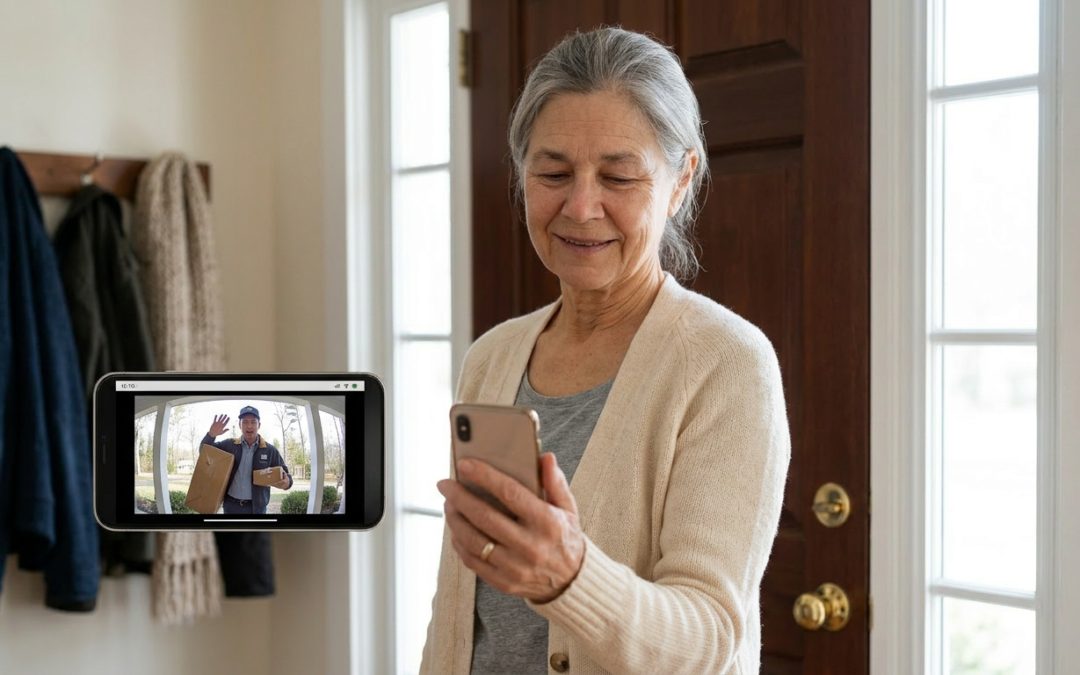
My daughter set up a doorbell camera not long after. The first time it quietly showed me who was there before I crossed the house, I felt something I did not expect. It was not “wow, technology.” It was relief. One small worry, gone, and it had asked nothing of me in return.

That was the crack in the wall. Then the lights. I had been crossing one dark stretch of hallway by memory and squinting for years, the same stretch I noticed when I walked my own house with fresh eyes. A motion light that came on when I entered and off when I left removed a small daily negotiation I had stopped noticing I was having. Then a small medical alert that stays in my pocket, that I genuinely forget is there, and that, so far, I have not needed.

None of these made me a tech person. That is the part I most want you to hear.

The reframe

Here is what actually shifted, and it was not my skill level. It was the category itself.

I had been thinking about all of this as gadgets. Things to master. Hobbies for people younger and more patient than me. Once I stopped thinking that way, I could see what it actually was. Not gadgets. A small number of quiet tools that each remove one worry and then ask nothing of me again.

That is the whole point, and it is the opposite of what I feared. The point is not to be plugged in. The point is to have fewer things that can go wrong. A doorbell camera is not me getting modern. It is one fewer moment of opening my door blind. The light is not me being fancy. It is one fewer dark step. Each one is a small piece of infrastructure, the same as a grab bar or a folder of documents or the short list of people who would come. It does the same quiet job, which is keeping me in my own home with less to be afraid of.

What this is not

I need to be clear, because the old picture is sticky, and it is the thing that keeps people out.

This is not a connected house that talks to you. It is not a speaker listening in every room. It is not a hobby, a subscription you will resent, or a system you have to understand. It is not being good with technology, and you do not have to become someone you are not.

It is picking a few specific tools that solve a few specific worries, setting each one up once, ideally with a patient person beside you, and then letting it disappear into the background where it belongs. The good ones, you forget you have. That is how you know they were the right ones.

Where to start

Do not try to do a smart home. There is no such project, and starting there is exactly how skeptics stay skeptics.

Pick one worry. The one that actually nags at you. Opening the door without knowing who is there. The dark hallway. Being alone in the house if you fell. Then find the single simplest tool that removes that one worry, and set up only that. One tool, one worry, once. Notice how it feels to have something taken off your mind that asks for nothing back. Then maybe a second one. Maybe not. There is no quota.

A quick, honest note. Some of the product types I mention across this pillar will eventually be affiliate links, which means if you buy through one I may earn a small amount at no extra cost to you. I will tell you every time, I only point to things I would put in my own house, and I will tell you just as plainly when something is not worth it. Several of the most useful tools are inexpensive and a one-time purchase.

If you want to see where technology sits next to the other parts of staying independent, the Independence Assessment scores you across all five pillars in three minutes and tells you which one needs you first.

Take the 3-Minute Assessment

I still do not care about being good with technology. I care about having fewer things that can go wrong. It turned out those were never the same goal, and once I saw that, the eye-rolling stopped.

I’m glad you’re here.

Anne

The Room-by-Room Home Safety Audit for Adults 55+ (Free Checklist Inside)

The Room-by-Room Home Safety Audit for Adults 55+ (Free Checklist Inside)

I’ve written before about the afternoon I finally walked through my own house and saw it the way a stranger would. That piece was the story. This one is the tool. It is the checklist I wish someone had handed me that day, organized the way you actually move through a house, so you are not trying to hold it all in your head.

You do not need a contractor for this. You do not need to spend a dollar to do the walk-through itself. You need an hour, a notepad, and a willingness to look at rooms you stopped seeing years ago.

Here is how to use it. Go room by room, in order. In each room, do not fix anything yet. Just look, and write down what you find. Fixing comes later, and most of it is smaller than you expect. Seeing is the part almost everyone skips, and it is the part that matters most.

A quick note before we start. A few of the fixes mention products, and some of those will become affiliate links over time, which means I may earn a small commission at no extra cost to you. I only point to the kinds of things I would put in my own house, and most of what is on this list costs nothing at all.

Start outside: the approach to your door

Most audits start inside. Start outside, because the first fall many people have is on the way in, with their hands full.

Walk up to your own front door the way you do when you are carrying groceries. Then check:

  • Are the steps even, solid, and free of moss or cracks
  • Is there a handrail, and does it hold firm when you pull on it hard
  • Can you see the steps clearly after dark, or do you do them from memory
  • Is the path level, or are there roots, pavers, or a hose you step around
  • Can you set bags down somewhere while you find your keys

The fixes here are usually a handrail, a brighter or motion-sensor light by the door, and a small shelf or bench near the entrance so you are never balancing bags and keys at the same time.

Stairs and hallways

Stairs are where the worst falls happen, and hallways are where you move fastest without looking.

  • Is there a handrail on both sides of every staircase, inside and out
  • Does every handrail hold firm when you shake it
  • Is anything stored on the stairs, ever, even temporarily
  • Is each step a consistent height, with no worn or slick spots
  • Are the stair edges easy to see, or do they blend together in low light
  • Are hallways clear, and lit well enough that a guest would not squint

Free fixes: clear the stairs completely and keep them clear, and tighten loose rails. The fix that costs a little: a second handrail where there is only one, and better lighting where steps blend together.

The bathroom

If you only audit one room, audit this one. Water, hard surfaces, and the motions of getting in and out of a tub make the bathroom the highest-risk room in most homes.

  • Is there something solid to hold getting into and out of the tub or shower, and is it an actual grab bar, not a towel bar
  • Is there a non-slip surface inside the tub or shower
  • Could you sit to shower if you ever needed to
  • Is the floor slick when wet, especially right where you step out
  • Can you get on and off the toilet without pulling on the sink or the towel bar
  • Is there a night light so the path here works at three in the morning

The fixes that matter most here are properly installed grab bars anchored into studs, a non-slip mat inside the tub, and a non-slip bath mat outside it. A shower seat and a raised toilet seat are not signs of giving up. They are the difference between staying in your home and having to leave it.

The bedroom and the night path

Almost everyone makes the same trip in the dark, half asleep, from the bed to the bathroom. Almost no one has ever audited it.

  • Walk that exact path. Is it clear, or do you step around furniture or a rug
  • Is there light you can trigger without crossing the dark to reach a switch
  • Is a phone reachable from the bed if you could not get up
  • Is the bed a height you can get into and out of without effort
  • Are cords, chargers, and shoes off the floor along that route

This is the highest-value, lowest-cost fix in the whole house. A plug-in motion-sensor light or two along the night path, a clear floor, and a reachable phone. Almost free, and it protects the trip you are least equipped to make safely.

The kitchen

You spend a lot of time here, often with hot or heavy things in your hands.

  • Are the things you use most within reach without a stool or a deep bend
  • If you must reach high, do you have a stable step stool with a handle, not a chair
  • Is there a slick spot on the floor near the sink or the stove
  • Are walkways clear of the bins, mats, and bags that collect underfoot
  • Is the lighting good over the counter where you use a knife

Free fix: move daily-use items to the shelves between knee and shoulder height, so the heavy pots are not on the floor and the everyday plates are not over your head. The small purchase: a real step stool with a handrail. Standing on a kitchen chair is one of the most common ways people my age end up in an emergency room.

Living areas

The room you relax in is also the room you have stopped seeing most completely.

  • Are walkways clear from the doorway to your chair to the rest of the house
  • Are rugs secured or removed, with no curled edges
  • Are cords run along walls, never across a path
  • Is the chair you use easy to rise from, or do you push off the arms and rock
  • Can you reach a lamp without crossing a dark room to a switch

Most of this is free. Reroute cords, secure or remove rugs, clear the paths. The one thing worth money is a chair you can actually get out of, if your main chair has quietly become a daily struggle.

Whole-house essentials

A few things do not belong to a single room. Check them once.

  • Do the smoke and carbon monoxide detectors work, and were they tested in the last six months
  • Could emergency responders get in if you could not reach the door
  • Is there a way to call for help reachable from the floor, not only from standing
  • Is there a flashlight you could find in the dark during a power outage
  • Does anyone outside the house know it well enough to help in an emergency

These are mostly free and mostly forgotten. The detectors especially. Set a recurring reminder to test them, because the day you need them is not the day to find out the battery died two years ago.

What to do with what you found

You now have a list. Do not try to do all of it this weekend. Sort it into three piles.

The free fixes you can do today: clearing stairs, rerouting cords, securing rugs, moving kitchen items, testing detectors. Do these now. There is no reason to wait on any of them.

The small purchases: night lights, a step stool, non-slip mats, a second handrail. Order them this week.

The bigger jobs: grab bars installed into studs, lighting added, a chair that works for you. These take a little planning, but they are still far smaller and far cheaper done now, on a calm Tuesday, than done in a panic after a fall.

If you want the short version of where falls actually happen, I wrote a piece on the seven most common hazards that show up in nearly every house. Start there if this felt like a lot.

I made a one-page printable version of this entire audit, the actual checklist, so you can carry it room to room with a pen instead of working from memory. It is free. I send it to my newsletter, and you can get it by signing up at the bottom of any page on this site.

And if you want to see where home safety sits next to the other parts of staying independent, the Independence Assessment scores you across all five pillars in three minutes and tells you which one to start with.

Take the 3-Minute Assessment

Print the list. Walk your house. You already know some of what you will find. The whole point is to write it down somewhere you can actually act on it.

I’m glad you’re here.

Anne

How to Ask for Help Without Feeling Like You’re Losing Your Independence

How to Ask for Help Without Feeling Like You’re Losing Your Independence

You know the moment I mean.

The phone is in your hand. You know exactly who to call and exactly what you need. It is not even a big thing. A ride. A hand with something heavy. Someone to sit with you at an appointment you do not want to go to alone.

And you put the phone down. You tell yourself you will manage. You tell yourself it is not worth bothering anyone. What you are actually telling yourself, underneath, is that if you make that call, something about you changes. That is the part I want to talk about, because I have put that phone down more times than I can count, and I was wrong almost every time.

Why asking feels like losing

We have to be honest about why this is hard, or nothing I say after it will land.

Most of us were handed a definition of independence that means needing no one. We built an identity on it. Being the capable one. The one who manages. The one other people lean on, never the other way around. So every time you ask for something, it does not feel like a small logistical request. It feels like a withdrawal from an account labeled still myself, and you are afraid of what happens when the balance runs low.

I am not going to tell you that fear is silly. It is not silly. It is just aimed at the wrong thing.

What not asking actually costs

Here is what I learned the hard way.

The people who lose their independence fastest are very often the ones who would not ask until it was already a crisis. Not asking is not independence. It is delay. And delay is expensive, because it turns small asks into big ones. The grocery run you would not request becomes the empty fridge. The little hand up the step you were too proud to want becomes the fall. The ride to the early appointment becomes the thing you put off until it was an emergency room instead of an office visit.

Refusing to ask did not keep me independent. More than once, it did the exact opposite. It just let the bill come due later, larger, and with far less choice left in it.

The part nobody says about being asked

Now the part that actually changed me.

Think about a time you wanted to help someone you loved, and they would not let you. They insisted they were fine. They kept you at arm’s length while they struggled right where you could see it. Remember how that felt. It was not relief that they were not bothering you. It felt like being shut out. It felt like being told you were not close enough to be needed.

That is what we do to the people who love us when we will not ask. We think we are sparing them a burden. We are actually denying them the thing that makes a relationship real, which is being trusted enough to be needed.

Being asked is not a weight you drop on people. For the people who actually love you, it is the opposite. It is the door opening.

A village runs on exchange

There is a practical version of this too.

A village does not run on one person always giving and never taking. That is not generosity. It is a slow starvation of the relationship. The ledger that only ever runs one direction, you the helper, never the helped, builds its own quiet distance. People feel close to you when you let them in, and asking is one of the main ways you let them in.

If you have built any of the village I wrote about, and you never let it carry anything for you, you have not protected it. You have left it unused. And unused things, as we keep finding in every part of this, quietly stop working.

Make the first ask small

So here is the practical heart of it.

You do not fix this by deciding to be brave the next time something big happens. The big moment is the worst possible time to ask for the first time in years, the same way the emergency is the worst time to start building the village, or the worst time to first try standing on one foot. The muscle has to already be there.

Asking is a muscle. You keep it by using it. You lose it by not. So you practice it small, on purpose, when nothing is wrong and the stakes are nearly zero. “Would you grab milk while you are out.” “Can you hold this for a second.” “I am not sure about this one, what do you think.” Tiny asks, made on ordinary days, for things you could technically manage yourself. Not because you need the help. Because you are keeping the muscle alive for the day you will.

The small asks are not the point. They are the practice that makes the real one possible.

Where to start

This week, ask for one small thing you would normally have powered through alone. Notice that the sky does not fall. Notice, if you can, the small thing that happens on the other end of it, which is almost never annoyance. It is usually something much closer to glad.

That is the whole exercise. One small ask. The rest of this pillar goes deeper on building the people worth asking, but the asking itself starts with one low-stakes sentence and a phone you do not put back down.

And if you want to see where community sits next to the other parts of staying independent, the Independence Assessment scores you across all five pillars in three minutes and tells you which one needs you first.

Take the 3-Minute Assessment

You are not losing your independence when you ask for help. You are doing the thing that lets you keep it. I had that exactly backwards for most of my life. I would rather you not lose the years I lost figuring it out.

I’m glad you’re here.

Anne