by lynncarnes@gmail.com | Oct 13, 2026 | Community, Stories
We have gotten independence wrong.
We treat it like a solo sport. The person who needs no one. Who does it all herself. Who would rather struggle than ask. We hand each other that picture like it is something to be proud of, and then we are surprised when it leaves people stranded in their own homes with nobody to call.
I believed that picture for most of my life. I want to tell you what it cost me to find out it was backwards.
The frame we were handed
For a long time, the proudest thing I could say about myself was that I did not need help. I had a husband, children, neighbors I waved at, a couple of old friends I saw a few times a year. I would have told you I had a full life and a strong one. I would have told you I was independent.
What I had was a contact list. That is not the same thing as a village, and I did not learn the difference until I needed the village, reached for it, and found it was not really there.
The night I learned the difference
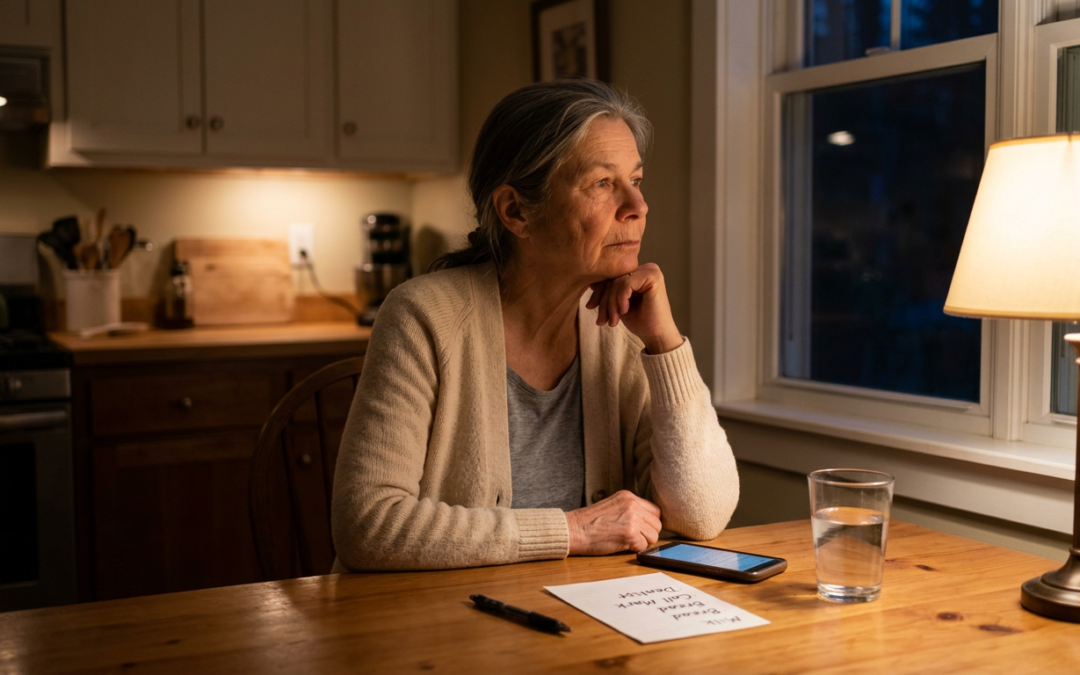
When something hard happened in my family, the kind of thing that does not keep office hours, I sat down one night and tried to make a list of the people I could actually call. Not people I knew. People I could call at nine o’clock on a Tuesday, and they would come, or at least pick up and stay on the line.
The list was short. Embarrassingly short, for a woman who knew a lot of people.
It was not short because I was unlikable or because nobody cared. It was short because I had let almost every one of those relationships go quiet. I had been busy. I had assumed they would be there because they always had been. I had treated my friendships like a fixed asset instead of a thing that needs tending, and they had quietly depreciated while I was not looking, the same way muscle does, the same way a house does.
What independence actually is
Here is the reframe that changed everything for me.
The most independent people I know are not the most alone. They are the most connected. It is not a coincidence and it is not a contradiction. It is the entire point.
Independence is not the absence of needing people. That version is a fantasy, and a fragile one, because it is one bad night away from collapse no matter how organized your paperwork is or how strong your legs are. The strongest, most prepared person I know is still one fall, one diagnosis, one loss away from losing her independence completely if there is no one to call when it happens.
Real independence is having built the relationships that let you stay in your own life when something goes wrong. The village is not the opposite of independence. The village is the thing that makes independence survivable. It is infrastructure, the same as the folder of documents, the same as the grab bar in the shower. You do not see it until the day it is the only thing holding you up.
Why this changes everything
Once you see it that way, connection stops being the soft, social, optional item, the thing you will get to when you have time. It becomes part of the plan. It moves onto the same list as the will and the handrail, because it does the same job. It keeps you in your home and your life when the thing you did not plan for arrives.
That is why I put Community next to Preparedness and Strength, and not off in some lighter lifestyle category. It is not lighter than those. On the worst days it is the heaviest one.
What this is not
I want to be clear, because the old frame is stubborn.
This is not about being a social butterfly. It is not about a big network, or a full calendar, or being the kind of person who is good at parties. I am not that person, and I am not asking you to become her.
It is about a small number of real relationships that you actually keep up. Five people who would come is worth more than two hundred you wave at. Reciprocity matters more than reach. The goal is not to be popular. The goal is that the list of people you could call at nine on a Tuesday is not as short as mine was.
Where to start
The first step is the reframe itself. You have to stop seeing connection as the optional social thing and start seeing it as part of staying independent. Nothing useful happens until that flips.
Then do the small, slightly uncomfortable thing. Make the list. Honestly. Who would actually come. Do not flinch from how short it is, if it is short. Mine was short, and I am still here, and I have spent the years since making it less short on purpose.
Then pick one person you have let go quiet, someone who would not find it strange to hear from you, and reach out this week. Not for anything. Just to start tending the thing again. That is the whole first move. One message. You are not building the entire village this week. You are remembering that it has to be built on purpose, and beginning.
I am putting together a simple worksheet for thinking through your own village, who is in it, who could be, where the gaps are. When it is ready I will send it to my newsletter. If you are not on the list, you can sign up at the bottom of any page on this site.
And if you want to see where community sits next to the other parts of staying independent, the Independence Assessment scores you across all five pillars in three minutes and tells you which one needs you first.
Take the 3-Minute Assessment
You do not have to build a village this week. You just have to stop believing you are supposed to do this alone. That part you can change right now.
I’m glad you’re here.
Anne
by lynncarnes@gmail.com | May 29, 2026 | Community
One of the things that surprised me when I started researching aging in place was how much help is available locally, and how hard it is to find.
It’s not that the resources don’t exist. They do, in most parts of the country. What’s missing is a clear map to them.
This is that map, or at least the starting point for drawing one.
Start with the Area Agency on Aging
Every region of the United States has an Area Agency on Aging. These are local organizations funded through the federal Older Americans Act, and they coordinate services for older adults in their communities. What they offer varies because local needs and local funding vary, but they are as close to a one-stop resource as anything I’ve found.
The simplest way to find yours is the Eldercare Locator, a free federal service at eldercare.acl.gov or by phone at 1-800-677-1116. Enter your zip code, and it connects you to your local Area Agency on Aging.
Through your Area Agency on Aging, you may be able to find or access: transportation assistance, in-home help, meal programs, caregiver support, legal assistance, health insurance counseling, and more. Not every program is available in every area, but starting here tells you what is.
Meals on Wheels
If getting regular nutritious meals at home has become harder, Meals on Wheels is worth knowing about. The program is more widespread than most people realize, and it’s not just food. The volunteers who deliver meals often serve as a daily wellness check for people living alone. That human contact, brief as it is, is part of the value.
You can find the program nearest to you at mealsonwheelsamerica.org.
Transportation
Transportation is one of the practical barriers that most directly affects independence, particularly for people who have stopped driving or who drive only occasionally.
Most urban and suburban areas have paratransit programs: door-to-door transportation for people with disabilities or mobility limitations. These are usually subsidized and significantly less expensive than taxis or rideshare services. Some are specifically for medical appointments. Others are general-purpose.
Some Area Agencies on Aging run their own transportation programs or have contracts with local services. Faith communities often organize ride networks for members. Some senior centers have shuttle services.
Your local Area Agency on Aging is the right starting point for understanding what transportation options exist in your specific area.
Senior centers
Senior centers have changed considerably in recent years. Many are no longer primarily social clubs. They offer fitness programs, health screenings, educational workshops, legal clinics, and technology assistance. Some run programs that would be expensive to access privately.
If you dismissed your local senior center years ago and haven’t revisited that impression, it may be worth a second look. Call and ask what they currently offer. The range is often surprising.
Public libraries
Libraries are a resource that aging-in-place planning rarely mentions, but they offer more than most people use.
Many library systems now offer digital literacy programs specifically designed for older adults: help with smartphones, tablets, video calling, and navigating the internet. These are free, often led by trained staff or volunteers, and specifically designed for people who are newer to technology.
Libraries also offer meeting spaces, notary services, and access to research databases. If you’re trying to understand your legal options, research local services, or learn about a health topic, a library reference librarian can often help you find a starting point.
Faith community networks
Faith communities, churches, synagogues, mosques, and other congregations, often have informal or formal programs to support members who are aging in place. Volunteer networks, friendly visitor programs, meal support, and transportation help are common.
Even if you’re not an active member of a particular congregation, many extend these services more broadly to neighbors and community members. If you have a relationship with a local faith community, it’s worth asking what they offer.
Home repair and modification programs
Some programs help older adults with home safety modifications at low or no cost. These are often run through Area Agencies on Aging, local nonprofits, or housing authorities.
They may fund grab bar installation, ramp construction, lighting improvements, or other safety modifications for eligible households. Availability and eligibility criteria vary significantly by location and current funding.
Your Area Agency on Aging can tell you what programs exist in your area and how to apply.
Building your personal resource list
The most useful version of this information isn’t a list you read once. It’s a short document you put together for your specific situation.
The name and phone number for your local Area Agency on Aging. The Eldercare Locator number (1-800-677-1116). The senior center nearest you. The transportation option that serves your area. The faith community or neighborhood group with a support network.
Build that list now, when you don’t need most of it. Because when you do need it, having it already assembled makes everything simpler.
Take the 3-Minute Assessment
The resources exist. The work is finding them once so they’re there when you need them.
Anne
by lynncarnes@gmail.com | May 29, 2026 | Community
In 2002, a small group of neighbors in Beacon Hill, Boston, had a problem and a theory.
The problem: they wanted to age in their homes, but the existing options for support, assisted living, senior services, formal care, didn’t fit what they wanted. Too institutional. Too much loss of control. Too expensive.
The theory: if neighbors helped each other, if they organized the kind of informal support that used to happen naturally in communities but had eroded in modern suburban life, they could create something that worked.
They called it a Village. And it worked well enough that hundreds of others built the same thing.
What a Village actually is
A Village is a neighborhood-based membership organization where older adults who want to age in place exchange help with each other and with community volunteers.
The basic structure is simple. Members pay a modest annual fee. In exchange, they can call the Village for a range of services: a ride to a medical appointment, help with a technology problem, a referral to a vetted local contractor, someone to walk through the house after a storm, friendly check-in calls.
Villages vary enormously in what they offer. Some have professional staff. Many are all-volunteer. Some are formal nonprofits. Some are informal neighborhood networks. What they share is the organizing principle: aging in place is a community project, not just an individual one.
Why this model works
The Village model addresses something the traditional aging services model largely ignores: the gap between independent and needing professional care.
Most people don’t need a nurse or a physical therapist every day. They need a ride. They need someone to change a lightbulb they can’t safely reach. They need a recommendation for a plumber they can trust. They need someone to notice if they haven’t been seen in a few days.
These are the things neighbors and community members can do for each other. But in the fragmented social landscape most of us live in, those connections don’t form naturally anymore. A Village creates the structure that makes them happen.
For members, the benefit is practical: access to help that’s reliable, vetted, and affordable. But the research on Villages also shows something more significant: members report lower rates of social isolation and higher sense of wellbeing than comparable older adults outside the model. The connection itself is part of the value.
Who Villages are for
Villages tend to attract people in their sixties and seventies who are healthy and independent now and want to stay that way. They join before they need a lot of help, because the time to build community infrastructure is before you need it.
If you’re looking for intensive care management or professional health services, a Village is not that. It’s community. The services are supplemental and social, not medical.
But for people who want to remain in their own homes, who want to know their neighbors, who want a reliable network of support that doesn’t require moving to a facility, Villages are exactly what the model was designed for.
How to find out if there’s one near you
The Village to Village Network is the national organization that supports the model and maintains a directory of Villages across the country. Their website has a search function by zip code.
Not every area has a Village. Some are in development. And some communities that don’t have a formal Village have informal versions, neighborhood groups, faith community networks, or other local structures that serve similar functions.
If there’s nothing near you, the Village to Village Network also provides resources for people who want to start one. It’s been done in communities ranging from dense urban neighborhoods to small towns.
If there’s no Village near you
The absence of a formal Village doesn’t mean the principle doesn’t apply.
The core idea, that aging well requires genuine community, that the connections you build now determine what support you have later, is true regardless of whether there’s an organization facilitating it.
I wrote about building your own support network separately. The practical question is the same: who are the people in your life who know you, who you could call, who would notice? Building that, intentionally, before you need it, is the Village idea applied at the individual level.
Take the 3-Minute Assessment
The neighborhood you already live in might be more of a resource than you’ve built it to be.
Anne

by lynncarnes@gmail.com | May 29, 2026 | Community
There’s a word that gets used in conversations about older adults with a kind of casual assumption that it’s describing one thing when it’s actually describing two.
That word is “alone.”
“She lives alone.” “He spends most of his time alone.” The implication is that alone is a problem, that it points toward loneliness, toward declining wellbeing, toward something that needs to be fixed.
But alone and lonely are not the same thing. And getting clear on the difference is genuinely useful.
What alone actually means
Being alone means being without other people in your physical presence.
That’s it. It’s a description of circumstance, not of subjective experience. It says nothing about how someone feels, whether they’re content, whether they have meaningful relationships, or whether their life is rich or empty.
Many people thrive while spending significant time alone. Introverts recharge alone. Creative people often do their best thinking alone. Contemplative people, readers, thinkers, those with rich inner lives, often need solitude the way others need company.
Being alone is not inherently a problem. For a lot of people, it’s part of a life that’s working.
What lonely actually means
Loneliness is a subjective experience. It’s the feeling of disconnection. Of not having enough meaningful contact. Of not being known. Of wanting connection and not having it.
What makes it complicated is that loneliness is not caused by time spent alone. It’s caused by unmet need for connection. And those two things can vary independently.
You can be surrounded by people and feel profoundly lonely. Loneliness in crowded families, in busy workplaces, in social scenes where everyone knows your name but nobody knows what you’re actually going through, is a real and common experience.
And you can spend much of your time alone, in genuine solitude, and feel no loneliness at all. You have the relationships you need. They’re not always present, but they’re there. When you need them, they show up.
Why the distinction matters
For your own self-understanding, knowing which one you’re experiencing changes what’s useful.
If you spend time alone and find it genuinely restorative, and your relationships are solid when you need them, you don’t have a community problem. The framing that you should be more social because you live alone misses what’s actually true about your life.
But if time alone has shifted from restorative to isolating, if you notice the lack of connection, if you’re not sure who you’d call in a hard week, that’s a different thing. That’s not a preference for solitude. That’s loneliness, and it has real health implications worth taking seriously.
The question to ask yourself
Not “how much time do I spend alone?” but “do I have the connection I need?”
Can you name two or three people who know what’s actually happening in your life right now?
Do you have someone you could call, not in an emergency, but just on a hard Tuesday?
When something good happens, is there someone you want to share it with, and do you feel comfortable reaching out?
When something difficult happens, do you feel like you’re handling it alone, or do you feel supported even from a distance?
These questions get closer to the actual measure than physical presence or absence does.
What to do if the answer is uncomfortable
If the honest answer to some of those questions reveals a gap, that’s information worth having. Not an emergency. Not a failure. Information.
The health research on loneliness, and I wrote separately about how serious it is, points clearly to connection quality over quantity. One or two close relationships protect health outcomes. A thousand acquaintances don’t.
So the question becomes: where is there potential for depth that hasn’t been developed yet? Not how do I become more social, but where are the relationships I want to invest in?
That’s a different project, and it’s a more manageable one.
One more distinction worth making
There’s a version of solitude that is chosen and a version that isn’t.
Someone who moves to a new city, loses a spouse, retires from a job where they had daily colleagues, experiences the slow attrition of friends and family over time, can end up alone in a way they didn’t choose and don’t want. The experience looks like solitude from the outside but feels like loneliness from the inside.
That gap, between the life you have and the social life you’d want, is worth naming. Not to feel bad about it. To take it seriously enough to do something about it.
If you want to understand where community fits in your overall independence plan, the 3-minute assessment gives you a picture across all five areas.
Take the 3-Minute Assessment
Alone is not the problem. Lonely is. And you get to decide which one you’re in.
Anne
by lynncarnes@gmail.com | May 29, 2026 | Community
If you’re reading this, you’re probably the person in the family who finally decided someone has to say something.
You’ve noticed things. A parent who is slower on the stairs than they used to be. A house that’s gotten harder to keep up. A conversation that went sideways when you brought up the future, and now you’re not sure how to try again.
You are not alone in this. And the instinct to bring it up, to have the conversation before a crisis forces it, is a good one. The problem is usually not the intention. It’s the approach.
Why these conversations go wrong
Most aging conversations with parents go sideways not because the topic is impossible but because of how they start.
They start with a solution. “I think you should move closer.” “Have you thought about getting help around the house?” “I looked into some options.”
From a parent’s perspective, this sounds like: I’ve already decided what’s best for you.
The result is defensiveness. Resistance. “I’m fine. Don’t worry about me.” The conversation ends, the wall goes up, and the next attempt is harder than the first.
The most common mistake is leading with what you think should happen rather than asking what they think about what’s happening.
What actually works: leading with curiosity
The conversations that go well almost always start the same way. Not with a plan. With a question.
“I’ve been thinking about getting more prepared for the future. Can I ask you about some of this stuff?”
“I’ve been reading about aging at home. Can I share some of what I’ve been thinking?”
“I want to make sure I know what you’d want if something happened. Can we talk about that?”
These openers do something specific: they position the conversation as collaborative rather than advisory. You’re not coming with answers. You’re coming with questions. That’s a fundamentally different dynamic.
Three openers that work
The planning together opener: “I’ve been thinking about this for myself and for you both. Can we talk through what we each want?”
This is useful when you want to normalize the conversation by making yourself part of it. You’re not singling them out.
The “I want to know” opener: “I’ve realized I don’t actually know what you’d want if something happened. And I want to know. Can we talk about it?”
This frames the conversation as a gift to you, not an intervention on them. It’s honest and often surprisingly effective.
The soft check-in: “How are things feeling lately? Is there anything about the house or day-to-day stuff that’s been on your mind?”
This gives them the door without walking through it yourself. Sometimes the conversation you needed happens because you asked and then listened.
What not to say
A few things that reliably close the conversation:
“I’m worried about you.” (Signals surveillance, not care. They’ll reassure you everything is fine and shut down.)
“We’ve been talking about this and we think…” (Presenting a united family front feels like an ambush.)
“At your age…” or “when people get older…” (No one wants to be categorized.)
“You really should…” (Any form of “should” is a wall-builder.)
The goal of the first conversation is not to solve anything. It’s to open a door. A successful first conversation is one where they feel heard and where they’re willing to talk again. That’s it.
If it doesn’t go well the first time
It might not. Some parents aren’t ready. Some have been independent for sixty years and hear any conversation about the future as a threat to that independence.
If the first conversation ends in resistance or hurt feelings, don’t push. Let some time pass. Come back with a different angle or a smaller ask.
“I don’t need to talk about everything. I just want to know where the important documents are, in case something happens.”
“I’m not asking you to change anything. I just want to understand what you’re thinking.”
Smaller asks feel safer. They’re also often the way in.
It’s also worth considering that your parent may have thoughts and wishes they’ve been wanting to share but nobody ever asked. The conversation you’re dreading might be one they’ve been hoping someone would start.
The goal
I want to name what you’re actually trying to accomplish here, because it’s worth keeping in mind when the conversation gets hard.
You are not trying to take control. You are not trying to get agreement on a plan. You are trying to make sure that if something happens, you know what they’d want, and they know you’re someone who can handle the conversation.
That’s the goal. A door. Not a decision.
And from the other side, speaking as someone who is in the parent role now, I want you to know something. Most of us know this conversation needs to happen. We just need it to feel like connection rather than assessment.
If this article helped, share it with someone who’s been putting off the conversation. Sometimes it’s easier to start with “I read this and thought of you” than with the first word on your own.
Take the 3-Minute Assessment
The door you open today might be the most important one.
Anne
by lynncarnes@gmail.com | May 29, 2026 | Community
I remember standing in the garage, both cars broken down, my husband in the hospital, and realizing I didn’t know who to call.
Not because I had no one. I knew people. I had relationships. But the kind of connection I needed in that moment, someone who could just show up and help me figure it out, that wasn’t something I’d built with anyone nearby.
I’ve always been independent. I’ve always handled things myself. What I hadn’t understood was that independence and connection are not opposites. You can’t actually have one without the other.
That’s what this article is about.
Why we don’t talk about loneliness
Loneliness carries a kind of stigma. It feels like something you’re supposed to keep private, as though admitting it means something is wrong with you, that you’ve failed at something fundamental.
So people don’t bring it up. They manage. They keep busy. They tell themselves it’s fine.
Meanwhile, the research has been building for years, and what it shows is serious enough that in 2023, the U.S. Surgeon General declared loneliness a public health concern. Not a personal struggle. A public health concern.
What loneliness actually does to your body
The CDC notes that social isolation and loneliness in older adults are associated with a 50% increased risk of dementia, a 29% increased risk of heart disease, and a 32% increased risk of stroke.
Those are not small numbers. And they’re not about extreme reclusion. They’re about ordinary, everyday disconnection. Not having enough meaningful contact. Not having people to talk to. Not having the kind of closeness where you’d feel comfortable asking for help.
The mechanism is still being studied, but the leading explanation involves the stress response. When we feel socially isolated, our bodies stay in a low-grade alert state. Chronically elevated stress hormones affect sleep, inflammation, cardiovascular health, and cognitive function over time.
Connection, it turns out, is not a nice-to-have. It’s a health behavior, the same category as exercise and nutrition.
Who this is affecting more than you might think
It’s easy to assume loneliness is about people who are visibly isolated, people who never leave the house or have no family. But the research doesn’t support that picture.
Many people who report significant loneliness are surrounded by people. They have spouses, children, neighbors, colleagues. What they lack is depth. Closeness. The sense that someone really knows them and has their back.
Retirement removes work relationships that many people didn’t realize were load-bearing until they were gone. Adult children move away or get busy. Longtime friends move, get sick, or die. The social infrastructure that existed in midlife quietly dissolves, and nobody announces when it happens.
By the time people are in their 70s and 80s, many of them have a much thinner support network than they had twenty years earlier. And most of them built it on autopilot, through proximity and circumstance, without ever consciously tending to it.
The warning signs
A few things I watch for, in myself and in the people I know:
Having trouble naming three people you could call if something went wrong. Not in an emergency, just in a rough week.
Realizing that most of your conversations in a given day are transactional, the cashier, the pharmacist, the doctor’s office.
Feeling like nobody really knows what’s happening in your life right now.
Dreading the weekend more than the weekday, because the structure disappears.
None of these mean something is catastrophically wrong. They mean it’s time to be honest with yourself about the state of your connections, and start building.
What actually helps
The research on what works is clear about one thing: quality matters more than quantity.
One or two genuinely close relationships protect health outcomes far better than a large but shallow social network. So the goal isn’t to become someone who goes to every neighborhood event. The goal is depth. The goal is the kind of connection where you feel known.
A few things that help:
Routine contact works better than special occasions. A regular Tuesday call with someone you care about does more than a big holiday gathering. Frequency builds closeness, not scale.
Shared activity helps. Having something to do together, a class, a walk, a project, creates the context for closeness to develop without forcing it.
It helps to go first. Most people are waiting for someone else to reach out. If you reach out, you’ll often find they were waiting too.
You don’t have to rebuild everything at once. One relationship deepened, one new connection started, over the next year, matters more than a complete social overhaul.
Making a first move
If you took anything from this article, I hope it’s permission to take the community piece of your independence plan seriously. Not as a “soft” nice-to-have alongside the legal documents and the home modifications, but as a real health factor with real consequences.
I built a worksheet called “Build Your Own Village” for exactly this reason. It’s a simple exercise for mapping who you have, identifying the gaps, and deciding who you want to reach out to. No grand gestures required.
And if you want to see where community fits within your overall plan, including where you stand on all five pillars, the 3-minute assessment is a good place to start.
Take the 3-Minute Assessment
You don’t need a hundred people. You need a few good ones.
Anne
