by lynncarnes@gmail.com | May 29, 2026 | Strength
Here is something I wish someone had told me earlier: most of the fitness research you’ve been handed your whole life was done on young men.
Not all of it. But enough of it that the advice shaped by that research, the recommended calorie counts, the ideal workout formats, the guidance on recovery time and protein needs, was calibrated for a body that is not yours and has never been yours.
This is not a complaint. It’s a useful piece of information. Because once you know it, you can stop trying to make advice designed for someone else work for you, and start looking for what actually applies.
What changes after 60, specifically for women
Menopause changes the hormonal environment in ways that affect muscle, fat distribution, bone density, and recovery. Estrogen plays a role in maintaining muscle and bone. When it drops, the body changes how it responds to exercise and how it uses protein.
This is not a reason to exercise less. It’s a reason to exercise differently.
Researcher Dr. Stacy Sims has spent years studying how women’s physiology differs from men’s and how those differences should change exercise recommendations. Her conclusion is consistent: women, particularly postmenopausal women, do better with different protocols than the standard guidelines suggest.
The broad takeaways that come up repeatedly in this area of research:
Higher-intensity resistance training matters more, not less. The standard advice for older adults often emphasizes gentle movement and low weights. For bone density and muscle maintenance, heavier resistance (relative to your capacity) is more effective than high reps with light weight. This runs counter to a lot of popular guidance.
Recovery takes longer. This isn’t a weakness. It’s physiology. Building more recovery time into a training schedule improves results rather than slowing them down.
Protein timing matters. Muscle protein synthesis is more sensitive to timing after 60. Getting a meaningful protein source within a couple of hours of resistance exercise helps the body actually use the workout.
As always, talk to your doctor before making significant changes to your exercise routine, especially if you have any conditions affecting your joints, heart, or bones.
The “gentle” problem
I want to address the word “gentle” directly, because it comes up a lot in fitness content for older women, and I think it sometimes does harm.
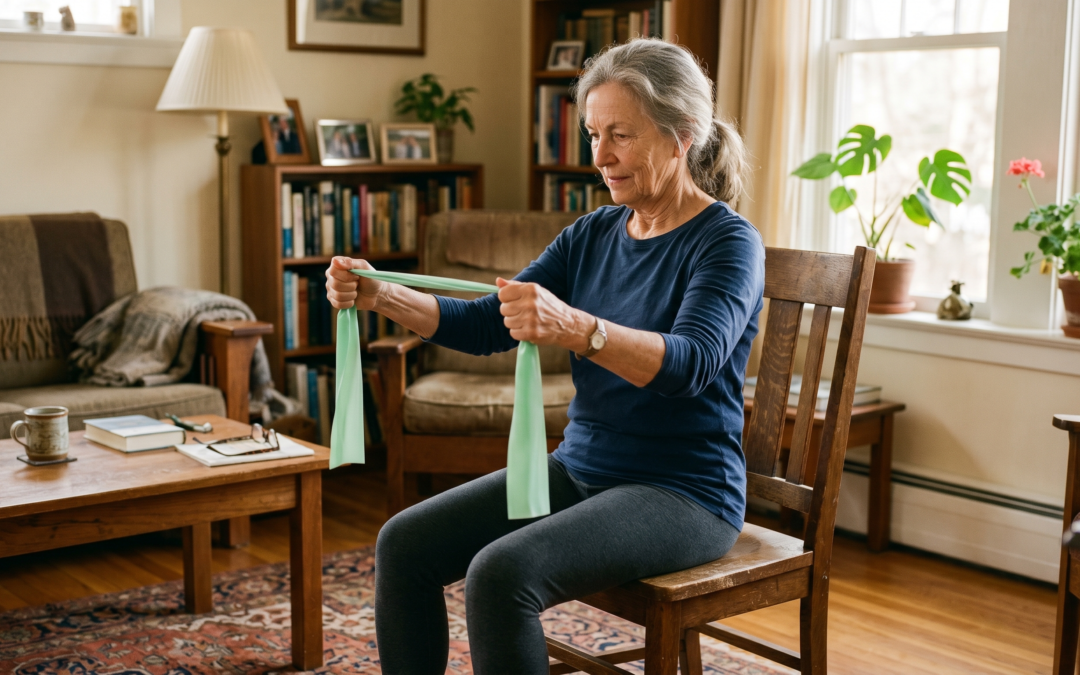
Gentle has its place. A gentle walk is better than no walk. Gentle stretching maintains flexibility. The balance exercises I do every morning count as gentle, and they matter.
But gentle should not be the ceiling. If “gentle” is the only register you exercise in, you are probably not doing what your bones and muscles need. Bone density responds to load. Muscle responds to challenge. There is a version of exercise appropriate for your current condition and your history that is also demanding enough to create the adaptation your body needs.
Finding that version, with a good trainer or a physical therapist who specializes in older adults, is worth the investment.
What this means practically
I’m not suggesting you join a powerlifting gym. I am suggesting that if you’ve been doing gentle chair exercises for three years and wondering why you don’t feel stronger, the gentleness might be part of the reason.
A few things that move the needle:
Standing exercises over seated ones, where possible. Your body has to manage balance when you’re standing. That’s part of the work.
Resistance that feels challenging by the last few repetitions. If you can do twenty repetitions of something without noticing, the weight is too light for strength building.
Consistency over intensity. Three days a week of meaningful movement beats one grueling session followed by five days off.
Exercises that mimic what you actually need: getting up from a chair, going up stairs, carrying things, reaching overhead. Functional movement for a functional life.
The bigger point
Your body after 60 is not a lesser version of your body at 35. It is a different body with different needs, different strengths, and a different relationship with exercise.
The research is catching up to this. The advice is getting better. But you have to seek out the version of it that was designed for someone like you, not the version that was designed for a study population that didn’t include you.
If you want to understand where your overall independence stands, including strength and balance, the 3-minute assessment gives you a picture across all five pillars.
Take the 3-Minute Assessment
You’ve got more capacity than most of the advice assumes.
Anne
by lynncarnes@gmail.com | May 29, 2026 | At-Home
Of all the things I’ve changed in my home over the past few years, nothing was cheaper or made a bigger immediate difference than lighting.
That surprised me. I’d been focused on bigger projects — the grab bars, the conversation about the stairs, the first aid kit. Lighting felt too simple to matter much.
Then I started paying attention to when I felt uncertain in my own home. The answer was almost always the same: dim corners, dark hallways at night, the bathroom at three in the morning.
I’ve since come to think of lighting as the single most underrated safety investment you can make. Here’s why.
What changes about vision after 60
The eyes change with age. This isn’t a dramatic decline. It’s a gradual shift that most people adapt to without fully realizing it.
The pupil gets smaller and responds more slowly to changes in light. The lens yellows slightly, filtering out shorter wavelengths. Contrast sensitivity decreases. Recovery time from bright light, like headlights on a dark road, gets longer.
What this means practically: you need more light than you used to, you adjust between light and dark more slowly, and low-contrast environments (a gray step edge against a gray floor) become genuinely harder to read.
Most homes are not built with any of this in mind.
Where lighting matters most
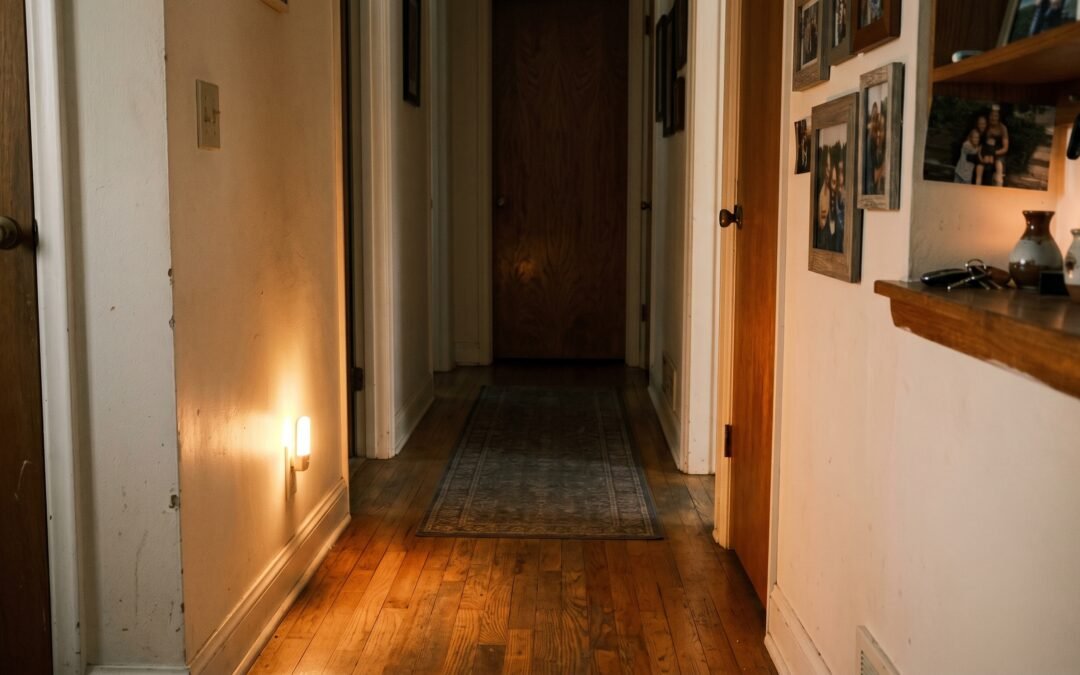
The path between the bed and the bathroom. This is the highest-risk journey in your home. Middle of the night, groggy, dark hallway. Night lights along this path, low enough that they illuminate the floor rather than shining in your eyes, are one of the highest-impact changes you can make. Motion-activated versions mean you never have to remember to turn them on.
Stairways. Both the top and the bottom of every staircase should have a light switch. If you can only reach a staircase light from one end, that’s a problem worth fixing. Light the whole staircase, not just the landing.
The bathroom. A bright bathroom matters. If your bathroom overhead light is a single dim bulb, add a brighter one or supplement with vanity lighting. You make decisions in the bathroom, about medications, about balance, about what you’re doing, and you make them better with good light.
Entry points. The front door, the garage door, the back door. Coming in from the dark to the inside of your home, or the reverse, is a transition that benefits from good lighting on both sides.
The kitchen. Under-cabinet lighting is cheap and effective. The counter is where you prepare food, handle medications, read labels. Shadow from overhead lighting is a common problem in kitchens, and task lighting solves it directly.
The easy wins
Motion-sensor night lights are inexpensive, require no wiring, and plug directly into an outlet. A few of these along the bedroom-to-bathroom path cost less than twenty dollars and last for years.
Smart bulbs let you set schedules so certain lights come on automatically at dusk or at a set time at night. Once configured, you don’t have to remember anything.
For stairways, a simple dimmer switch upgrade can make a meaningful difference. Full bright on the way up; softer when coming down at night.
For the bathroom, a bright daylight-spectrum LED is often a direct swap for what’s there. The color temperature matters: bulbs labeled “daylight” (around 5000K) give better contrast than “warm white” (2700K) for detail tasks.
What this costs
Most of these changes are in the range of ten to fifty dollars per area. The full path from bedroom to bathroom could be covered with three or four night lights. The kitchen under-cabinet lighting is a weekend project.
This is the part I want to emphasize, because people sometimes delay safety projects while they figure out which big renovation to do first. Lighting is not a big renovation. It’s a Tuesday afternoon.
The bigger picture
Lighting is one piece of the home safety picture. If you want to walk through your entire home with a checklist, the room-by-room home safety audit covers every area and tells you exactly what to look for and what to fix first.
And if you want to understand where home safety fits within your overall plan, the Independence Assessment gives you a picture of all five pillars in three minutes.
Take the 3-Minute Assessment
Good light isn’t a luxury. It’s what lets you move through your own home with confidence.
Anne
by lynncarnes@gmail.com | May 29, 2026 | Preparedness
Every paramedic, every ER nurse, every doctor I’ve ever talked to says the same thing: the medication list is the document they wish every patient had.
Not the advance directive. Not the insurance card. The medication list.
Here’s why. When someone arrives in an emergency room unable to speak for themselves, the team needs to know what’s in their system. What medications. What doses. What they’re allergic to. Getting that information wrong, or not having it at all, can turn a manageable situation into a dangerous one very quickly.
Most people don’t have this list. Most people who are on six or eight medications have them stored in their head, or scattered across three pharmacy apps, or in a cabinet no one else knows to open.
This is one of the easiest things to fix. And it takes about twenty minutes.
What goes on the list
A good medication list has five things for each medication:
The name. Both the brand name and the generic name if you know it. ER teams use generic names. Pharmacists can help you fill this in.
The dose. The number on the bottle. Not what you actually take (though you can note that separately). What’s prescribed.
What it’s for. One line. “Blood pressure.” “Thyroid.” “Anxiety.” The medical team doesn’t need your full history. They need context.
The prescribing doctor. Name and phone number. This becomes important when teams need to verify something quickly.
How long you’ve been on it. Approximately is fine. “Two years” or “since 2019.” This helps the team understand your baseline.
Beyond medications, include:
- Allergies, including what happens when you have a reaction (rash, breathing difficulty, nausea)
- Over-the-counter supplements and vitamins you take regularly (these interact with medications more than people realize)
- Your primary care doctor’s name and number
- Your pharmacy name and number
- Your emergency contact
Where to keep it
The list is only useful if someone can find it.
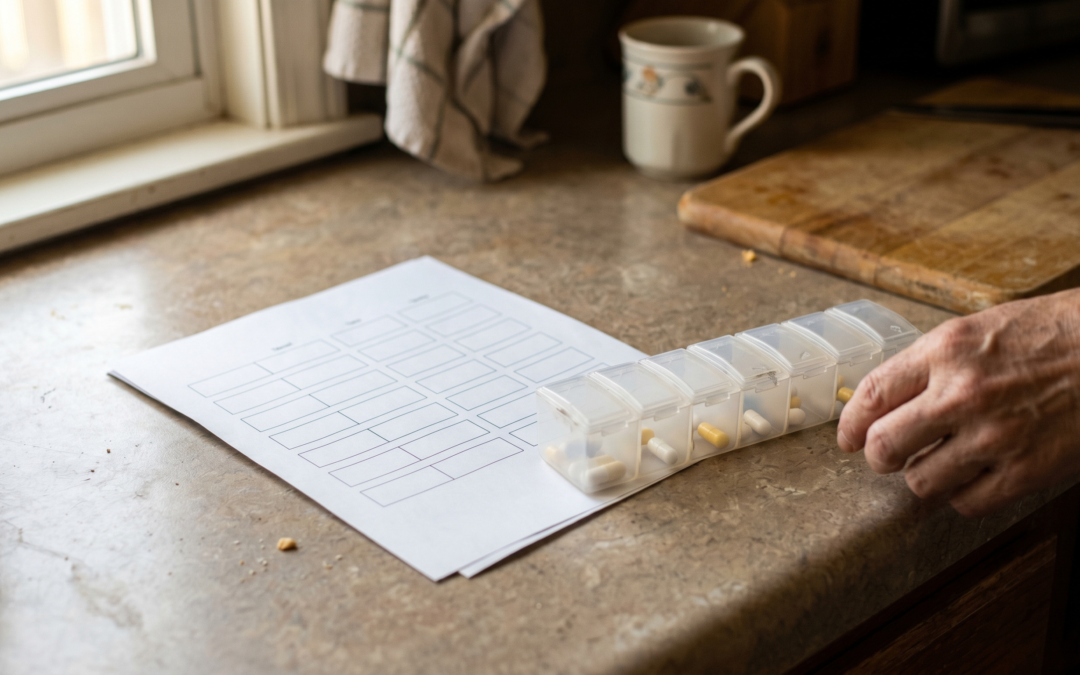
Three copies. One on your person or in your wallet (a folded piece of paper works fine). One on the refrigerator. One with whoever would be called in an emergency.
The refrigerator sounds like an odd choice, but emergency responders are trained to look there. It’s a known location. If you use a standard medical information holder (they’re inexpensive, often called a “Vial of Life”), it goes on the refrigerator door.
A digital copy in your phone’s health app (iPhone Health or Android equivalents) is also useful. Emergency responders can sometimes access this from the lock screen.
The pharmacy shortcut
If you’re on multiple medications and the thought of writing everything down is overwhelming, your pharmacist is your best friend here.
Call your pharmacy and ask for a printout of all your current prescriptions on file. They can generate this in minutes. It won’t have everything, but it gives you a starting point you can fill in from there. Ask them to include generics if your list shows only brand names.
Your doctor’s office can also provide a current medication list from your chart. Many practices now have patient portals where you can download this directly.
The part people forget
I want to say something about supplements, because this is the piece that gets left off the most.
Fish oil, melatonin, turmeric, vitamin D, CoQ10, magnesium — these interact with prescription medications. Blood thinners and fish oil. Antidepressants and St. John’s Wort. Thyroid medication and calcium supplements (they should be taken hours apart).
A clinician cannot catch interactions they don’t know about. If you take supplements, they go on the list. All of them.
Keep it current
The list is only as good as the last time you updated it. A few simple habits:
When a new medication is prescribed, add it before you leave the doctor’s office.
When you stop a medication, cross it off.
Review the whole list once a year, ideally at your annual physical. Ask your doctor to verify it’s complete and current. This review has a side benefit: it often surfaces duplications or outdated medications that nobody caught.
This is one of the five
The medication list is one of the five documents I think every adult over 55 should have in place. The others cover legal preparedness, emergency contacts, financial access, and what to do if something happens to you.
If you want to know where you stand on all five, the Independence Assessment takes three minutes and gives you a clear picture of what you have and what’s missing.
Take the 3-Minute Assessment
Your medication list won’t prevent anything bad from happening. But it gives the people caring for you exactly what they need to help you.
Anne
by lynncarnes@gmail.com | May 29, 2026 | Technology
I’m a lifelong tech person. I spent my career in IT. I am not intimidated by new tools.
And I still went nearly two years without using telehealth for anything, even after it became widely available.
Not because I couldn’t figure it out. Because I hadn’t thought carefully about when it made sense. I had a doctor I liked. I knew how to get to her office. Why change that?
Then I started actually paying attention to what telehealth can and can’t do. And I realized I’d been leaving a genuinely useful tool on the table.
What telehealth actually is
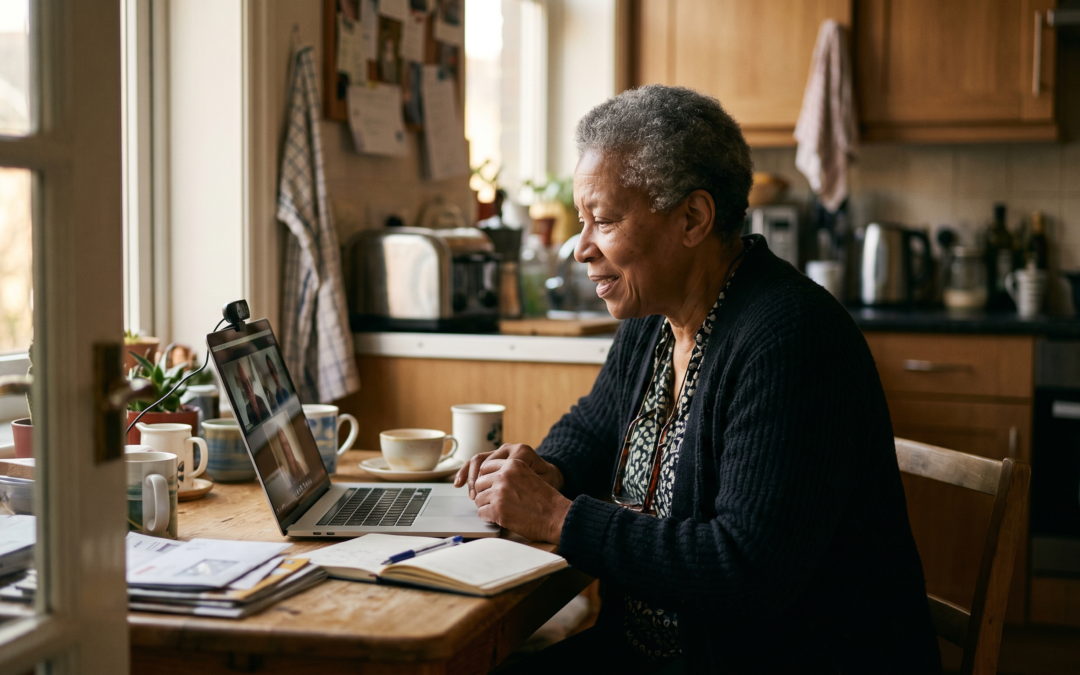
Telehealth means seeing your doctor, nurse practitioner, or other healthcare provider via video or phone instead of going to their office. That’s it.
You’re not seeing a random doctor somewhere. In most cases, you’re connecting with your own provider or someone in their practice. The visit is documented in your medical record the same way an in-person visit is.
Since the pandemic, the range of what can be handled remotely has expanded significantly. And Medicare now covers most telehealth services, which removed one of the main barriers for people over 65. As always, coverage details change, so check with your specific plan.
What can actually be handled remotely
This is where a lot of people are surprised, because the list is longer than most assume.
Follow-up visits after an in-person appointment can almost always be done by video. Reviewing lab results, checking in on how a medication is going, discussing a test result, these don’t require you to sit in a waiting room for forty-five minutes.
Mental health appointments are handled remotely with particular effectiveness. Many therapists and psychiatrists now do the majority of their sessions by video.
Prescription refills and medication management conversations often don’t require an in-person visit.
Checking in on a new symptom that isn’t urgent, not a chest pain or breathing emergency, but something you want to have looked at, is frequently manageable remotely. Your provider can assess it, decide if you need to come in, and save you the trip if you don’t.
Annual check-ins with specialists, when the specialist is reviewing records and talking through a chronic condition rather than performing an exam, can often be done by video.
What requires in-person care: anything that needs a physical examination, lab work, imaging, procedures of any kind. Telehealth is a supplement, not a replacement.
Why more people over 60 aren’t using it
I’ve asked this question in a lot of conversations. The answers tend to fall into a few categories.
“I don’t know how it works.” This is the most common one, and the most fixable. Your doctor’s office can walk you through it. Most systems take about five minutes to set up.
“I’m not sure my insurance covers it.” Coverage expanded significantly with the pandemic and has stayed broad for most plans. Calling your insurance company to ask specifically about telehealth coverage takes one phone call.
“I prefer seeing my doctor in person.” This is a completely valid preference for your primary care visits. You don’t have to replace in-person care. You can use telehealth for the visits that don’t actually need you to be there, and keep your in-person appointments for the ones that do.
“I’m not comfortable with video calls.” If you can do a FaceTime with family, you can do a telehealth visit. If you can’t, most providers also offer phone-only options. The technology is flexible.
How to set up your first visit
Start by calling your primary care office and asking whether they offer telehealth appointments and how to set up an account. Most practices use one of a handful of platforms (Zoom for Healthcare, Epic MyChart, Teladoc, and others) and their staff can walk you through it.
Before your first visit:
Find a quiet, well-lit place to sit. Your kitchen table works fine.
Test the technology fifteen minutes before the appointment. The platform usually has a test feature. If something isn’t working, call the office. They’re used to this.
Have your medication list nearby, the same one you’d bring to an in-person visit.
Write down the two or three things you want to address, because telehealth visits run to time the same way in-person ones do.
That’s it. The first one is the hardest, and “hard” means “slightly unfamiliar.” After that it’s just a different kind of appointment.
The real value over time
The way I think about telehealth now is as a way to stay in closer contact with my healthcare without the friction of getting there.
When getting to a doctor’s office requires planning, arranging a ride, taking time out of a day, people delay things they shouldn’t delay. A question that could be answered in a fifteen-minute video call becomes a thing they just live with. A medication that needs adjusting goes unadjusted.
Telehealth removes some of that friction. And for people who have difficulty with transportation, who live in rural areas, or who manage multiple chronic conditions and have frequent follow-up needs, it removes a significant amount.
The tool is there. It works. It’s covered by most insurance including Medicare. The main thing standing between most people and using it is just familiarity.
If you want to understand where technology fits into your overall independence plan, including what tools are genuinely worth exploring and what’s just noise, the 3-minute assessment gives you a clear picture across all five pillars.
Take the 3-Minute Assessment
I was late to this one. You don’t have to be.
Anne
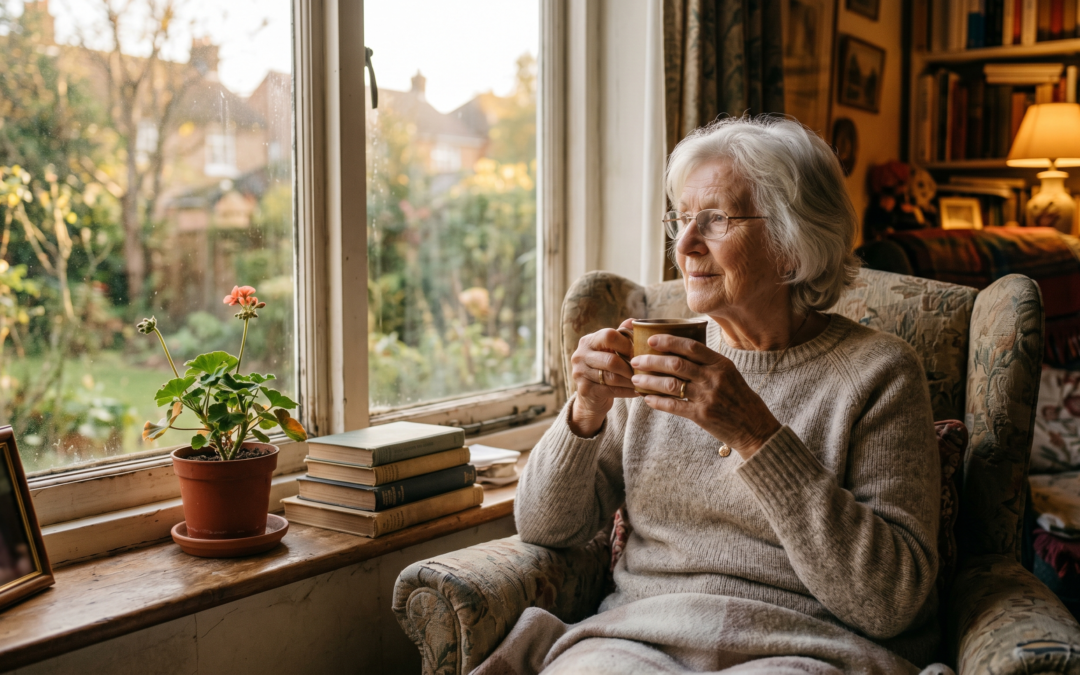
by lynncarnes@gmail.com | May 29, 2026 | Community
I remember standing in the garage, both cars broken down, my husband in the hospital, and realizing I didn’t know who to call.
Not because I had no one. I knew people. I had relationships. But the kind of connection I needed in that moment, someone who could just show up and help me figure it out, that wasn’t something I’d built with anyone nearby.
I’ve always been independent. I’ve always handled things myself. What I hadn’t understood was that independence and connection are not opposites. You can’t actually have one without the other.
That’s what this article is about.
Why we don’t talk about loneliness
Loneliness carries a kind of stigma. It feels like something you’re supposed to keep private, as though admitting it means something is wrong with you, that you’ve failed at something fundamental.
So people don’t bring it up. They manage. They keep busy. They tell themselves it’s fine.
Meanwhile, the research has been building for years, and what it shows is serious enough that in 2023, the U.S. Surgeon General declared loneliness a public health concern. Not a personal struggle. A public health concern.
What loneliness actually does to your body
The CDC notes that social isolation and loneliness in older adults are associated with a 50% increased risk of dementia, a 29% increased risk of heart disease, and a 32% increased risk of stroke.
Those are not small numbers. And they’re not about extreme reclusion. They’re about ordinary, everyday disconnection. Not having enough meaningful contact. Not having people to talk to. Not having the kind of closeness where you’d feel comfortable asking for help.
The mechanism is still being studied, but the leading explanation involves the stress response. When we feel socially isolated, our bodies stay in a low-grade alert state. Chronically elevated stress hormones affect sleep, inflammation, cardiovascular health, and cognitive function over time.
Connection, it turns out, is not a nice-to-have. It’s a health behavior, the same category as exercise and nutrition.
Who this is affecting more than you might think
It’s easy to assume loneliness is about people who are visibly isolated, people who never leave the house or have no family. But the research doesn’t support that picture.
Many people who report significant loneliness are surrounded by people. They have spouses, children, neighbors, colleagues. What they lack is depth. Closeness. The sense that someone really knows them and has their back.
Retirement removes work relationships that many people didn’t realize were load-bearing until they were gone. Adult children move away or get busy. Longtime friends move, get sick, or die. The social infrastructure that existed in midlife quietly dissolves, and nobody announces when it happens.
By the time people are in their 70s and 80s, many of them have a much thinner support network than they had twenty years earlier. And most of them built it on autopilot, through proximity and circumstance, without ever consciously tending to it.
The warning signs
A few things I watch for, in myself and in the people I know:
Having trouble naming three people you could call if something went wrong. Not in an emergency, just in a rough week.
Realizing that most of your conversations in a given day are transactional, the cashier, the pharmacist, the doctor’s office.
Feeling like nobody really knows what’s happening in your life right now.
Dreading the weekend more than the weekday, because the structure disappears.
None of these mean something is catastrophically wrong. They mean it’s time to be honest with yourself about the state of your connections, and start building.
What actually helps
The research on what works is clear about one thing: quality matters more than quantity.
One or two genuinely close relationships protect health outcomes far better than a large but shallow social network. So the goal isn’t to become someone who goes to every neighborhood event. The goal is depth. The goal is the kind of connection where you feel known.
A few things that help:
Routine contact works better than special occasions. A regular Tuesday call with someone you care about does more than a big holiday gathering. Frequency builds closeness, not scale.
Shared activity helps. Having something to do together, a class, a walk, a project, creates the context for closeness to develop without forcing it.
It helps to go first. Most people are waiting for someone else to reach out. If you reach out, you’ll often find they were waiting too.
You don’t have to rebuild everything at once. One relationship deepened, one new connection started, over the next year, matters more than a complete social overhaul.
Making a first move
If you took anything from this article, I hope it’s permission to take the community piece of your independence plan seriously. Not as a “soft” nice-to-have alongside the legal documents and the home modifications, but as a real health factor with real consequences.
I built a worksheet called “Build Your Own Village” for exactly this reason. It’s a simple exercise for mapping who you have, identifying the gaps, and deciding who you want to reach out to. No grand gestures required.
And if you want to see where community fits within your overall plan, including where you stand on all five pillars, the 3-minute assessment is a good place to start.
Take the 3-Minute Assessment
You don’t need a hundred people. You need a few good ones.
Anne
