by lynncarnes@gmail.com | May 29, 2026 | Strength
When most people hear “strength training,” they picture something that has nothing to do with them.
A gym. Weights. People in their twenties doing something that looks effortful and loud. An entire cultural image attached to a phrase that makes it very easy for anyone over sixty to say “that’s not for me” and move on.
I want to spend a few minutes on what strength training actually looks like when it’s designed for where you are right now. Because the picture in your head is probably wrong in a specific direction, and that wrongness is keeping a lot of people from doing something that would genuinely help them.
The image that’s doing the damage
The cultural image of strength training was built on a research base and a media ecosystem that centered young men. Heavy barbells. High-intensity programs. Max lifts. Before-and-after photos that measure success by appearance.
None of that has much to do with what your body needs after sixty, or what getting stronger actually looks like for most people at this stage of life.
Getting stronger after sixty looks like:
Being able to get up from the floor without assistance. Carrying groceries in from the car without stopping. Walking up a flight of stairs without your legs feeling it the next day. Picking something up from a low shelf without thinking twice.
These are the actual goals. Not aesthetics. Functional capacity. The ability to move through your life independently.
What the research says about the basics
You don’t need a gym. The research on resistance training for older adults is fairly consistent on a few practical points.
Two to three sessions per week of resistance exercise is enough to maintain and improve muscle mass and strength. The sessions don’t need to be long. Thirty minutes is sufficient.
The resistance can be body weight, resistance bands, light to moderate weights, or any combination. What matters is progressive challenge over time, doing something that’s slightly harder than what was easy last time. Your muscles respond to challenge, not to a specific setting or equipment type.
The exercises that produce the most functional benefit are the ones that mimic real movements. Squats (sitting and standing from a chair). Step-ups (climbing stairs). Push variations (pressing things overhead or away from you). Pull variations (pulling toward you). Carrying things while walking.
Nothing exotic. All of it accessible.
The balance piece
Strength and balance are not the same thing, but they’re closely connected, and the training benefits overlap.
Balance exercises specifically work the neuromuscular system, the connection between your brain, your nervous system, and your muscles, that determines how quickly and accurately your body responds when your footing is uncertain.
The good news is that balance can be trained. Unlike some things that change with age, balance responds well to specific practice. Standing on one foot. Heel-to-toe walking. Weight shifts. None of these require equipment or a gym.
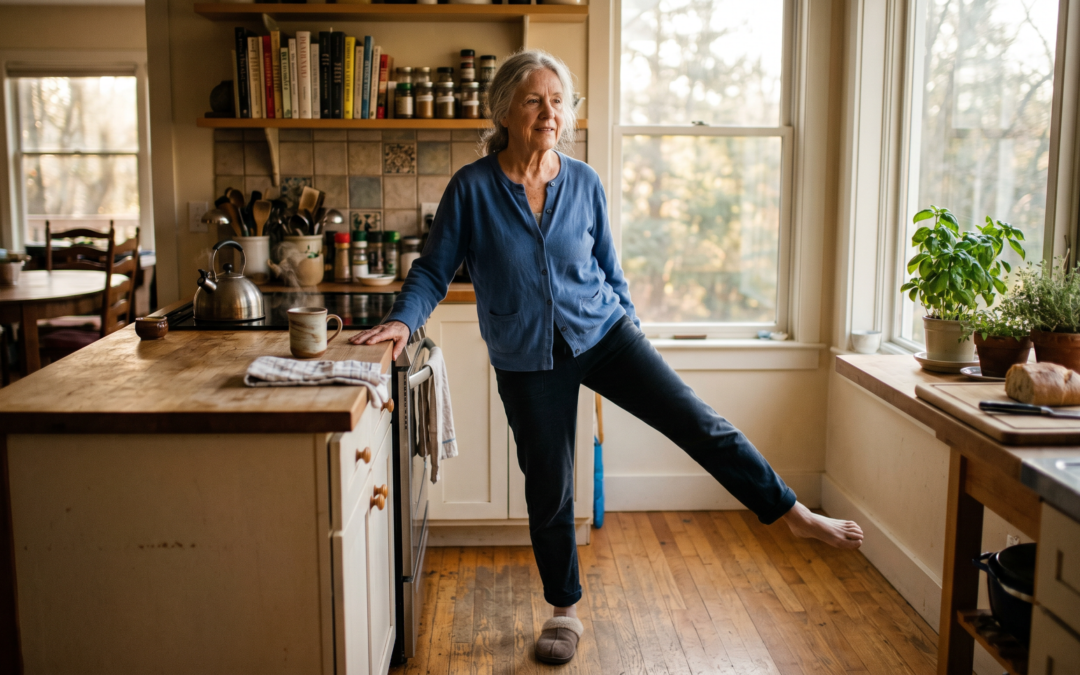
I talked about this more in the article on gentle balance moves, which covers specific exercises designed for exactly this. They’re done at the kitchen counter. Five minutes.
The part that surprises most people
Getting stronger after sixty often feels different than people expect.
It doesn’t usually involve soreness that leaves you unable to move. Done correctly, at an appropriate starting level, it feels more like effort than pain. The day after a good workout, your muscles might feel “worked” rather than damaged. That’s the adaptation process.
And the results come faster than many people expect, because starting from a relatively lower base means the early gains are noticeable. People who start resistance training in their sixties often report meaningful changes in how they feel and move within weeks.
This is not a promise of any specific result. Your experience depends on your starting point, your consistency, and what else is going on with your health. Talk to your doctor before starting a new exercise program, especially if you have any conditions affecting your joints, cardiovascular system, or bones.
But for most people who have been sedentary and start even a modest resistance program: something changes fairly quickly. And what changes is usually something they can feel in everyday life.
What to do with this
If you’ve been thinking about this and not starting, the barrier is probably not lack of desire. It’s not knowing where to begin.
The simplest starting point is body weight resistance: sit to stand from a chair, ten times. Do that three days this week. Add one set of wall push-ups. That’s a start. A real one.
If you want to understand where strength fits in your overall picture, the 3-minute assessment gives you a view across all five pillars of independent living.
Take the 3-Minute Assessment
Getting stronger after sixty is not the thing in your head. It’s simpler, more accessible, and more worth your time than the picture suggests.
Anne
by lynncarnes@gmail.com | May 29, 2026 | At-Home
When you visit, you see things your parent doesn’t see anymore.
Not because they’re unaware. Because familiarity does something to perception. The rug that’s been in that corner for thirty years doesn’t look like a hazard. It looks like part of the living room. The dim hallway at the back of the house doesn’t look dangerous. It looks like home.
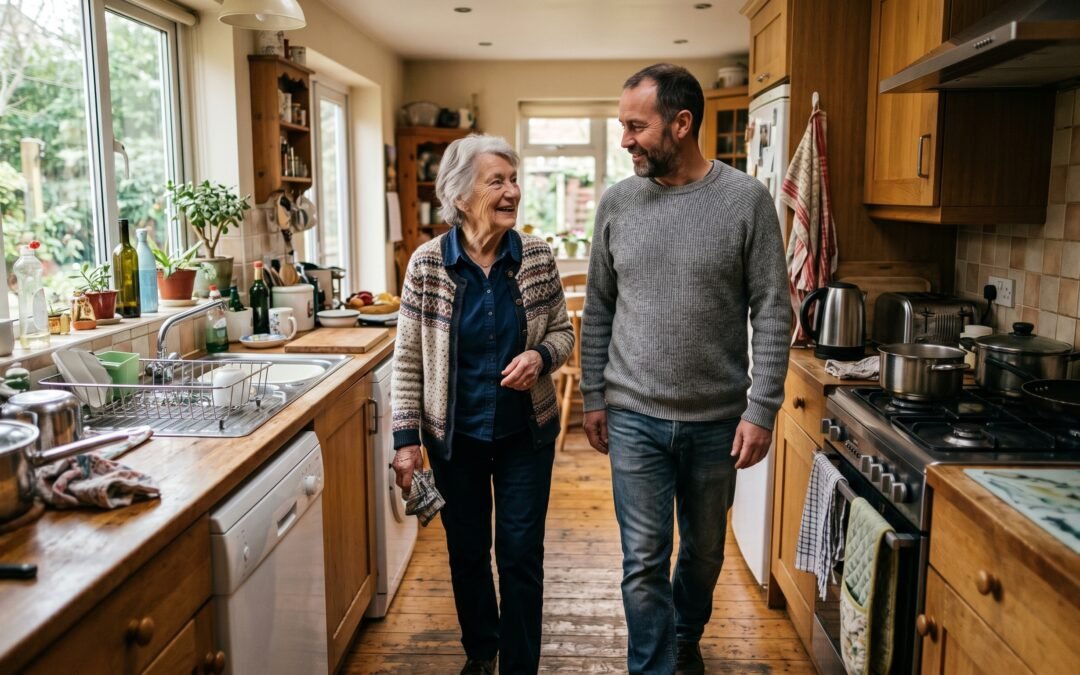
You come in with fresh eyes. And if you know what to look for, a visit becomes an opportunity to notice things that matter.
The challenge is doing this in a way that helps rather than creates conflict. This guide is for that specific task.
The frame: observation, not inspection
The difference between a visit that opens conversation and one that puts your parent on the defensive is almost entirely about framing.
You’re not there to evaluate. You’re not there to declare problems. You’re there to be present, to help where you can, and to gently notice things that you might bring up later, with care, as a question rather than a concern.
Walk through the house with your eyes open. Keep your observations to yourself during the visit unless something is genuinely urgent. Then, in a separate conversation, not in the house, not in the moment, share what you noticed as a question.
“I noticed the hallway doesn’t have much light. Is that something that bothers you?”
“The throw rug in the bathroom caught my attention. Would you ever consider something with a non-slip backing?”
What you’re doing is giving them information and a choice, not a verdict.
What to look for, room by room
Kitchen: Are the things used daily accessible without climbing or reaching to the back of high shelves? Is the stove clean and in use? Is the refrigerator stocked with food that looks fresh? Is there a fire extinguisher visible and accessible? Are items stored in a way that doesn’t require bending to floor-level cabinets repeatedly?
Living room and main areas: Are there clear walking paths, or are there tables, cords, or objects in the flow of traffic? Does the main seating have sturdy arm support for getting up? Are there rugs that slide or curl at the edges? Is the lighting adequate for reading or moving around at night?
Bathroom: This is the highest priority room. Is there anything to hold onto getting in and out of the shower or tub? Is the floor mat non-slip and does it lie flat? Is there a bathmat outside the tub or shower? Is the toilet at a comfortable height? Are medications stored where they’re easily accessible?
Bedroom: Is the path from the bed to the bathroom clear, even at night? Is there a lamp or light switch within reach of the bed? Are there cords or items on the floor? Does the bed height allow for getting up and sitting down easily?
Stairs (if present): Are both handrails solid? Is the lighting adequate at both the top and the bottom? Are there any objects stored on the stairs?
Outside the front and back: Are the steps in good repair, with no cracks or movement? Is there something to hold while going up and down? Is there adequate lighting for arriving home after dark?
What to notice beyond the physical
A home tells a story beyond the physical space.
Is the home being maintained at roughly the same level it always was? A significant change in cleanliness, organization, or upkeep can be a signal worth noting.
Is the refrigerator being used normally? Significant changes in eating habits sometimes show up in what’s in the kitchen.
Is the mail stacked up in a way that suggests it’s not being managed? Bills and correspondence that seem to be accumulating can indicate difficulty with paperwork.
You’re not investigating. You’re noticing. Most of these things turn out to have ordinary explanations. But noticing them gives you the ability to ask a gentle question.
How to bring it up
The conversation about anything you noticed is a separate moment from the visit. Not immediately after leaving. Not while still in the house.
A day or two later, in a calm moment, you might say: “I’ve been thinking about my visit. There’s something I noticed that I wanted to ask you about.”
Then ask one thing. Not a list. Not a briefing. One question, with genuine curiosity, and then listen.
The goal is a conversation, not a to-do list handed to your parent.
If there’s something that genuinely needs to change, and your parent is receptive, you can work on it together. If they’re not ready yet, planting the question is still a contribution. It may come back when the time is right.
Sharing this
If you have siblings who visit, or other family members who care for your parent’s wellbeing, share this guide. Consistent eyes across multiple visitors give a better picture than one person’s observations. And having the same language for what you’re looking for makes it easier to compare notes.
Take the 3-Minute Assessment
The next visit is an opportunity. You already care. Now you have a framework.
Anne

by lynncarnes@gmail.com | May 29, 2026 | Preparedness
I’m going to ask you one question. Just one.
If you were admitted to the hospital tonight, could the person closest to you navigate your life for a week without you?
Not with difficulty. Not by improvising their way through it. Actually navigate it. Know what bills need to be paid. Know your medications and your doctors. Know where your important documents are. Know what you’d want if a decision needed to be made.
Take a moment with that question before you read further. Most people, when they actually sit with it, find the honest answer is: probably not.
What the question reveals
There’s a version of preparedness that feels real but isn’t. Having a will that hasn’t been updated since the nineties. Knowing you should set up a healthcare proxy but not having done it. Keeping your password system in your head because it’s “easier.”
Feeling prepared and being prepared are two very different things. The question above cuts through the feeling and asks about the actual state.
If your answer is yes, fully, without reservation, you are ahead of most people. Genuinely. That’s not a small thing.
If your answer is somewhere between “mostly” and “not really,” you’re in the company of the majority of adults over 55, including me before I got serious about this.
What it would actually take for the answer to be yes
The requirements fall into roughly five areas. Not coincidentally, they map to the five pillars of The Independence Plan.
Someone can speak for you medically. You have a healthcare proxy designated, they know what you’d want, and the document is findable. If a doctor needs to make a decision while you can’t communicate, someone with authority is there.
Someone can handle your finances. The bills are accessible. The accounts are findable. A power of attorney is in place if needed. Your financial picture doesn’t require you to be conscious to function.
Your home is manageable. If you were recovering, if someone else needed to care for you at home, your house would work for that. No critical single points of failure.
Someone would know who to call. Not just a spouse or a child, but a network. The name of your doctor. The neighbor who has a key. The friend who could be there quickly. The village, documented.
The technology you depend on is understood by someone else. Your phone. Your accounts. What apps you use and why. Not for them to take over, but for them to help if needed.
Most people have some of these. Very few have all of them. The gap between “some” and “all” is where most of the risk lives.
Why most people who feel prepared aren’t
The feeling of preparedness often comes from having done the visible parts. The will. Maybe the advance directive. The sense that you’ve “thought about” the future.
The invisible parts are what trips people. The operational stuff. The daily-life infrastructure that your partner or children don’t know about because it’s never come up. The systems that work fine when you’re running them and break down the moment you aren’t.
I know this from personal experience. We had wills. We had directives. We thought we were good. And then my husband was hospitalized for two months and I found out exactly how much operational preparedness we’d skipped.
The next step
If the one question made you uncomfortable, that discomfort is useful information. It’s telling you something specific about where to start.
The Independence Assessment takes three minutes. It asks about all five areas and gives you a picture of where you’re strong and where the gaps are. It doesn’t ask you to do everything. It helps you see what to focus on first.
Take the 3-Minute Assessment
One question. Now you know.
Anne
by lynncarnes@gmail.com | May 29, 2026 | Technology
I want to talk about something that I’ve seen get two very different reactions depending on who you ask.
Some people think AI companions for older adults are a genuinely good idea, a useful tool for people who live alone, a way to reduce social isolation, a technology that has real potential to improve wellbeing.
Other people think they’re deeply concerning, a substitute for real human connection, a way for families to feel better about limited contact, a technology that could make loneliness worse by making it easier to ignore.
Both reactions contain something true. That’s what makes this worth thinking through carefully.
What an AI companion actually is
An AI companion is a conversational software program that you interact with by speaking or typing. You can tell it about your day. Ask it questions. Have it remember things you’ve told it before. Some are designed with specific older-adult use cases in mind.
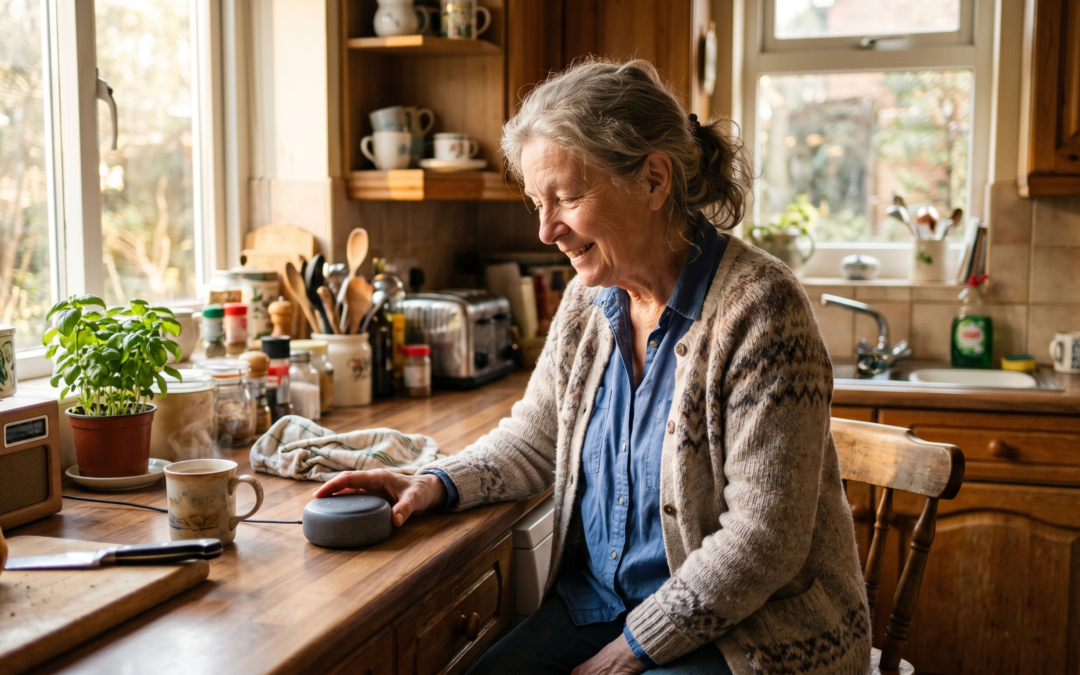
Examples that are currently available include products like ElliQ (a physical device designed for older adults) and various app-based companions. Smart home assistants like Amazon Alexa and Google Assistant have some companion features but are primarily utility tools.
These are distinct from customer service bots, which are purely transactional. AI companions are designed for ongoing, relational interaction. They remember context. They ask follow-up questions. They simulate sustained interest.
What they can do
The strongest argument for AI companions comes from the research on loneliness, and loneliness is a real health concern with documented physical consequences.
For someone who lives alone and whose daily contact with other humans is limited to transactional interactions, having something that responds to them, that asks about their interests, that’s available whenever they want to talk, can provide a form of interaction that reduces the experience of isolation.
Small studies on specific tools have shown some promise in reducing reported loneliness scores. The research is still early and limited, and the field is moving fast. But the mechanism makes sense: if the problem is a lack of conversational interaction, AI conversation provides that interaction.
For older adults who have difficulty with mobility, who live in rural areas, who are between human visits, having something to talk to has practical value.
What they cannot do
This is the part that matters.
An AI companion cannot replace human connection. It can simulate some of the conversational texture of a relationship, but it cannot actually know you in the way another person does. It cannot show up. It cannot be vulnerable back. It cannot have its own experience of caring about you.
The concern with AI companions as a solution to loneliness is that they might make the situation easier to live with without actually addressing it. If a family member installs an AI companion and feels reassured that “she has something to talk to now,” that reassurance might delay the work of building actual connection.
Used as a supplement, particularly for the hours when human contact isn’t available, they have genuine value. Used as a replacement, they have real costs.
There’s also a privacy consideration worth knowing about. These tools collect and store conversation data. Understanding what data is collected, how it’s stored, and who has access to it is worth doing before adopting any specific product.
My honest take
I am curious about this technology. I think it has legitimate potential, particularly for people with limited mobility or social access who are genuinely isolated and don’t have easy paths to more human connection.
I’m also cautious about how it’s being marketed. “Your parent will be less lonely” is a message designed for adult children who feel guilty about contact frequency. The right use of AI companionship is not to make the guilt go away. It’s to genuinely supplement a social life that’s thin in some areas.
If you’re considering this for yourself or for a parent, the questions I’d ask are:
Is this filling actual gaps in daily interaction, or is it being used in place of human contact that should be happening?
Does the person using it understand what they’re interacting with? There are real ethical concerns about older adults who aren’t fully aware that their “friend” is a software program.
What does the person themselves want? The research on wellbeing consistently shows that autonomy and choice matter. If someone finds an AI companion genuinely enjoyable and chooses to use it, that’s different from having one installed for them.
The bigger picture
Technology is a tool. Whether it helps depends almost entirely on how it’s used and what it’s used for.
AI companionship is one small piece of the technology landscape for older adults living alone. The more important questions, about building real community, about the depth of existing relationships, about what connection you actually want in your daily life, those don’t get answered by any app.
If you want to understand where you stand on community and connection as part of your overall independence plan, the 3-minute assessment covers all five pillars.
Take the 3-Minute Assessment
The technology is interesting. The human questions are more important.
Anne

by lynncarnes@gmail.com | May 29, 2026 | Community
There’s a word that gets used in conversations about older adults with a kind of casual assumption that it’s describing one thing when it’s actually describing two.
That word is “alone.”
“She lives alone.” “He spends most of his time alone.” The implication is that alone is a problem, that it points toward loneliness, toward declining wellbeing, toward something that needs to be fixed.
But alone and lonely are not the same thing. And getting clear on the difference is genuinely useful.
What alone actually means
Being alone means being without other people in your physical presence.
That’s it. It’s a description of circumstance, not of subjective experience. It says nothing about how someone feels, whether they’re content, whether they have meaningful relationships, or whether their life is rich or empty.
Many people thrive while spending significant time alone. Introverts recharge alone. Creative people often do their best thinking alone. Contemplative people, readers, thinkers, those with rich inner lives, often need solitude the way others need company.
Being alone is not inherently a problem. For a lot of people, it’s part of a life that’s working.
What lonely actually means
Loneliness is a subjective experience. It’s the feeling of disconnection. Of not having enough meaningful contact. Of not being known. Of wanting connection and not having it.
What makes it complicated is that loneliness is not caused by time spent alone. It’s caused by unmet need for connection. And those two things can vary independently.
You can be surrounded by people and feel profoundly lonely. Loneliness in crowded families, in busy workplaces, in social scenes where everyone knows your name but nobody knows what you’re actually going through, is a real and common experience.
And you can spend much of your time alone, in genuine solitude, and feel no loneliness at all. You have the relationships you need. They’re not always present, but they’re there. When you need them, they show up.
Why the distinction matters
For your own self-understanding, knowing which one you’re experiencing changes what’s useful.
If you spend time alone and find it genuinely restorative, and your relationships are solid when you need them, you don’t have a community problem. The framing that you should be more social because you live alone misses what’s actually true about your life.
But if time alone has shifted from restorative to isolating, if you notice the lack of connection, if you’re not sure who you’d call in a hard week, that’s a different thing. That’s not a preference for solitude. That’s loneliness, and it has real health implications worth taking seriously.
The question to ask yourself
Not “how much time do I spend alone?” but “do I have the connection I need?”
Can you name two or three people who know what’s actually happening in your life right now?
Do you have someone you could call, not in an emergency, but just on a hard Tuesday?
When something good happens, is there someone you want to share it with, and do you feel comfortable reaching out?
When something difficult happens, do you feel like you’re handling it alone, or do you feel supported even from a distance?
These questions get closer to the actual measure than physical presence or absence does.
What to do if the answer is uncomfortable
If the honest answer to some of those questions reveals a gap, that’s information worth having. Not an emergency. Not a failure. Information.
The health research on loneliness, and I wrote separately about how serious it is, points clearly to connection quality over quantity. One or two close relationships protect health outcomes. A thousand acquaintances don’t.
So the question becomes: where is there potential for depth that hasn’t been developed yet? Not how do I become more social, but where are the relationships I want to invest in?
That’s a different project, and it’s a more manageable one.
One more distinction worth making
There’s a version of solitude that is chosen and a version that isn’t.
Someone who moves to a new city, loses a spouse, retires from a job where they had daily colleagues, experiences the slow attrition of friends and family over time, can end up alone in a way they didn’t choose and don’t want. The experience looks like solitude from the outside but feels like loneliness from the inside.
That gap, between the life you have and the social life you’d want, is worth naming. Not to feel bad about it. To take it seriously enough to do something about it.
If you want to understand where community fits in your overall independence plan, the 3-minute assessment gives you a picture across all five areas.
Take the 3-Minute Assessment
Alone is not the problem. Lonely is. And you get to decide which one you’re in.
Anne
