
I was the person who rolled her eyes at smart homes.
Not quietly, either. I had opinions. I did not want a camera watching my front door. I did not want to talk to a speaker. I did not want one more thing in my house that needed an update, a password, and a charger I would inevitably lose. I had spent sixty-some years opening my own door and turning on my own lights, and I genuinely did not see the problem all of this was supposed to solve.
I want to tell you what changed, because it was not what the commercials said would change, and because I think a lot of you are standing exactly where I was standing.
Why I resisted
Let me be honest about the reasons, because they were real reasons, not silly ones.
The first was privacy. The idea of cameras and microphones inside my own home, sending who-knows-what to who-knows-where, did not feel like convenience. It felt like inviting a stranger to stand quietly in the corner of every room.
The second was the identity thing. “I am not good with technology,” I would say, almost proudly, the way you announce a fixed fact about yourself. Being the woman who could not work the device felt worse than not having the device at all.
The third was simpler. It all seemed frivolous. A solution looking for a problem. I did not need my lights to come on by themselves. I had a hand, a switch, and a lifetime of practice.
What actually changed my mind
It was not a sales pitch. It was a small, specific, slightly embarrassing moment.
Someone knocked one afternoon when I was at the back of the house, where getting to the front door quickly is a production. I did not know who it was. I went and opened it anyway, because that is what you do, and it was nothing, a delivery. But I stood there afterward with a small cold thought I had not let myself have before. I had just opened my door to whoever was on the other side of it, without knowing, because the alternative felt like more trouble than it was worth.
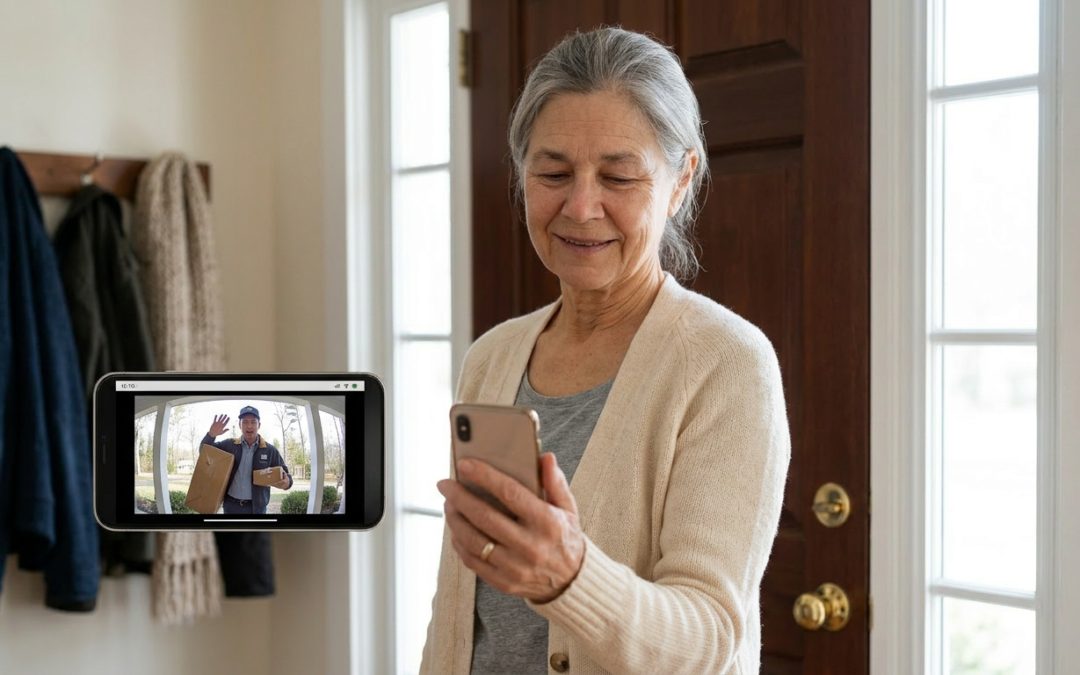
My daughter set up a doorbell camera not long after. The first time it quietly showed me who was there before I crossed the house, I felt something I did not expect. It was not “wow, technology.” It was relief. One small worry, gone, and it had asked nothing of me in return.
That was the crack in the wall. Then the lights. I had been crossing one dark stretch of hallway by memory and squinting for years, the same stretch I noticed when I walked my own house with fresh eyes. A motion light that came on when I entered and off when I left removed a small daily negotiation I had stopped noticing I was having. Then a small medical alert that stays in my pocket, that I genuinely forget is there, and that, so far, I have not needed.
None of these made me a tech person. That is the part I most want you to hear.
The reframe
Here is what actually shifted, and it was not my skill level. It was the category itself.
I had been thinking about all of this as gadgets. Things to master. Hobbies for people younger and more patient than me. Once I stopped thinking that way, I could see what it actually was. Not gadgets. A small number of quiet tools that each remove one worry and then ask nothing of me again.
That is the whole point, and it is the opposite of what I feared. The point is not to be plugged in. The point is to have fewer things that can go wrong. A doorbell camera is not me getting modern. It is one fewer moment of opening my door blind. The light is not me being fancy. It is one fewer dark step. Each one is a small piece of infrastructure, the same as a grab bar or a folder of documents or the short list of people who would come. It does the same quiet job, which is keeping me in my own home with less to be afraid of.
What this is not
I need to be clear, because the old picture is sticky, and it is the thing that keeps people out.
This is not a connected house that talks to you. It is not a speaker listening in every room. It is not a hobby, a subscription you will resent, or a system you have to understand. It is not being good with technology, and you do not have to become someone you are not.
It is picking a few specific tools that solve a few specific worries, setting each one up once, ideally with a patient person beside you, and then letting it disappear into the background where it belongs. The good ones, you forget you have. That is how you know they were the right ones.
Where to start
Do not try to do a smart home. There is no such project, and starting there is exactly how skeptics stay skeptics.
Pick one worry. The one that actually nags at you. Opening the door without knowing who is there. The dark hallway. Being alone in the house if you fell. Then find the single simplest tool that removes that one worry, and set up only that. One tool, one worry, once. Notice how it feels to have something taken off your mind that asks for nothing back. Then maybe a second one. Maybe not. There is no quota.
A quick, honest note. Some of the product types I mention across this pillar will eventually be affiliate links, which means if you buy through one I may earn a small amount at no extra cost to you. I will tell you every time, I only point to things I would put in my own house, and I will tell you just as plainly when something is not worth it. Several of the most useful tools are inexpensive and a one-time purchase.
If you want to see where technology sits next to the other parts of staying independent, the Independence Assessment scores you across all five pillars in three minutes and tells you which one needs you first.
I still do not care about being good with technology. I care about having fewer things that can go wrong. It turned out those were never the same goal, and once I saw that, the eye-rolling stopped.
I’m glad you’re here.
Anne