
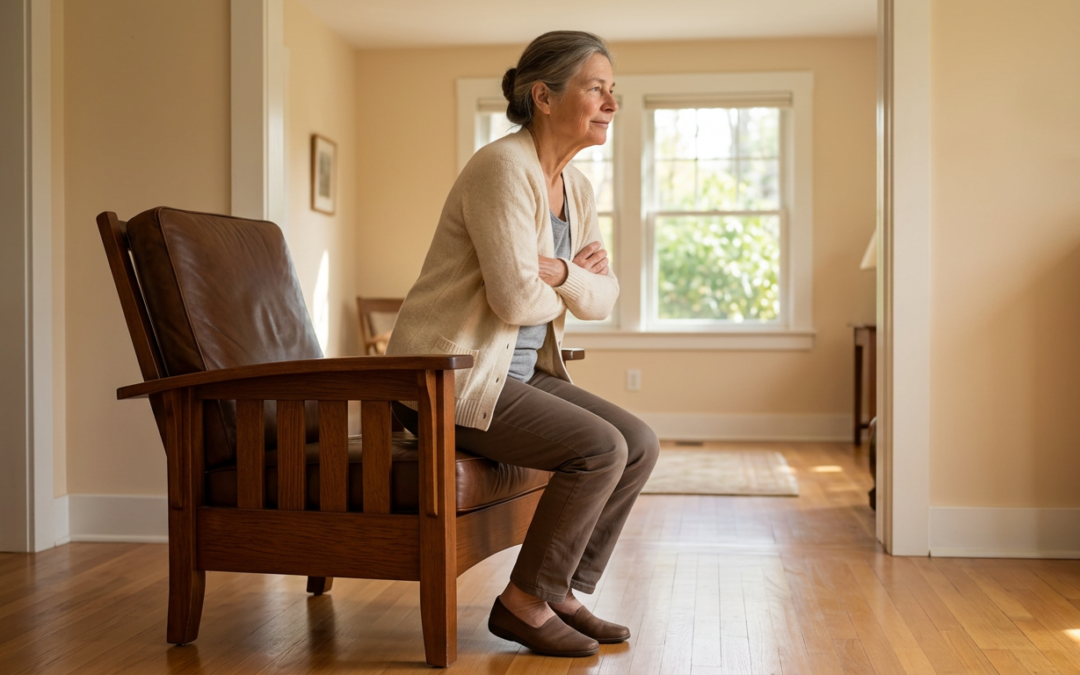
Here is a question I want you to actually answer, not just read past.
Can you stand up from a regular chair, and sit back down, without using your hands?
Not in a hurry. Not for anyone watching. Just once, if you are somewhere safe to try it. Most people assume they can. A good number find out it is not as easy as they expected, and almost nobody has ever checked on purpose.
I check this on myself a few times a year. It takes ten seconds. It has told me more about where my body is actually heading than any number on a scale ever has. I wrote a while back about why strength is really your independence insurance and not a vanity project. This is how you read the gauge.
Before you try this, read this part
This matters more than the test, so I am putting it first.
Do this only if you are reasonably steady on your feet today. Set a sturdy chair against a wall so it cannot slide. Have something solid within arm’s reach to grab, a counter or a heavy table, in case you need it. If you live with balance trouble, joint pain, a heart condition, dizziness, or anything that makes standing and rising a question mark, do not do this on your own. Ask your doctor first, and ask whether they want to watch you do it. There is no prize for finding out the hard way.
If at any point you feel dizzy, lightheaded, or anything sharp, stop. Sit down. The check is not worth a fall. Nothing on this site is.
With that said, here is the thing itself.
The check
Sit in the sturdy chair, feet flat on the floor, about shoulder width apart. Fold your arms across your chest so you cannot use them.
Stand all the way up. Then sit all the way back down, with control, not a drop.
That is the whole thing. While you do it, notice three things.
Could you do it at all without your hands. Some people cannot, and that itself is the answer, and it is useful, not shameful.
How did it feel. Easy and boring is good. A real effort is information. Having to rock forward to get momentum is information.
How does it compare to a year ago, if you can honestly remember. The single attempt is not the point. The direction over time is the entire point.
What it actually tells you
I want to be careful here, because this is where people want a score and a verdict, and I am not going to give you one. I am not a doctor. This is not a diagnosis. It is a gauge, not a sentence.
Here is what the check is really for. Standing up from a chair is the same movement, exactly, as standing up from the toilet. As getting off a low couch. As getting up off the floor after you reach the bottom cabinet. As rising from a chair in a waiting room with people watching. It is one of the most repeated movements in an independent life, and it is one of the first to quietly get harder.
The value of the check is not the ten seconds. It is that it drags something out of the background and makes you look at it on purpose. Most loss at this age happens precisely because it stays in the background. You make the accommodation, you tell yourself the small story, you never actually look. This makes you look.
If it was easy, good. Do it again in a few months and make sure it stays easy. If it was harder than you expected, that is not bad news. That is early news, which is the best kind, because early is when it is still cheap to do something about.
What to do with what you noticed
The honest answer is gentler than you think, and it is not in this article, because the right next step depends on you, and I am not the person who knows your body.
If anything about the check worried you, or you have conditions in the mix, that is a conversation with your doctor, not with a blog. Bring it up at your next visit. Tell them you tried it and exactly what happened. Doctors take a specific report like that more seriously than “I think I’m slowing down a little.”
If it was simply harder than you would like, it turns out the practice is the movement itself. Standing up and sitting down, with control, a few honest times, most days, near something you could grab if you needed it. Talk to your doctor about whether that is right for you, then start absurdly small. I am putting together a simple home strength starting guide, no equipment, nothing heroic, and when it is ready I will send it to my newsletter. If you are not on the list, you can sign up at the bottom of any page on this site.
And if you want to see where strength sits next to the other parts of staying independent, the Independence Assessment scores you across all five pillars in three minutes and tells you which one needs you first.
Most people will read this and never try the check, because trying it makes it real. Be the person who tries it. Ten seconds of honest information about your own body is worth more than a year of not looking.
I’m glad you’re here.
Anne