
When most people hear “strength training,” they picture something that has nothing to do with them.
A gym. Weights. People in their twenties doing something that looks effortful and loud. An entire cultural image attached to a phrase that makes it very easy for anyone over sixty to say “that’s not for me” and move on.
I want to spend a few minutes on what strength training actually looks like when it’s designed for where you are right now. Because the picture in your head is probably wrong in a specific direction, and that wrongness is keeping a lot of people from doing something that would genuinely help them.
The image that’s doing the damage
The cultural image of strength training was built on a research base and a media ecosystem that centered young men. Heavy barbells. High-intensity programs. Max lifts. Before-and-after photos that measure success by appearance.
None of that has much to do with what your body needs after sixty, or what getting stronger actually looks like for most people at this stage of life.
Getting stronger after sixty looks like:
Being able to get up from the floor without assistance. Carrying groceries in from the car without stopping. Walking up a flight of stairs without your legs feeling it the next day. Picking something up from a low shelf without thinking twice.
These are the actual goals. Not aesthetics. Functional capacity. The ability to move through your life independently.
What the research says about the basics
You don’t need a gym. The research on resistance training for older adults is fairly consistent on a few practical points.
Two to three sessions per week of resistance exercise is enough to maintain and improve muscle mass and strength. The sessions don’t need to be long. Thirty minutes is sufficient.
The resistance can be body weight, resistance bands, light to moderate weights, or any combination. What matters is progressive challenge over time, doing something that’s slightly harder than what was easy last time. Your muscles respond to challenge, not to a specific setting or equipment type.
The exercises that produce the most functional benefit are the ones that mimic real movements. Squats (sitting and standing from a chair). Step-ups (climbing stairs). Push variations (pressing things overhead or away from you). Pull variations (pulling toward you). Carrying things while walking.
Nothing exotic. All of it accessible.
The balance piece
Strength and balance are not the same thing, but they’re closely connected, and the training benefits overlap.
Balance exercises specifically work the neuromuscular system, the connection between your brain, your nervous system, and your muscles, that determines how quickly and accurately your body responds when your footing is uncertain.
The good news is that balance can be trained. Unlike some things that change with age, balance responds well to specific practice. Standing on one foot. Heel-to-toe walking. Weight shifts. None of these require equipment or a gym.
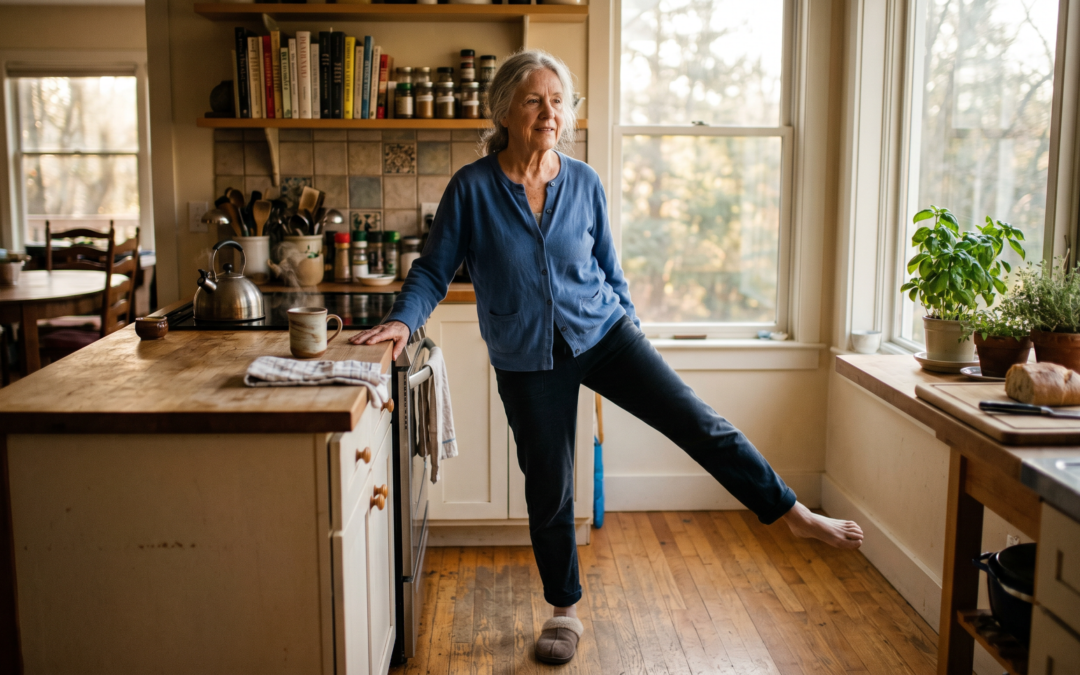
I talked about this more in the article on gentle balance moves, which covers specific exercises designed for exactly this. They’re done at the kitchen counter. Five minutes.
The part that surprises most people
Getting stronger after sixty often feels different than people expect.
It doesn’t usually involve soreness that leaves you unable to move. Done correctly, at an appropriate starting level, it feels more like effort than pain. The day after a good workout, your muscles might feel “worked” rather than damaged. That’s the adaptation process.
And the results come faster than many people expect, because starting from a relatively lower base means the early gains are noticeable. People who start resistance training in their sixties often report meaningful changes in how they feel and move within weeks.
This is not a promise of any specific result. Your experience depends on your starting point, your consistency, and what else is going on with your health. Talk to your doctor before starting a new exercise program, especially if you have any conditions affecting your joints, cardiovascular system, or bones.
But for most people who have been sedentary and start even a modest resistance program: something changes fairly quickly. And what changes is usually something they can feel in everyday life.
What to do with this
If you’ve been thinking about this and not starting, the barrier is probably not lack of desire. It’s not knowing where to begin.
The simplest starting point is body weight resistance: sit to stand from a chair, ten times. Do that three days this week. Add one set of wall push-ups. That’s a start. A real one.
If you want to understand where strength fits in your overall picture, the 3-minute assessment gives you a view across all five pillars of independent living.
Getting stronger after sixty is not the thing in your head. It’s simpler, more accessible, and more worth your time than the picture suggests.
Anne