
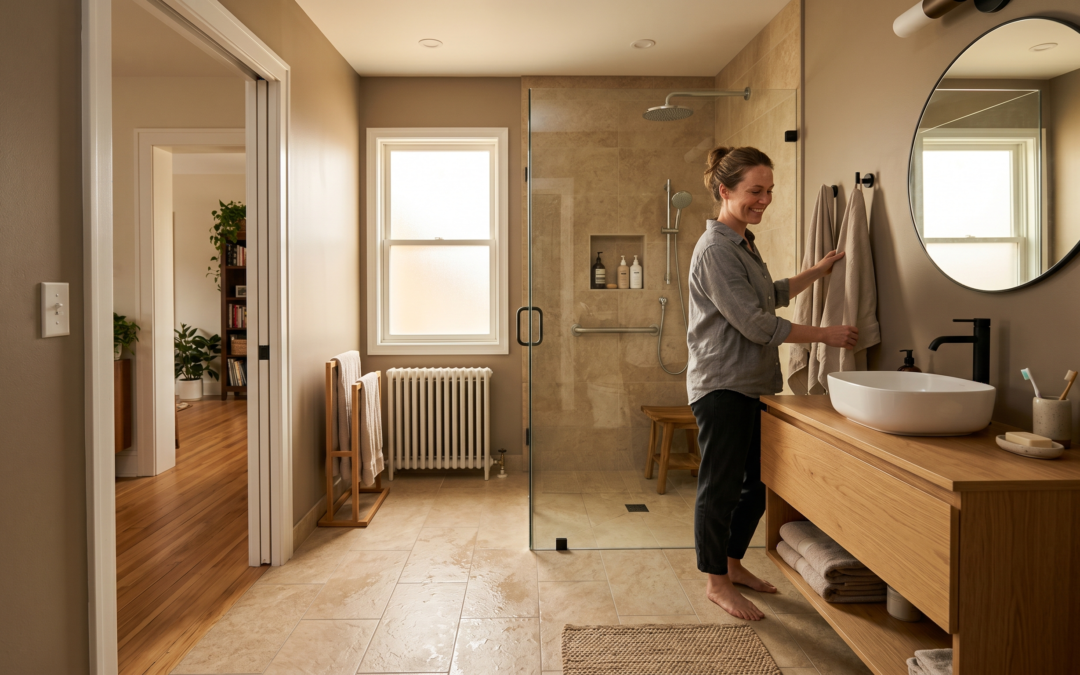
When my husband came home from the hospital, we started talking about what changes to make to our house. Not because we planned to sell it. Because we planned to stay in it.
What I didn’t expect was learning, in the middle of that process, that several of the things we were doing for safety were also things that would make the house more appealing on the market if we ever did decide to sell.
That surprised me. I’d assumed safety features were a compromise, something you do because you need to, that a potential buyer would see as a sign of the previous occupant’s limitations rather than as something to want.
The reality is more interesting than that.
What universal design actually means
The term is “universal design,” and it refers to home features designed to work well for people across a wide range of ages, abilities, and body types. Curbless showers. Wide doorways. Lever-style door handles. Single-floor living options. Rocker switches instead of toggle switches.
These features are not exclusively for older adults. They’re useful for anyone carrying groceries, anyone with temporary injuries, anyone moving furniture, any family with young children. The demographic shift has made them increasingly sought after, but the appeal was always broader than just the aging-in-place market.
What the real estate community says
The research here is directional rather than definitive. Home values are hyperlocal and depend on too many factors for broad numbers to mean much. But the consistent observation from real estate professionals who work with aging-in-place modifications is this: homes with good universal design features in key areas, particularly bathrooms and kitchens, sell more easily and at stronger prices than comparable homes without them.
The buyer pool has expanded. Multigenerational households are more common. Aging baby boomers are one of the largest buyer segments in many markets. Features that serve those buyers well are not liabilities.
For your specific market, talking to a local real estate professional who has experience with universal design or senior housing is the right move before making major decisions. This is general observation, not financial advice.
The modifications that do double duty
Curbless (zero-threshold) showers. A shower without a step to climb over is safer, easier to clean, and widely considered a design upgrade. Contractors and designers increasingly recommend them regardless of client age. They’re common in high-end homes.
Wider doorways. The standard in many older homes is 28 to 30 inches. Widening to 36 inches accommodates wheelchairs but also furniture moving, large dogs, anyone with a walker or crutches, and just generally creates a more open feeling. In new construction, this is increasingly standard.
Grab bars in the bathroom. I wrote separately about how modern grab bars look nothing like the institutional chrome bars of thirty years ago. High-quality grab bars in matching finishes look like intentional design. They are increasingly listed as features, not red flags.
First-floor bedroom or bedroom flex space. This one is high-value for aging in place and for sale. A dedicated first-floor bedroom, or a room that could serve as one, is highly sought after by buyers who are thinking ahead.
Lever handles. Replacing doorknobs with lever handles is inexpensive, takes an afternoon, and is better for nearly everyone, arthritic or not. The ease of use is a small quality-of-life improvement that costs almost nothing.
Rocker light switches. Standard toggle switches require more precise movement. Rocker switches are easier to use in the dark, with full hands, or with reduced grip strength. Again, inexpensive and broadly useful.
The ones that don’t add value
Not every modification works this way. Stair lifts, for example, are very useful for the people who need them and are almost always viewed as a liability by buyers who don’t. They can typically be removed if you sell, but they tend to signal a specific use case rather than a broadly desirable feature.
The same is true for some bathroom safety equipment when installed without attention to design. A cheaply installed grab bar that doesn’t match the fixtures signals “safety modification” in a way that a well-chosen bar in the right finish does not.
The principle is consistency. Modifications done well, with attention to design and finish quality, tend to read as upgrades. Modifications done hastily or purely for function tend to read as accommodations.
The main point
If you’re making modifications to age in place, make them well. That’s the whole argument.
Done well, many of these changes serve your daily life right now, protect your safety, and position your home as a more desirable property if your plans ever change.
If you want to think through what changes make sense for your home and your situation, the room-by-room home safety audit is a good place to start.
Your home can work harder for you. In more ways than you might expect.
Anne