
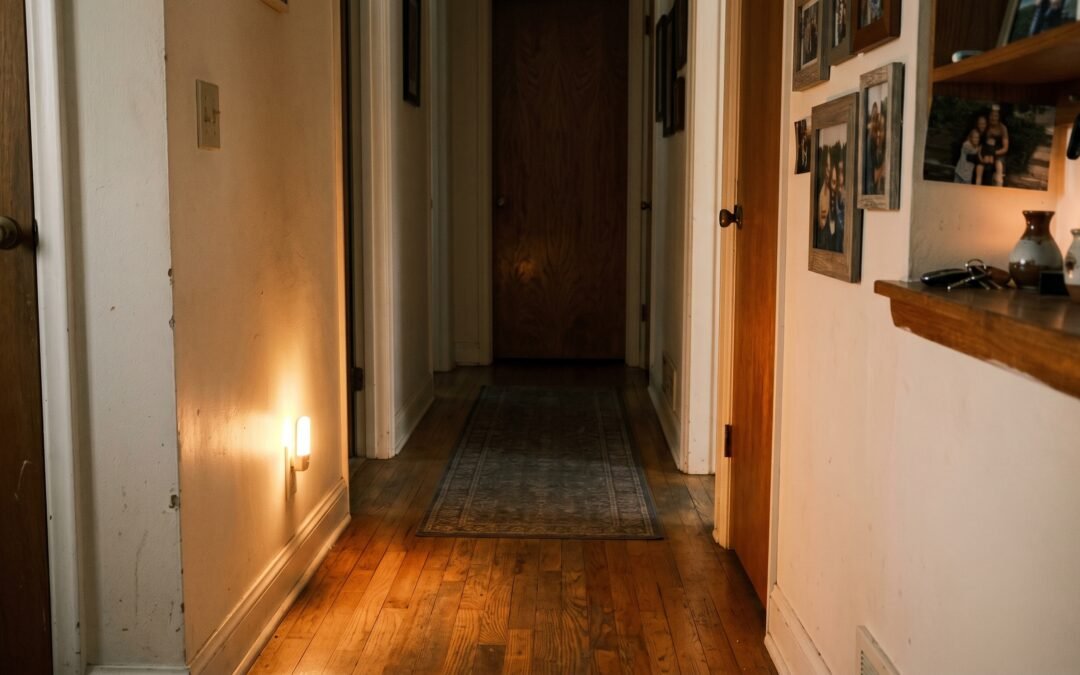
Of all the things I’ve changed in my home over the past few years, nothing was cheaper or made a bigger immediate difference than lighting.
That surprised me. I’d been focused on bigger projects — the grab bars, the conversation about the stairs, the first aid kit. Lighting felt too simple to matter much.
Then I started paying attention to when I felt uncertain in my own home. The answer was almost always the same: dim corners, dark hallways at night, the bathroom at three in the morning.
I’ve since come to think of lighting as the single most underrated safety investment you can make. Here’s why.
What changes about vision after 60
The eyes change with age. This isn’t a dramatic decline. It’s a gradual shift that most people adapt to without fully realizing it.
The pupil gets smaller and responds more slowly to changes in light. The lens yellows slightly, filtering out shorter wavelengths. Contrast sensitivity decreases. Recovery time from bright light, like headlights on a dark road, gets longer.
What this means practically: you need more light than you used to, you adjust between light and dark more slowly, and low-contrast environments (a gray step edge against a gray floor) become genuinely harder to read.
Most homes are not built with any of this in mind.
Where lighting matters most
The path between the bed and the bathroom. This is the highest-risk journey in your home. Middle of the night, groggy, dark hallway. Night lights along this path, low enough that they illuminate the floor rather than shining in your eyes, are one of the highest-impact changes you can make. Motion-activated versions mean you never have to remember to turn them on.
Stairways. Both the top and the bottom of every staircase should have a light switch. If you can only reach a staircase light from one end, that’s a problem worth fixing. Light the whole staircase, not just the landing.
The bathroom. A bright bathroom matters. If your bathroom overhead light is a single dim bulb, add a brighter one or supplement with vanity lighting. You make decisions in the bathroom, about medications, about balance, about what you’re doing, and you make them better with good light.
Entry points. The front door, the garage door, the back door. Coming in from the dark to the inside of your home, or the reverse, is a transition that benefits from good lighting on both sides.
The kitchen. Under-cabinet lighting is cheap and effective. The counter is where you prepare food, handle medications, read labels. Shadow from overhead lighting is a common problem in kitchens, and task lighting solves it directly.
The easy wins
Motion-sensor night lights are inexpensive, require no wiring, and plug directly into an outlet. A few of these along the bedroom-to-bathroom path cost less than twenty dollars and last for years.
Smart bulbs let you set schedules so certain lights come on automatically at dusk or at a set time at night. Once configured, you don’t have to remember anything.
For stairways, a simple dimmer switch upgrade can make a meaningful difference. Full bright on the way up; softer when coming down at night.
For the bathroom, a bright daylight-spectrum LED is often a direct swap for what’s there. The color temperature matters: bulbs labeled “daylight” (around 5000K) give better contrast than “warm white” (2700K) for detail tasks.
What this costs
Most of these changes are in the range of ten to fifty dollars per area. The full path from bedroom to bathroom could be covered with three or four night lights. The kitchen under-cabinet lighting is a weekend project.
This is the part I want to emphasize, because people sometimes delay safety projects while they figure out which big renovation to do first. Lighting is not a big renovation. It’s a Tuesday afternoon.
The bigger picture
Lighting is one piece of the home safety picture. If you want to walk through your entire home with a checklist, the room-by-room home safety audit covers every area and tells you exactly what to look for and what to fix first.
And if you want to understand where home safety fits within your overall plan, the Independence Assessment gives you a picture of all five pillars in three minutes.
Good light isn’t a luxury. It’s what lets you move through your own home with confidence.
Anne